
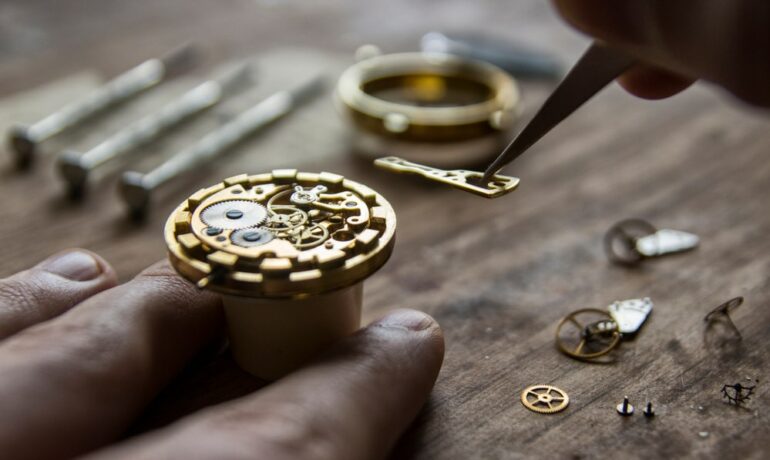
Watchmaking is a field where precision is paramount. Behind every watch, whether classic or haute horlogerie, lies a set of specialized tools that enable craftsmen to bring complex mechanisms to life. But what are these tools used daily in watchmakers' workshops, and how do they ensure this absolute demand for perfection?
The swiveling lathe: the tool for absolute precision
The pivot lathe is one of the key tools used in watchmaking. Used for several centuries, it is used to manufacture the pivots for the axles of the gears, which are essential components of a watch movement. The lathe allows these parts to be worked with extreme precision, sometimes down to the micron. Traditionally manual, this tool requires great dexterity on the part of the craftsman, who adjusts the thickness and shape of the parts by delicately turning a lever. Today, some models are motorized, offering even greater precision while retaining the artisanal touch.
The Brucelle: the watchmaker's tweezers
Watchmaker's tweezers, or watchmaker's pliers, are another essential tool. Made of stainless steel or antistatic alloy, these pliers are used to handle the tiny components of watch movements. The balance wheel, springs, and screws can thus be positioned without risk of damage or scratching.
Every watchmaker has a range of tweezers, some with pointed tips for maximum precision, others with flat tips for more fragile components. These tools are crucial, as they allow the handling of parts that are sometimes finer than a human hair.
Watchmaker's loupes: a closer look at minute details
Watchmaking is all about tiny details. Watchmaker's loupes, also known as binoculars, are essential for examining and assembling parts with magnified vision. These loupes can magnify between 3 and 15 times and are often worn on the forehead, leaving the craftsman's hands free.
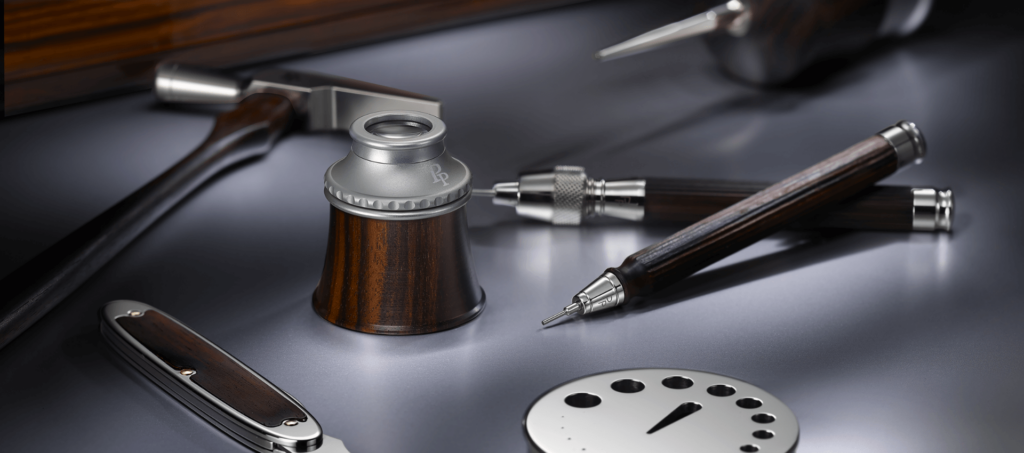
Quality control of the gears or the setting of precious stones on luxury watches requires careful observation, and a magnifying glass allows even the smallest imperfections to be checked. Some modern versions, known as watchmaking microscopes, offer even greater magnification and better lighting.
The hand chisel and the bocfil: for refined decorations
The art of watchmaking is not limited to mechanics: it also encompasses aesthetics. The hand chisel, used to engrave and decorate elements such as cases or movement bridges, is a simple tool that requires great skill to use. It can be used to create complex patterns, often arabesques or symbols engraved by hand on tiny components.
The bocfil, meanwhile, is a very fine saw used to cut delicate parts of a watch with extreme precision. It is often used to adjust the shape of bridges and gears, or to create openwork patterns on internal components, especially in skeleton watch models where the movement is visible.
Measuring tools: micron precision
Watchmakers work with extremely low tolerances, often in the micron range. Micrometric probes and dial gauges are measuring tools used to ensure that each component is exactly the right size. The feeler gauge is a manual instrument used to measure circular parts such as wheels or pinions with an accuracy of a few microns. The dial gauge, on the other hand, is used to check the concentricity of axles and detect thickness deviations.
To measure time, tools such as chronocomparators are used to test finished watches. This device measures the regularity of the movement by beating vibrations at an extremely fast frequency, thus ensuring that the watch is perfectly calibrated before it goes on sale.
The riveting jig: securing the pins with precision
The riveting tool is an essential tool for assembling the movement. It is used to attach the axles of the gears to the pinions or to assemble moving components. This tool is indispensable for ensuring the solidity of the parts without risking deformation. It allows for millimeter-precise adjustment of the moving parts, thus guaranteeing the proper functioning of the movement. Its use requires a steady hand and an experienced eye, as the slightest misstep can ruin hours of meticulous work.
An art form that resists modernization
Although technology has brought new electronic and digital tools to the watchmaker's workshop, traditional tools remain the cornerstones of this ancient art. Each instrument is an extension of the craftsman, whose expertise is based on decades of experience. Watchmakers continue to pass these manual techniques down from generation to generation, preserving the soul of this craft.