
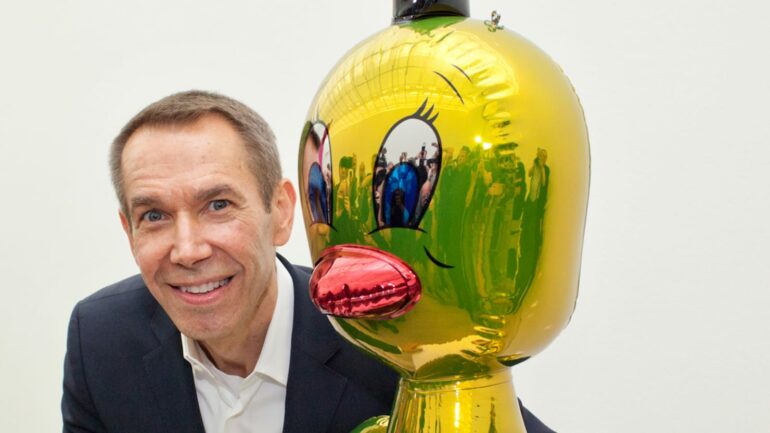
Like Damien Hirst, who has been accused of being nothing more than a businessman, Jeff Koons has also come under fire from some in the art world. However, the American artist has generated enthusiasm and gained a certain legitimacy over time, for example by havinga major retrospective dedicated to himat the Centre Pompidou, the Parisian reference point for contemporary art, to "take stock of an undeniably great body of work (...) a version that is certainly playful, but more subversive than it appears."
Since his collaboration with luxury brand Louis Vuitton, we have wanted to devote an article to the "Jeff Koons phenomenon." An article that we wanted to be as far removed as possible from the rave reviews he receives in both the general and specialized press. The renewed scandal surroundingthe installation of a sculpture of a bouquet of tulipsin front of the Palais de Tokyo in commemoration of the November attacks gives us an opportunity to do so.
FACING A SIDEAL CREATIVE VOID
Jeff Koons' new creations inevitably bring to mind the bags sold in low-end souvenir shops in all major European cities. In addition to Louis Vuitton further tarnishing its luxury brand image—asSlate explained, the world's wealthy no longer want overly visible logos—the American artist once again confronts us with his creative void.
Jeff Koons attempts to get himself out of this predicament with an intellectual maneuver, putting the bag—considered a work of art—in perspective alongside paintings by the great masters: Leonardo da Vinci, Rubens, and Titian. Not very convincing. And it's a shame when you consider that these pieces sell for several thousand euros. It's almost tempting to grab the same fire extinguisher as Kidult and go vandalize Vuitton stores to denounce the appropriation of "classical" painting for commercial purposes.
A PHILOSOPHICAL AND ECONOMIC APPROACH BY JEFF KOONS
Everyone can, of course, appreciate a particular work to a greater or lesser extent depending on their inclinations and the emotions it provokes in relation to their personal experience. But unbridled relativism has its limits, which can perhaps be found in philosophy. Kant defines beauty as "the pleasure experienced in looking at something judged to be beautiful." The universalist thinker thus hypothesizes a "common aesthetic sense," that is, a shared pleasure in a work of art, which can be found, for example, in the French Impressionists' interest in Japanese prints or African masks as part of a universal perception of beauty.
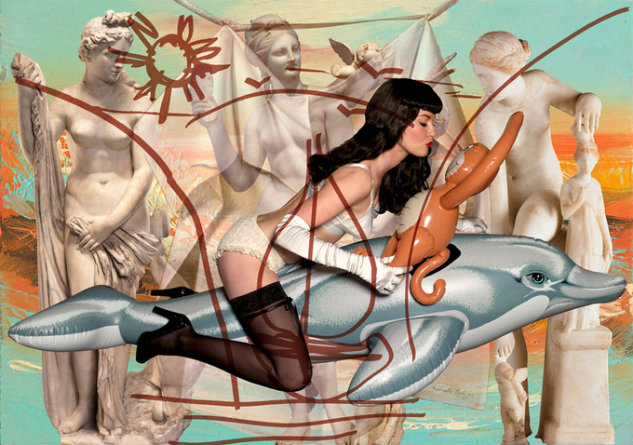
Do Jeff Koons' works really appeal to a common aesthetic sense? Or are they simply being exhibited more and more because of speculative bidding wars? In the same way as the economic theory of "winner takes all" on the internet, does the art market simply want to serve us headliners, blockbusters that are recognized by everyone and can be sold for millions of dollars? This is a criticism that could obviously be levelled at many contemporary artists: misunderstood by the majority of the population and considered as investments for billionaires. But Jeff Koons cannot even get the support of the contemporary art world itself, whichhas published an opinion piece in Libérationagainst the installation of his bouquet of tulips in front of the Palais de Tokyo, denouncing it as "artistic deception." The location chosen by Koons has prompted irony from philosopher Yves Michaud:
"The recipient of a gift is supposed to be able to do whatever they want with it. (...) Let's acknowledge Jeff Koons' elegance, though: he's not asking to be included directly in the Louvre, but just to be showcased in front of two major museum sites."

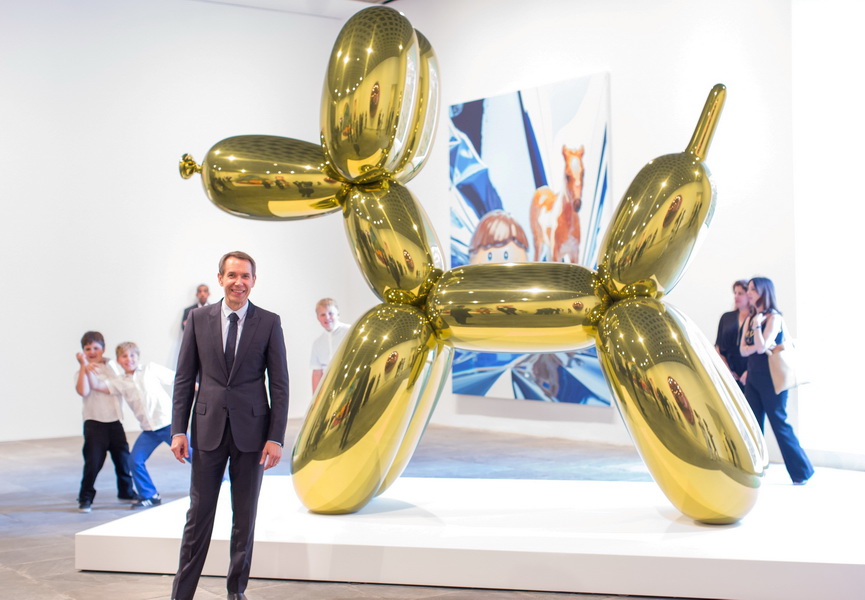
Jeff Koons is supported by wealthy figures such as François Pinaut, Dakis Joannou (Greek industrialist), and Steven A. Cohen (manager of an Edge Fund): three owners of his famousBalloon Dog sculptures whoare reaping the benefits of the artist's soaring popularity. The most prominent art dealers in the field also supported him in the context of the increasing globalization of the art market in the 1990s and 2000s:
"It was market globalization that drove it," explains former Parisian gallery owner Jérôme de Noirmont, who, during his first exhibition in France in 1996-1997, struggled to sellInflatable Flowers for more than €25,000. Asia, India, and the Middle East have taken over from Europe and America with an extra zero."
AN HEIR TO POP ART OR THE CREATOR OF DOLL ART?
Jeff Koons is symptomatic of our society: he has perfectly adapted to capitalism, which needs safe havens in which to invest, and to the star system, which is always seeking an audience and attention. Some see him as the heir to Andy Warhol, who, with his Factory, mass-produced art. Like Warhol, Koons has also focused on objects and characters that are loved by all. In the manner of the Factory and in the tradition of Marcel Duchamp, who saw industrial design as the culmination of artistic practice, he has worked on his technique by recruiting many renowned artisans to his studio. The director of the Centre Pompidou, Bernard Blistène, considers him to be "the last of the pop artists."
We prefer to describe it as new pop chic, a far cry from the spirit of pop art in its early days, as Andy Warhol was the pioneer and trailblazer who also dared to ventureinto less consensual subjects such as the macabre, or into music with The Velvet Underground. Massive, impeccably crafted and manufactured, Koons' works are commissioned in advance by major collectors, thus borrowing all the codes of the luxury industry. The circle is complete. In his fantastic doll art movement, Jeff Koons can return to work on his next collaboration with Bernard Arnault, boasting media support.