
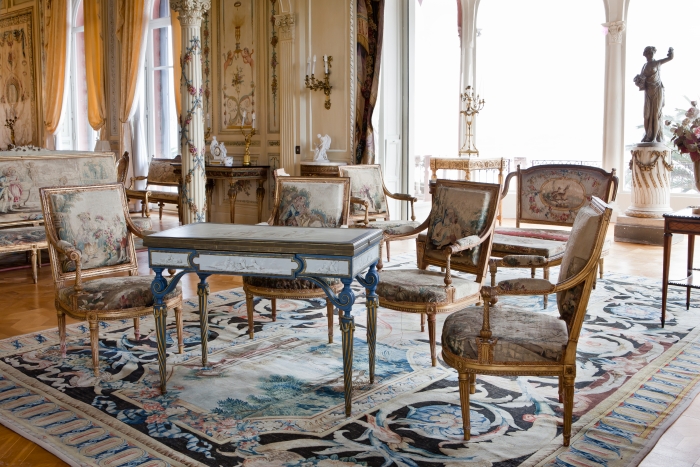
French furniture of the 18th century is marked by two major styles: Louis XV (1723-1774) and Louis XVI (1774-1793). Although these two periods are close in time, they are opposed in their decorative philosophy. Whereas the Louis XV style celebrates curves, exuberance, and asymmetry, Louis XVI returns to rigor, symmetry, and straight lines inspired by Antiquity.
Here's how to differentiate between these two styles on the main period furniture pieces.
1. The chest of drawers: curves versus rigor
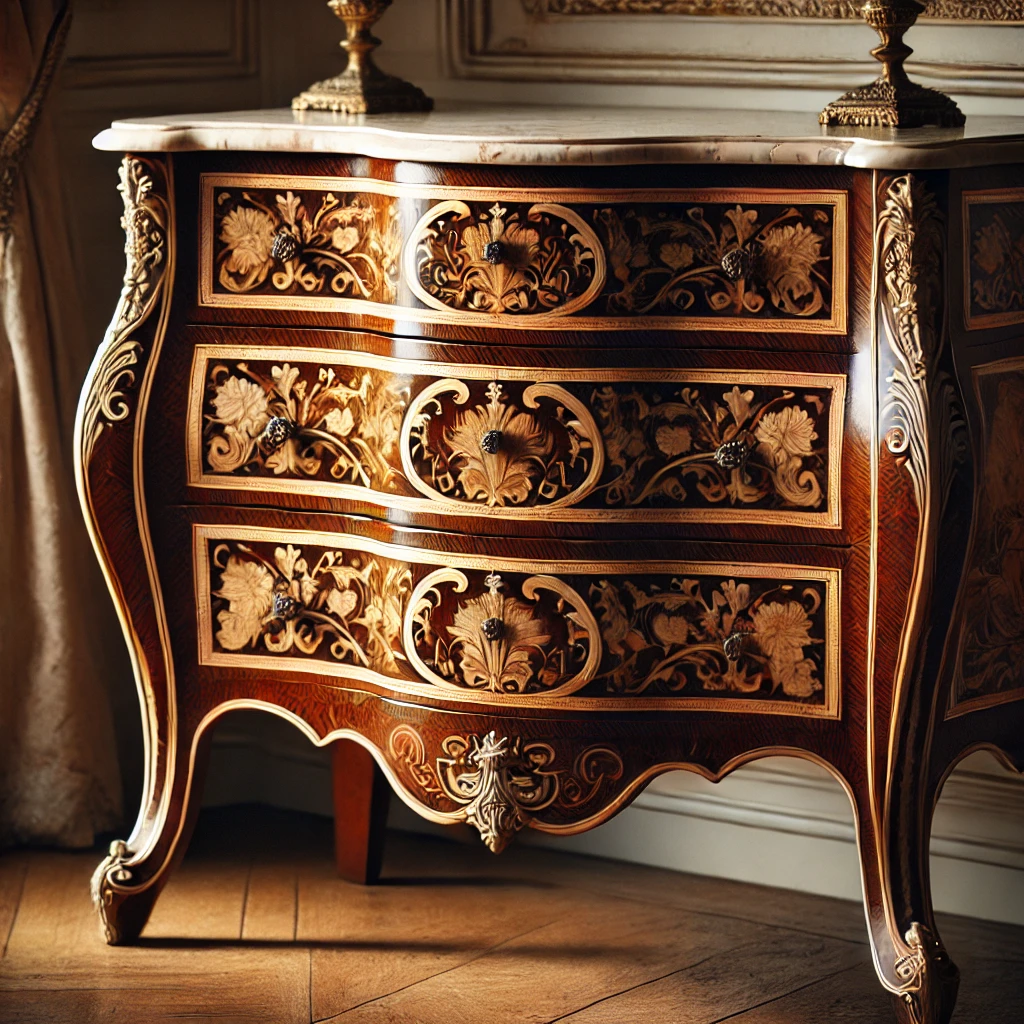
- Louis XV: The chest of drawers often rests on curved legs (in an "S" shape), giving an impression of lightness. The body of the piece is curved and sometimes rounded, i.e., convex on the front. The decoration favors gilded bronzes, floral motifs, and colorful marquetry.
Example: a rosewood chest of drawers with floral inlays and chiseled bronze handles in the shape of foliage.
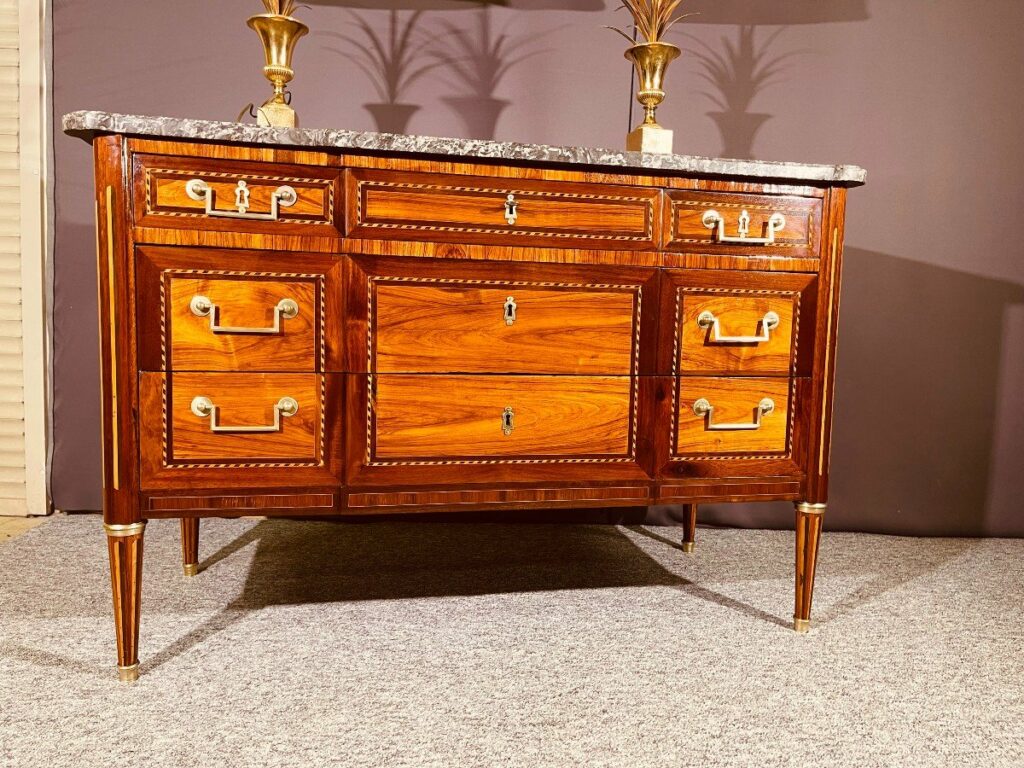
- Louis XVI: The structure becomes more geometric with straight lines and tapered, fluted legs. The front is flat, often decorated with carved panels. The decor is inspired by Antiquity with garland, pearl, or rosette motifs.
Example: a mahogany dresser with circular bronze handles and a white marble top.
2. Chairs: curved or straight legs
- Louis XV: The chairs have a curved backrest and a soft seat for comfort. The legs are curved and carved with foliage or shells. The lower crossbar is often carved with arabesques.
Example: a gilded wooden chair with an Aubusson tapestry seat featuring floral motifs. - Louis XVI: A return to antique forms with a straight backrest (often medallion or square), tapered and fluted legs, and a more rigid seat. The decorations are more understated, with ribbon or bow carvings.
Example: a medallion chair in carved beech, upholstered in blue velvet with brass trim.
3. Tables: flexibility versus symmetry
- Louis XV: Tables have sinuous shapes with curved legs ending in scrolls. The marquetry is often very elaborate, depicting flowers or arabesques.
Example: a card table with exotic wood inlays and a base decorated with gilded bronze. - Louis XVI: The lines become more rigorous, the legs are straight and sometimes connected by an X-shaped crossbar. Marble tops become more common.
Example: a rectangular mahogany console table with fluted legs and a beaded frieze under the top.
4. Cabinets: volume versus simplicity
- Louis XV: Cabinets are often large with curved doors and ornate cornices. The carved wood is embellished with floral, shell, and rocaille motifs.
Example: a carved walnut cabinet with curved doors and gilded bronze handles. - Louis XVI: The cabinet is structured with rectangular panels, the moldings are more discreet, and the bronzes less imposing. The antique influence is reflected in fluted columns or pilasters.
Example: a two-door mahogany cabinet, decorated with carved garlands and gilded moldings.

5. Offices: Rococo vs. Neoclassicism
- Louis XV: Desks feature curved shapes, sometimes cylindrical (roll-top desk). The curved legs are carved with asymmetrical patterns and the marquetry remains highly ornamental.
Example: a flat desk made of violet wood with floral patterns and chiseled bronze handles. - Louis XVI: Desks became more linear, often flat, with neatly aligned drawers. They could be topped with an openwork brass gallery.
Example: a mahogany secretary desk with symmetrical drawers and tapered straight legs.
How can you recognize a piece of furniture at a glance?
- Look at the legs: curved and sculpted? → Louis XV. Straight and fluted? → Louis XVI.
- Observe the structure: curved, asymmetrical, and sinuous? → Louis XV. Geometric and rigid? → Louis XVI.
- Analyze the decor: Rococo motifs (shells, flowers)? → Louis XV. Antique ornaments (ribbons, garlands, pearls)? → Louis XVI.
Louis XV and Louis XVI furniture illustrate two approaches to refinement. The former focuses on flexibility, lightness, and ornamentation, while the latter returns to a more refined aesthetic inspired by Antiquity. These differences are particularly visible on dressers, chairs, and desks, making it easy to identify the styles.
Whether you are a collector or a lover of interior design, these landmarks allow you to appreciate the genius of the 18th century and the evolution of tastes under the Ancien Régime.