
“Always There”: In the Wake of the Attacks
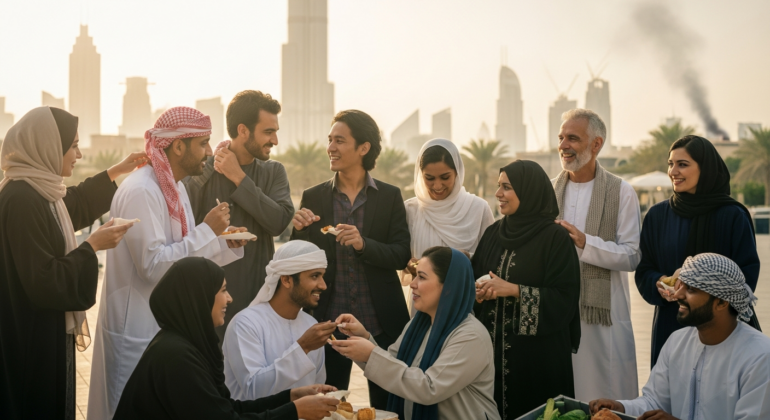
On the morning of March 7, as the streets of Abu Dhabi and Dubai were being cleared of debris left by the intercepted Iranian strikes, I received a striking photo from a colleague. The photo showed the terrace of a café in his neighborhood, Jumeirah. The tables were occupied, and the morning routine was back in full swing, bringing together people from all corners of the globe. On the window, someone had drawn a large heart with a marker, accompanied by these few words: “Still here.”
That image has stayed with me. Home to people of more than 200 nationalities, the United Arab Emirates is one of the most cosmopolitan hubs in the world, where nine out of ten residents were born abroad. For half a century, the nation has forged a unique model: a federation of city-states that draws its vitality from openness. Without the millions of expatriates, international companies, and transnational trade, the Emirates as we know them would cease to exist. The country’s founding fathers were fully aware of this, as were those who succeeded them.
Beyond infrastructure, a model under attack
Iranian drones and missiles struck airports, ports, residential complexes, hotels, and data centers critical to artificial intelligence projects across three continents. While Tehran claims to have targeted only U.S. military installations, the geography of the strikes tells a very different story. Beyond the buildings, it is a true philosophy that is under attack: the idea that a nation built on genuine inclusion can survive and thrive in the heart of one of the most unstable regions on the planet.
Ultimately, it is not the attack itself that is most surprising—many prosperous nations have already suffered the same fate. What is remarkable is the reaction that followed.
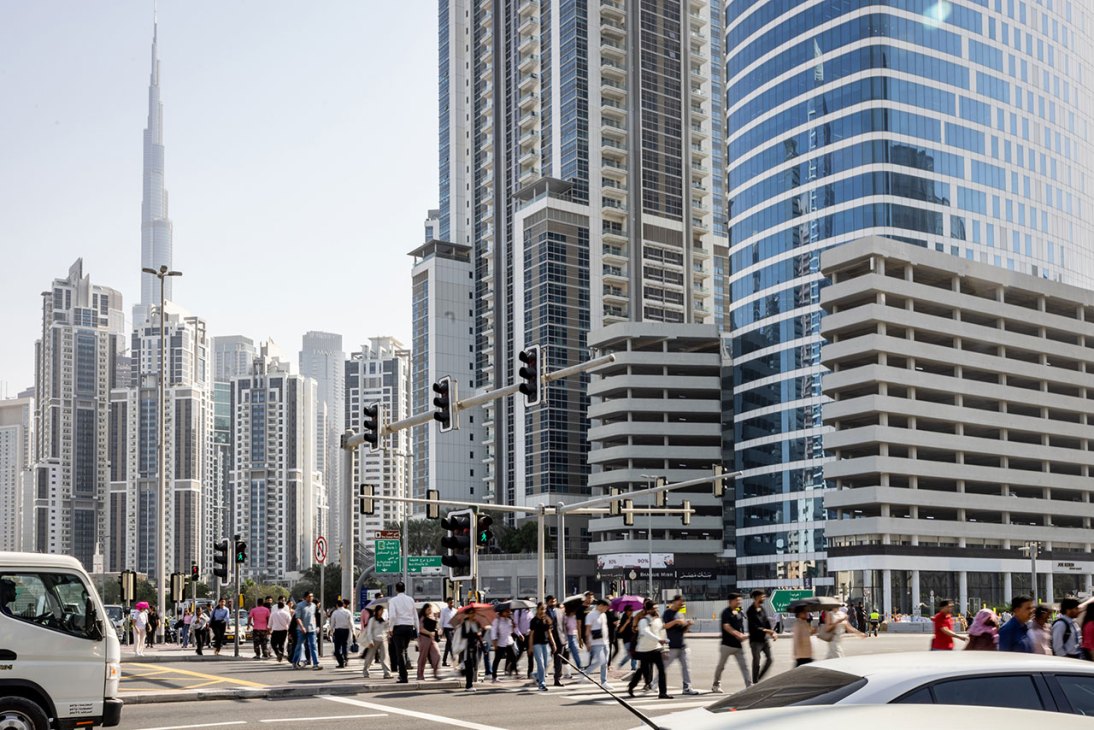
The vast majority of those who chose to settle here did not flee. Of course, we must not overlook the very real fear that drove some to leave, often on the advice of their embassies. The attacks left seven dead and dozens injured, devastating many families. Yet the extraordinary social fabric that holds the country together has not been torn apart. There is a fine line between residing in a country and belonging to it. In the Emirates, for the majority of those 89% of residents who came from elsewhere, these two realities have quietly merged.
A Sense of Belonging in Times of Crisis
This observation is fundamental: it represents the very essence of the country. The economic argument carries significant weight, given that the non-oil sector now generates more than 77% of the UAE’s GDP. But while an economy can be modeled and subjected to stress tests, a sense of belonging is something experienced in everyday life. The choice of these millions of expatriates to remain rooted in this land speaks to a strength far greater than any balance sheet.
For a long time, certain circles have portrayed the Gulf as a stopover, a transit point for rootless expatriates who expect nothing and are ready to leave at the first sign of trouble. This simplistic view has never done justice to the reality on the ground. Mureeb Zaman, the Pakistani driver tragically killed by falling debris on March 7, had been living and raising his family in the Emirates for over a decade. He was not merely a passing traveler: he was at home.

Diversity: An Unexpected Shield Against Adversity
By carrying out these strikes, the Iranian regime may have inadvertently highlighted the great paradox of the model it was trying to undermine. The UAE’s openness is not a weakness, but rather its greatest strength. A nation whose community bonds are forged not around ethnicity, religion, or language, but around a collective commitment to a societal project—its institutions, its ambitions, its worldview—proves remarkably difficult to destabilize. One does not easily abandon what has been built together.
There is a lesson here that resonates far beyond the Arabian Gulf. Around the world, many leaders advocate cohesion through homogeneity, security through exclusion, and identity through opposition to a common enemy. Going against the grain, the Emirates have been proving for fifty years that the most resilient societies are those that have the most to lose from chaos. They demonstrate that security and openness are perfectly compatible, and that bringing together 200 nationalities can prove, in our fragmented age, to be the most decisive social experiment of our time.
The results of this experiment are, in fact, indisputable.
The photo taken on the terrace of this café is clear proof of that.
Badr Jafar is the Special Envoy for Business and Philanthropy to the United Arab Emirates’ Ministry of Foreign Affairs.