

Geopolitics and the Real Estate Market: A Climate of Uncertainty at MIPIM
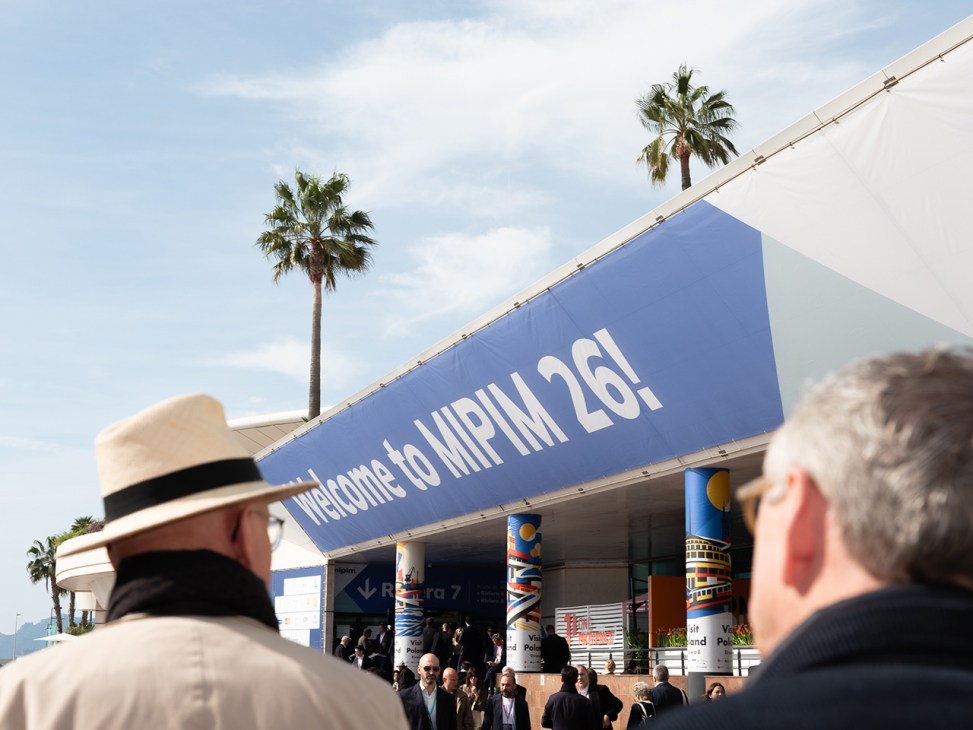
“What do you think of the atmosphere this year?” That was the question on everyone’s lips in the aisles of MIPIM, the world’s largest real estate trade show, which recently wrapped up in Cannes. This concern stemmed directly from events in the Gulf and recent conflicts in the Middle East. Indeed, many participants feared that these geopolitical tensions might slow the decline in interest rates, trigger a surge in material costs, and dampen investors’ appetite for risk—just as the economic outlook finally seemed to be improving. Proof that times are changing: industry professionals now follow defense news just as closely as they do the business pages.
The affordable housing crisis: a major challenge for European cities
International conflicts were not, however, the only cause for concern. Architects and local officials extensively discussed the shortage of affordable housing plaguing many major cities in Europe. Ian Mulcahey, Global Director of Cities and Urban Design at Gensler, emphasized that this is the most complex problem in the majority of urban areas he visits. “Every city we work in seems to be going through a housing crisis, and I still struggle to fully grasp all the reasons behind it. As a society, we still haven’t found the formula for building enough homes for our fellow citizens,” he says.
The scale of the problem was confirmed by London’s deputy mayor for housing and residential development. He revealed that while the British capital needs 88,000 new homes each year, housing starts last year barely reached the 4,000 mark. During its inaugural day dedicated to housing, MIPIM invited leaders from major cities, from Barcelona to The Hague, onto the stage to try to outline solutions. Clearly, there is still a long way to go.
New Horizons: Luxury Reimagined and Radical Sustainability
Despite these challenges, some in the industry expressed marked optimism and saw real opportunities for transformation. Giorgos Karampelas, creative director at the Athens-based agency K-Studio, explained that their vision of luxury—minimalist, highlighting the nobility of materials, and rooted in local identity—appealed to an audience far beyond Greece’s borders.
For his part, Kjetil Thorsen, co-founder of the prestigious firm Snøhetta, noted that his architecture firm now selects only clients committed to drastically raising standards of environmental responsibility. This is the case with Mehmet Kalyoncu, the developer of the Ion Riva project on the shores of the Black Sea. “I don’t think we’ve ever taken environmental studies this far on a site,” explained Kjetil Thorsen. “We know the site’s topography down to the smallest detail, right down to the precise path of a drop of water running down the hill. Our goal is to enhance these natural assets by letting the environment dictate where it makes sense to build and where we should refrain from doing so.”

The Technological Renaissance of Southern Europe
The dynamism and confidence displayed by certain regions, particularly in Southern Europe, were also palpable. A large number of Italian elected officials made the trip. City officials from cities such as Rome and Genoa spoke about the transformation of their municipalities, which are gradually becoming true hubs of technological innovation, capable of attracting new talent while realizing their environmental goals. Raffaele Laudani, deputy mayor in charge of urban planning in Bologna, elaborated on this urban repositioning.
“Bologna has established itself as an essential strategic European hub for big data and artificial intelligence. We are home to Leonardo, the world’s second-most powerful supercomputer dedicated to AI, around which an entire ecosystem of knowledge and technology is developing,” he said. “We account for 80% of Italy’s computing power and nearly 30% of Europe’s capacity. With the active presence of universities and research centers, we are redefining our public policies around this flagship project, which we have named the ‘City of Knowledge.’”
A resilient sector focused on the long term
While the overall atmosphere seemed tense at times this year, the real estate sector remains an industry accustomed to taking a long-term view and weathering periods of geopolitical turbulence. Moreover, key growth drivers remain very strong: whether it’s the explosive demand for data centers (conferences on this topic were, in fact, packed to capacity) or the infrastructure needed to address an aging population. This is undoubtedly why the vast majority of professionals left the Palais des Festivals with a sense of determination, still taking the time to savor a final glass of rosé on the Croisette before flying back to their capitals, from Berlin to Baku.