
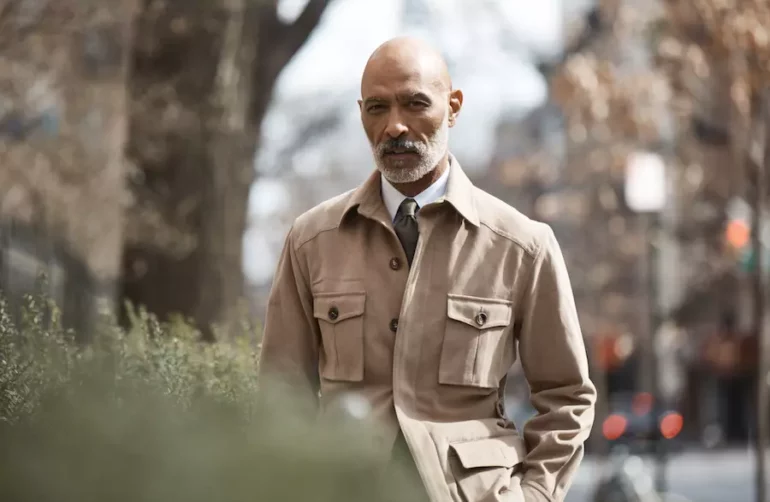
Born on the battlefield, the safari jacket, or simply the saharienne, has established itself as a key piece in men's fashion, combining military origins, luxurious elegance, and modern functionality thanks to the influence of big names such as Yves Saint Laurent and Ernest Hemingway.
A military heritage that has left its mark on men's fashion
Men's fashion is full of iconic pieces that have their origins in military clothing, reflecting a history in which practicality and style often go hand in hand. Whether it's the bomber jacket, which became a symbol of Royal Air Force pilots in the 1920s, or the trench coat designed during the Great War to withstand the elements, these items quickly outgrew their original purpose to become staples in the civilian wardrobe. For example, the cardigan owes its name to a British general from the Crimean War, and the Breton striped shirt is directly inspired by the French navy uniform. This blend of military history and everyday elegance is a good example of the enduring trend where utilitarian rigor feeds contemporary style.
The safari jacket: the perfect combination of adaptability and functionality
Among these garments, the safari jacket stands out for its unique history, which began on the battlefields of the Boer War and likely dates back to the era when khaki uniforms were worn in India. Originally, its designers focused on an urgent need: to combine lightness, comfort, and practicality in exotic and often harsh environments. Made of drill cotton or poplin, with shoulder pads, multiple practical pockets, and a belt for easy adjustment, this garment quickly won the hearts of explorers such as Theodore Roosevelt and Ernest Hemingway. When we consider the impact these figures had on the public, it becomes clear that the transition to civilian fashion was accelerated, especially thanks to Hemingway, who remains an essential reference. The famous "safari jacket" was recognized as such as early as 1935, and soon appeared in Hollywood films, worn by stars such as Gregory Peck, Grace Kelly, and Roger Moore, which truly reinforced its legendary status in men's fashion.
A transition to luxury for the city
Over time, the primary purpose of the safari jacket has naturally evolved. Previously, it was used to carry provisions, tools, or accessories related to hunting, exploration, or military missions. Today, it holds a whole range of everyday items such as smartphones and headphones—completely changing its role. Yves Saint Laurent was among the first to incorporate this type of jacket into haute couture in the late 1960s, placing the safari style at the height of fashion, and Ralph Lauren, Dolce & Gabbana, as well as several prestigious houses such as Cifonelli and Anderson & Sheppard, followed suit. The piece perfectly illustrates fashion's ability to reinvent a utilitarian garment while enhancing it with noble textures, refined fabrics, and customization that gives it a modernized look while respecting its roots. Today, the Irish linen version evokes this duality between practicality and casual elegance, offering a trendy alternative without straying too far from its utilitarian origins.

Between function and aesthetics, a symbol of style that stands the test of time
The safari jacket is living proof: how can a garment originally designed to meet military needs continue to be an integral part of today's fashion without becoming outdated? Its presence in today's wardrobe is an excellent demonstration of the balance between practicality, history, and sophistication. For those who want a look that is both rugged and refined, this garment invites you to experiment with bold combinations and modern accessories—far from the somewhat dated utilitarian clichés. And let's not forget other pieces that originated in the military world, such as Ray-Ban Aviator sunglasses, originally made to protect pilots from intense light, or the British aviators' sheepskin jackets. All these elements demonstrate the enduring influence of the military on civilian fashion, almost like a living legacy, showcasing the art of military craftsmanship, which remains relevant and charming even after all these years.