
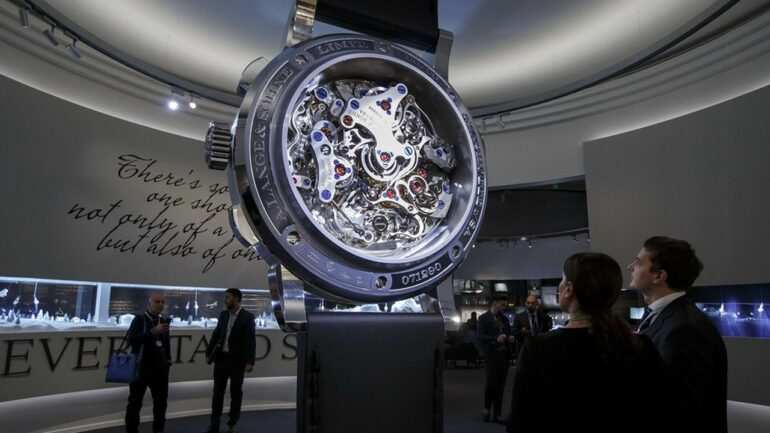
After a turbulent year in 2025, the global watch industry anticipates major price adjustments, market consolidation, and a redefinition of its strategies in 2026 in response to new economic and technological challenges.
2026: a year marked by prices and consolidation
According to WatchPro, the global watch industry is preparing to enter 2026 after a rather turbulent 2025. The American catalogs for Rolex and Tudor, which were leaked at the end of 2025, announce significant price increases starting January 1, 2026. These adjustments, which, to be honest, were to be expected, reflect the record rise in the price of gold, inflation affecting everything, the weakness of the dollar, and also the introduction of the famous 15% tax on Swiss imports into the US market.
Rolex is forecasting an average increase of around 7% in the United States. More specifically, steel models are expected to rise by 5 to 5.6%, and gold models by around 9%. In terms of value, this roughly translates to an average increase of 20% for gold watches and around 10% for steel models compared to the end of 2024. These figures are what we saw in the leaked catalog. And, according to WatchPro, the price difference between the United States and the United Kingdom remains relatively moderate once taxes and exchange rate variations are taken into account.
Major brands are trying to maintain a certain price parity around the world, which is important in order to keep demand from faltering. Several major brands could adopt a strategy that we are already familiar with: increasing their prices while slightly reducing the margins given to retailers. It is a kind of compromise, in fact: the manufacturer bears a larger share of the additional costs generated by import duties, without necessarily imposing a direct reduction in profits on retailers.
Pressure on margins and risk of falling demand
Listed groups such as LVMH, Swatch, and Richemont already have tight margins. Their goal is to raise prices by 5 to 10% without losing too much sales volume. But, and this is where it gets a little riskier, inflation in the supply chain and fragile demand for these high-end watches make this ambition not so straightforward. In short, 2026 could well be the year when some weaker retailers and operators are forced to readjust or even exit the market.
Non-Swiss competition and Japan's rise
One important thing to note is that Switzerland's market share by volume has been declining since the arrival of smartwatches. For example, Apple Watch sells between 40 and 50 million units each year, compared to 15.4 million watches exported by Switzerland in 2024. And things are also changing in Japan. Citizen saw its sales and volumes climb in 2024–25, and Seiko and Casio remain serious competitors. In fact, the figures show that Citizen's watch sales are not far behind those of brands such as Tudor and TAG Heuer.
Materials and product trends
Gold, paradoxically, is seeing increased demand despite soaring prices. Demand is boosted by status and the search for a safe haven. But annual increases of 20% on gold are pushing manufacturers to limit the release of new precious models. At the same time, there is a strong trend towards substituting gold with titanium, ceramic, sapphire, or even platinum. And to justify high prices on watches that are not necessarily precious, brands are highlighting technical complexity and skilled labor.

A boost for jewelers and a rebalancing among retailers
Traditional jewelers are also benefiting from the rise in gold prices. According to WatchPro, pure players in the jewelry sector, those who only sell jewelry, are flourishing with higher growth and profitability than chains specializing in watches. Stores that offer a mix of jewelry and watches seem to be better prepared. In fact, Watches of Switzerland has begun to adjust its activities by purchasing jewelry brands and launching new stores, which shows that they are revising their strategy.
The trend toward closing small boutiques is continuing. Brands are closing unprofitable points of sale in favor of larger, more sophisticated boutiques. Consolidation will continue and even accelerate. WatchPro predicts at least one major acquisition, most likely Watches of Switzerland. The aim is to offer a higher-quality customer experience while improving control over their distribution network .
The secondary market and CPO initiatives
Rolex, with its certified pre-owned watches, now holds around 10% of the global secondary market, according to EveryWatch. This standard, the Certified Pre-Owned program, has led other players such as The 1916 Company to sell only Rolex CPO watches. This has somewhat redefined the value of this secondary market and its credibility. Other brands such as Cartier, Audemars Piguet, and Richard Mille are developing or strengthening their own CPO programs. WatchPro points out that by carefully controlling the secondhand market, it is possible to preserve the longevity and value of very high-end watches.
Several notable openings are planned. For example, Audemars Piguet will open an AP House in Mayfair, and the largest project remains the Rolex headquarters and showroom tower at 665 Fifth Avenue in New York City. The first four floors will be dedicated to sales. When the London flagship store opened in 2025, CEO Jean-Frédéric Dufour said, and I quote: "I know," he said. "But I'm not going to tell you." The Manhattan ceremony is scheduled for the end of 2026.
In short, 2026 looks set to be a year of rebalancing. Companies will have to strike a balance between the need to protect their margins and the need to retain their loyal customer base. The retailers who succeed will be those who combine jewelry expertise, quality service, and a multi-brand shopping experience. The industry is at a crossroads: should it continue to raise prices without losing its mass market clientele, or accept a controlled contraction to maintain long-term value? Only time will tell.