
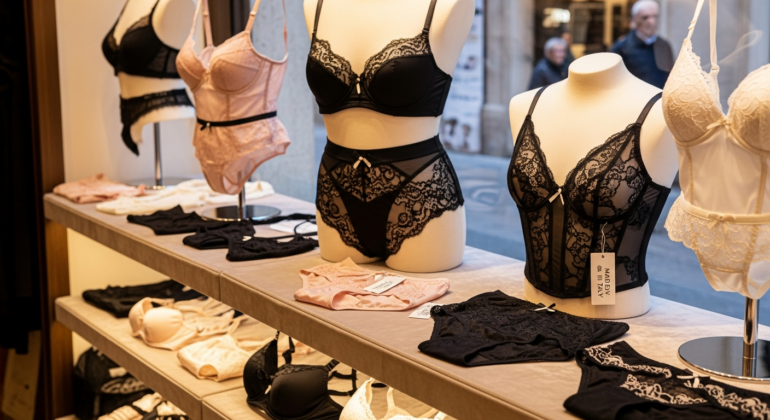
The Italian lingerie market: strategic and shifting towards premium products
The Italian underwear and lingerie market confirms its strategic importance for Italian and European fashion, despite undergoing gradual changes in consumer behavior. In Europe, the sector is worth around €17 billion, but is set to grow to €26 billion by 2033, according to Market Data Forecast. In this scenario, Italy retains a central role, both in terms of domestic consumption and in terms of production and exports.
Tourism consumption and impact
According to the analysis "Consumption, export, and import of intimate apparel in Italy 2025" commissioned by Underbeach —organizer of events dedicated to lingerie and swimwear—to Sita Ricerca and referring to the resident population (therefore excluding tourists and institutional purchases), the overall value of the intimate apparel market (including men's, women's, and hosiery) will be €3.105 billion in 2025, a slight decline (-0.4%) compared to 2024. This decline is linked to a contraction in volumes (-1.3%), while average prices continue to rise (+0.9%). If we also consider the impact of purchases by foreign tourists, which account for around 20% of the market, the value rises to around €3.7 billion. The women's segment remains the driving force behind the sector, accounting for more than €2 billion, or around 70% of the total, while men's underwear is showing weaker momentum.
The rise of the premium segment
The structure of the European market shows a strong focus on the entry-level segment, which accounts for 62.3% of consumption. In Italy, however, the most significant data point is the growth of the premium segment. In 2025, the value of premium lingerie for residents will reach €379.6 million, up nearly 10% from 2023. Given that around 80% of purchases made by foreign tourists in Italy are reasonably high-end and comparable in value to those made by residents, the overall turnover of the premium segment can be estimated at around €800 million, or approximately 22% of the total sector.

Single-brand chains dominate distribution
In terms of distribution, single-brand chains will remain the leading sales channel in 2025, with a 51.9% market share compared to 50.8% in 2023. The multi-brand channel will remain stable at 18.9%, while pure players (online stores) will remain at 6.5%. Channels relating to street vendors and large food retailers (hypermarkets, supermarkets, and discounters) are experiencing some difficulties, falling from 7.2% to 7% and from 11.2% to 10.6% respectively. Overall online spending on underwear and lingerie is close to €350 million, with a market share of around 11%.
Foreign trade: imbalance between imports and exports
Foreign trade is showing signs of imbalance. In the first ten months of 2025, Italian lingerie exports fell to €2.3 billion (-2.8%), while imports rose by +6.9% to €2.7 billion. Exports to the European Union in 2025 accounted for nearly 59% of the total, showing growth of 1.8%. The main markets are France, Germany, and Spain. In terms of imports, Italy purchases around €1.43 billion worth of underwear from countries outside Europe (52.2% of the total) and around €1.3 billion from Europe, with Bangladesh, the Netherlands, and Sri Lanka being the main exporters of lingerie to Italy.
Strategic data for the sector
"We wanted to conduct this research with the new Aimi, the Italian Association of Intimate Apparel, because we believe it is essential for those operating in these markets to have access to dedicated, accurate data that is truly representative of the sector," explains Alessandro Legnaioli, president of Underbeach, the company that organizes the Immagine Italia & Co trade show, dedicated to lingerie, and Maredamare, dedicated to the beachwear sector, which runs until today, February 16, at the Fortezza da Basso. "Until now, the information available was almost always aggregated within broader macro-categories, such as clothing, making it difficult to understand the real dynamics of our sector. This survey fills an important information gap and provides a strategic tool for companies, operators, and stakeholders. The journey will continue in the coming months: in July, at the 2026 edition of Maredamare, specific data on swimwear and beachwear will be available."