
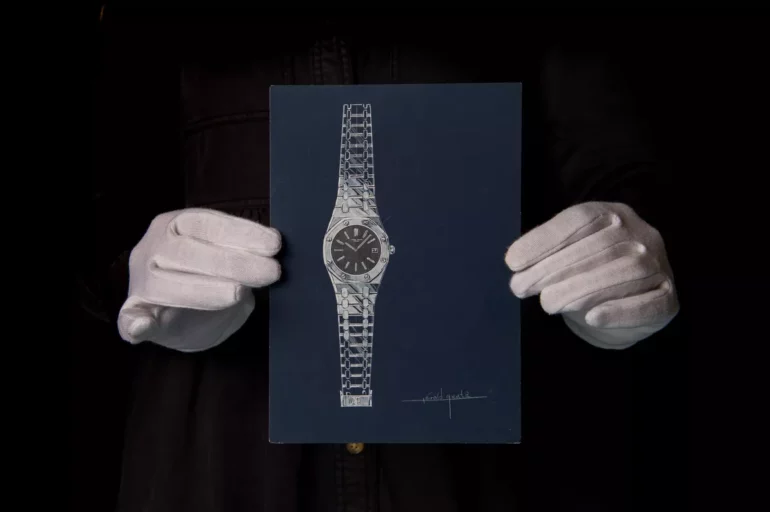
In the hushed world of fine watchmaking, certain names resonate with particular force, and Audemars Piguet's Royal Oak is one of them. Launched in 1972, this watch broke the mold, establishing itself as an essential reference.
The boldness of a design
In the early 1970s, high-end watchmaking was dominated by classic gold watches with leather straps. It was against this backdrop that Audemars Piguet, an established and respected brand, decided to take a bold new direction. The Royal Oak, designed by Gérald Genta, immediately stood out: an octagonal case inspired by ship portholes, a bezel secured by visible screws, and an integrated steel bracelet. This aesthetic, both sporty and luxurious, was a radical departure from the norms of the time.
The choice of steel, a material less noble than gold due to its history and abundance, was a true revolution. Audemars Piguet succeeded in elevating it, working with unparalleled precision and refinement. This choice of material, combined with innovative design, positioned the Royal Oak not only as a luxury watch, but also as a symbol of modernity.
Growing success
Despite a lukewarm initial reception, the Royal Oak quickly gained popularity. It attracted a clientele eager to break free from convention, seduced by its unique character. Over the years, Audemars Piguet has expanded the collection with new versions, some featuring sophisticated watch complications, earning the Royal Oak prestigious accolades in the field of fine watchmaking.
Cultural influence
The Royal Oak then transcended the world of watchmaking to become a cultural icon. It was embraced by celebrities, top athletes, and influential figures, contributing to its aura, from Serena Williams to Patrick Bruel in France, and more recently rugby player Antoine Dupont.

A legacy perpetuated
Today, the Royal Oak is no longer just a watch, it is an icon, as stated in the beautiful book produced by the brand in collaboration with publisher Assouline. More than just a watchmaking success, it embodies a true aesthetic and technical revolution. From its bold design to its rise as an icon, it represents a fascinating chapter in the history of watchmaking. By breaking the rules, it not only created a new segment in luxury, but also redefined the prestige watch.
Did you say complications?
1. The Chronograph
A classic among complications, the Royal Oak chronograph allows for precise measurement of time over short periods. This complex mechanism, with its counters and pushers, adds a functional and sporty dimension to the watch, while retaining its distinctive elegance.
2. The Perpetual Calendar
The perpetual calendar is a feat of watchmaking engineering, capable of following the Gregorian calendar and indicating the day, date, month, and often the phases of the moon, without requiring manual adjustment for leap years. The Royal Oak with perpetual calendar combines this complexity with its iconic design.

3. The Minute Repeater
The minute repeater is a rare and fascinating complication that allows the watch to "sound" the time on demand. It uses an extremely delicate mechanism that emits sounds to indicate the hours, quarters, and minutes. The Royal Oak enriches this tradition with its modern style.
4. The Whirlwind
Originally designed to improve the accuracy of pocket watches, the tourbillon has become a symbol of luxury watchmaking. In the Royal Oak, the tourbillon is not just a technical device; it is integrated into the watch's design, offering a fascinating visual spectacle through the dial.
5. The GMT
The GMT complication, or Greenwich Mean Time, allows two time zones to be displayed simultaneously. In the Royal Oak, this function is often elegantly integrated, making the watch ideal for international travelers.