
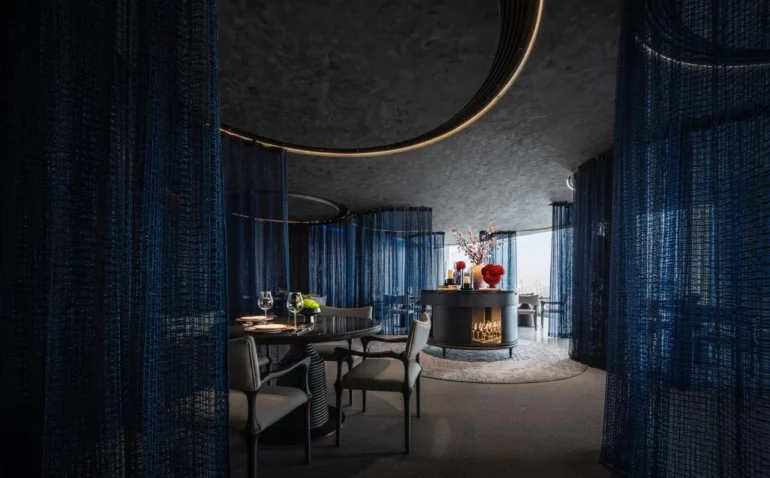
Through his projects, Joe Cheng blends regional tradition and modernity to create spaces where detail, sensitivity, and sustainability become the new expectations of Asian luxury.
Joe Cheng embodies an approach to high-end interior design that combines meticulous craftsmanship with a sensitivity to spatial narrative. Founder of Cheng Chung Design (CCD), he has created hotels and residences that seem less concerned with attracting attention than with establishing a sensitive relationship between the user and their environment.
Born in Hong Kong, Joe Cheng studied at the Guangzhou Academy of Fine Arts and then at South China University of Technology. He left academia to launch his own agency, CCD, some 30 years ago. According to a profile published by The Peak Magazine, the company now has nine international offices, with global headquarters in Shenzhen and an Asia-Pacific office that opened in October 2024 at the Collyer Quay Centre in Singapore.
A signature based on detail
Cheng's work places strong emphasis on the quality of touch, the composition of space, and the staging of light. According to The Peak Magazine, each project is considered a musical score: proportions, rhythm, interaction with the landscape, and furniture selection all contribute to creating a coherent and deliberate atmosphere. One could say that each element has its role to play.
For Cheng, "the sense of relaxation" sums up his vision of luxury. The Peak Magazine explains that he contrasts ostentation with what he calls a form of "inner spiritual nourishment." He also asserts that modern luxury among wealthy clients favors what could be called "quiet elegance," a discreet aesthetic that promotes intimacy and well-being.

This idea is reflected in several projects. For example, the Waldorf Astoria Shanghai Qiantan seeks to create a contemplative and private atmosphere, according to the launch press release published by Hilton Stories. Similarly, One Central Park in Shanghai reinterprets the idea of making everyday life more "hotel-like," where the refinement of a hotel influences the residential experience, according to Archilovers.
CCD draws on regional traditions while also utilizing contemporary expertise. The Angsana Chengdu Wenjiang, presented by The Plan and Indesign Live, for example, makes use of courtyard typology and Qing elements: sloping roofs, bamboo structures, and local materials for a micro-resort centered on the concept of "healing living."
For its part, the InterContinental Shanghai Wonderland, which received the Outstanding Property Awards in 2020, plays with the aesthetics of the mine: its natural rock walls and interior cliffs create a unique universe, according to the report.

Giving voice to Chinese creators
According to The Peak Magazine, Cheng recalls that international recognition of Chinese designers was not immediate. He describes a progression: from initial rejection, to acceptance, to participation in the standards of major global hotel chains.
He cites ambitious projects such as The Dali EDITION, which is expected to be completed this year. The latter interacts with the spectacular landscape of Mount Cangshan and Erhai Lake, blending local elements with the contemporary spirit unique to the EDITION brand, he explains.
CCD revisits Shanghai's haipai heritage, notably with One Central Park, according to Archilovers. The Regent Shanghai on the Bund offers a reinterpretation of modern elegance, but with references to history, as Swiss-Architects points out. These projects follow a consistent theme: merging urban memory with the demands of the contemporary world.
Sustainability and regional climate
In his projects in Southeast Asia, Cheng emphasizes openness to climatic and natural factors. The Peak Magazine reports that in Bali and Phuket, luxury is defined by light, natural ventilation, and connection to local vegetation. The Angsana Chengdu Wenjiang, meanwhile, also illustrates a particular focus on the use of local materials and sustainable practices, according to The Plan and Indesign Live.
CCD's practice is distinguished by understated elegance rather than ostentation. The various awards and distinctions it has received confirm this consistency in an aesthetic focused on sensory experience and materiality. But it is also true that this ambition to reconcile cultural preservation and global expansion raises challenges: how to address climate issues, responsible sourcing, and authenticity on a large scale?
Joe Cheng has built a creative identity that emphasizes slowness and attention. According to The Peak Magazine and other specialized publications, his work spans various fields, including architecture, luxury hotels, and residences, always with the aim of translating contexts and memories into spatial experiences. This positioning helps to raise the profile of Chinese talent on the world stage, while also raising the question of cultural and ecological sustainability in the medium term.