
Make Texture a preferred source on Google to support us
Add Texture to GoogleSongtsam: The New Face of Luxury and Immersive Travel in the Remote Corners of China
While the spending power of Chinese tourists abroad has long been the financial driving force behind many Asian and Western destinations, a fundamental trend is now reshaping the travel landscape: the rediscovery of the homeland. Tired of standardized tours, affluent travelers from the metropolises of the east coast are now turning their attention to the vast expanses of inland China. Their quest? Spectacular natural getaways and exclusive experiences, far from the urban hustle and bustle. It is in the central and western regions that independent brands are forging a new definition of luxury, deeply rooted in geography, craftsmanship, gastronomy, and local heritage.
A leading figure in this movement, Tashi Tsering heads Songtsam, a prestigious hotel group with properties scattered across the Tibetan Plateau and Yunnan Province. At a recent conference for entrepreneurs in Shanghai, he outlined his vision for a reimagined Chinese hospitality, centered on authenticity and respect for traditions.
Beyond mere accommodation: the promise of a Himalayan adventure
At the helm of the company for thirteen years, Tashi Tsering oversees a network founded more than a quarter-century ago. Yet he rejects the traditional label of hotel operator. The brand now comprises some twenty charming lodges scattered from northwestern Yunnan to the Himalayan borders, following the historic route of the ancient Tea and Horse Road toward Lhasa. The uniqueness of this project lies in its holistic approach: the properties are conceived as stops along a grand itinerant circuit. The primary mission is not to rent rooms, but to create a bridge allowing visitors to truly immerse themselves in Tibetan culture.
A management style inspired by traditional matriarchy
Contrary to the organizational structures of traditional hotels, the group’s properties are not managed by “general managers,” but by “hostesses.” This managerial approach draws directly from local sociological traditions. In Tibetan culture, it is indeed the female figure who is the absolute pillar of the household. It is the mother who holds the reins of the home; in her absence, balance is doomed to chaos. Transposed to the hotel hospitality sector, this philosophy guarantees a protective, warm, and deeply familial atmosphere.
A celebration of disconnection in the face of the frenzy of constant connectivity
While the tourism industry competes with innovations to offer ever more technological services, this travel pioneer has made a radical commitment to minimalism: no televisions and connectivity limited to the bare minimum. A major challenge when it comes to welcoming guests from fast-paced megacities, who are often accustomed to constant overstimulation. Yet the brand chooses to enforce this slowdown to prioritize contemplation and tranquility.

While this demanding approach took time to find its audience—the group’s reputation having been built over time through word of mouth praising the excellence of the experience—it has proven worthwhile. Perfectly integrated into its wild surroundings, the very architecture of the site invites escape. The absence of screens becomes a direct incentive to step outside: to go hiking in the mountains, explore centuries-old monasteries, and take the time to chat with the monks. It is this raw immersion in nature that allows city dwellers to truly slow down.
People at the heart of the model: empowering forgotten communities
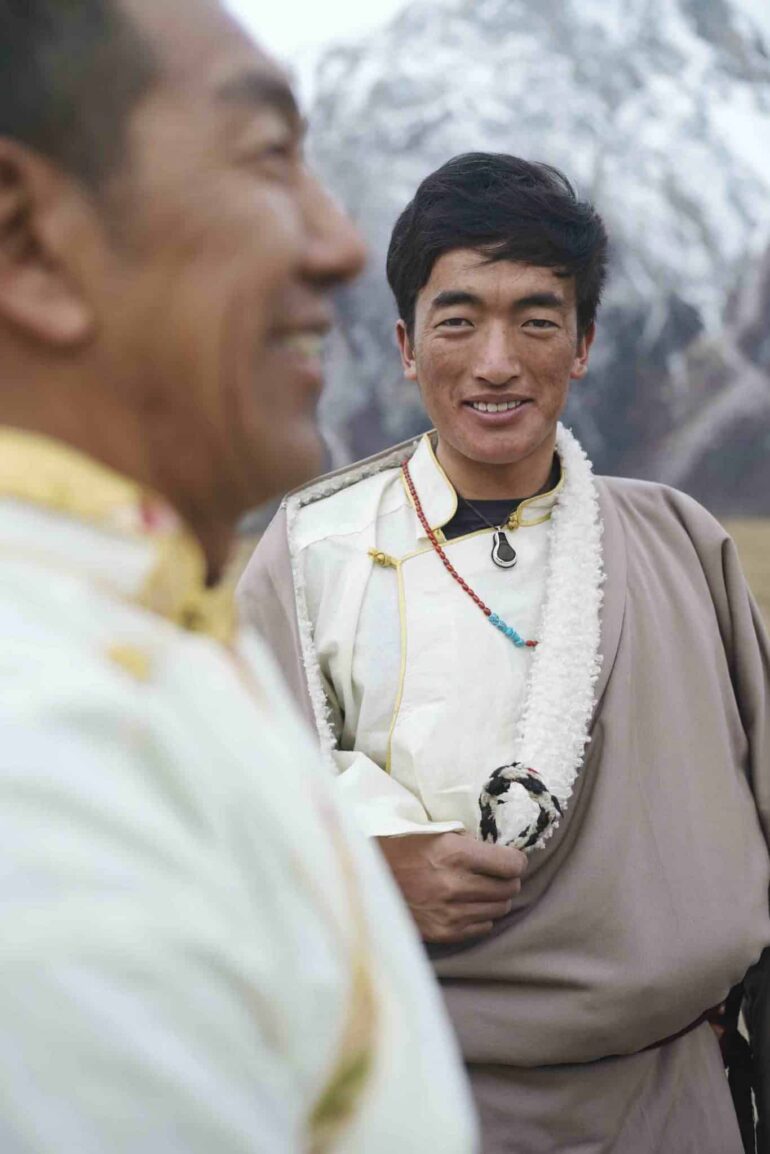
The group’s commitment is also reflected in a human resources policy deeply rooted in the local community. Of the roughly 1,600 employees who keep these establishments running, more than 90% come from the surrounding villages. While the majority are of Tibetan origin, the teams form a true cultural melting pot that now brings together 21 ethnic minorities. A large professional family where academic backgrounds matter little, since more than half of the employees have not completed high school.
Before these hotels arrived, career prospects in these remote areas were virtually nonexistent, often forcing residents to leave in search of economic opportunities. By creating local jobs, the company has given these communities the chance to live and work in their homeland. More than just employees, these men and women are regarded as the true guardians and living ambassadors of an exceptional cultural heritage.