
Make Texture a preferred source on Google to support us
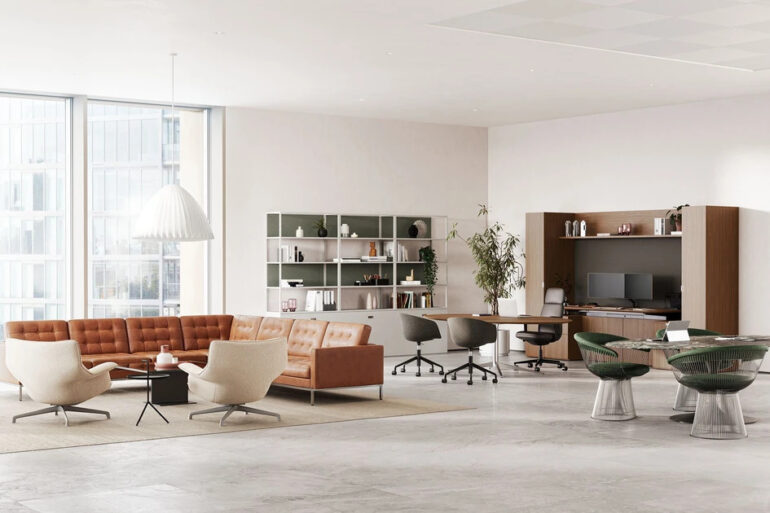
Add Texture to GoogleIn Clerkenwell, MillerKnoll embraces functional modernism. At Clerkenwell Design Week 2026, the American giant presents a cutting-edge vision of the contemporary office, combining flexibility, environmental consciousness, and historical heritage in the heart of London’s highly competitive market.
Clerkenwell, a laboratory for contract design
For the fifteenth edition of this must-see London festival, MillerKnoll has chosen to present a surgical vision of the modern office. The British capital, which over the years has become a veritable testing ground for corporate design, is seeing a proliferation of installations and showroom openings to celebrate an international design landscape in the midst of transformation.
The group’s message is clear: the contemporary workspace demands flexibility, minimalism, and resource optimization. At least, that is the manifesto championed through an exhibition focused on the sustainability and circularity of materials. In an industry where the language of environmental responsibility is often overused, this promise naturally calls for careful scrutiny and demands real guarantees regarding its practical implementation.
The Micro-Segmentation of Workspaces
Herman Miller illustrates this point with a sit-stand pod and a desk system designed for the agility of open spaces, transition zones, and libraries. Knoll responds with a new private office system designed by Paolo Dell’Elce, while reviving its heritage with the reissue of the Morrison Hannah Chair, designed in 1973. For its part, Colebrook Bosson Saunders highlights Lana, a laptop stand praised for its ergonomics.
This orchestration goes beyond a simple product launch. It reflects a broader strategy aimed at breaking down the workplace into a multitude of micro-uses, each equipped with highly specific furniture. While this quest for efficiency is firmly rooted in the history of design—from the Bauhaus to the open-plan offices of the 2000s—it now strives to be more discreet, almost domestic, and infinitely less intrusive.
The archive as a stylistic refuge
In the same vein, the HAY brand blurs the lines with the Palissade Cantilever family and the Deville and Terraza collections. Muuto unveils Coltre, a modular sofa designed by Studiopepe, while NaughtOne focuses on absolute ease of use with the Lotti Chair and the Pullman Modular.
This proliferation illustrates an inherent tension in contemporary design: how to reinvent oneself without repeating the past? The strong comeback of archival pieces demonstrates that design heritage remains a formidable commercial asset. Faced with the constant flood of new products on the market, heritage reassures far more than it surprises, offering a beacon of stability in an industry in search of meaning.

The emulation of an industry in transition
Clerkenwell Design Week features major installations designed to question our relationship with materials and the built environment. In this wake, the competition is organizing itself with sharp focus. The Senator Group is reimagining its showroom around modularity, Bisley Group is asserting a new, highly textured visual identity, while Thonet is playing the heritage card with a reinterpretation of the S 33/S 34 chair, celebrating the centennial of the Bauhaus Dessau.
MillerKnoll is thus operating in a competitive ecosystem where design can no longer rely solely on functionality. To win over consumers, furniture must now prove itself in terms of materiality and longevity. This is a fundamental requirement, far more complex and beneficial than a mere exercise in style.
The industry’s weight against the promises
With projected net sales of $3.7 billion, MillerKnoll reminds us that its historic portfolio is far from that of a marginal player testing mere aesthetic hypotheses. It is an industrial powerhouse capable of dictating trends on a large scale, giving its London announcements a special resonance.
One central question remains, however: to what extent will these grand principles of adaptability truly disrupt manufacturing chains and the lifespan of products? In Clerkenwell, the answer lies for now in the art of presentation. As is often the case in the world of luxury and design, while forms may enhance intentions, only the test of time will validate the true substance of these commitments.