
Make Texture a preferred source on Google to support us
Add Texture to GoogleThe exhibition “Matisse, 1941–1954” reveals a period of intense and innovative creativity during the artist’s final years, defiantly challenging conventional wisdom about old age and artistic exhaustion.
At the Grand Palais, Henri Matisse occupies a place that suits him perfectly: that of the self-evident. Yet the exhibition “Matisse, 1941–1954” subtly shifts our perspective. Far from merely celebrating the undisputed master of color, it focuses on the twilight of his life. A time when war, aging, and physical frailty could have signaled the closing of a chapter, but which, on the contrary, ushered in a season of absolute freedom.
The Height of a Reinvented Creativity
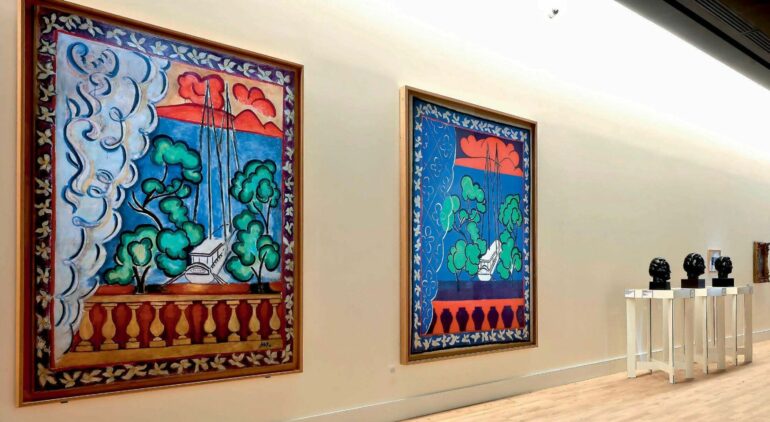
On view through July 26, 2026, the exhibition brings together more than 300 works. Paintings, drawings, cut-out gouaches, textile creations, illustrated books, and stained-glass windows form a collection of rare scope. The exhibition masterfully demonstrates how Matisse never slowed his inventive momentum between 1941 and 1954: he simply transcended it.
The Grand Palais highlights this period of late creativity, often overshadowed by his dazzling Fauvist works or his large Mediterranean canvases. Herein lies the true paradox: the older the artist grew, the more his formal language was stripped down, gaining in precision. His brushwork became more refined, achieving an unprecedented accuracy.
The Studio as a Space of Resistance
The historical context lends these works a particular depth. As Christopher C. Gorham notes in *Matisse at War*, the artist lived through the Occupation in France while his loved ones were threatened and many of his works had to be hidden or were even looted. Despite this climate, Matisse chose to remain in the country, dividing his time between Nice and Provence.
This loyalty to France is by no means trivial. It infuses a subtle tension into works that, at first glance, might seem imbued with lightness. In reality, they embody an intimate resistance—that of a creator who refuses to let the turmoil of the world extinguish his thirst for beauty.
The Architecture of Color
Claudine Grammont, curator of the exhibition, highlights the tenacity with which Matisse pursued his explorations of color, cut-outs, and the quintessence of forms. While *Le Monde* recently highlighted the impact of his role in Fauvism on art history, this late period reveals a palette that is no longer merely vibrant. It becomes thoughtful, meticulously crafted, almost architectural.
The cut-out gouaches thus take center stage. Far from being merely decorative flourishes, they constitute a true experimental laboratory. The forms born of this technique foreshadow *Jazz* (1947), and later the masterful *Blue Nudes* of the 1950s. By prioritizing the exploration of the method over style alone, the exhibition perfectly illustrates this creative continuity.
The Art of Variation and Simplification
One of the great strengths of this retrospective is its celebration of Matisse as a master of variation. He takes a motif, alters it, refines it, and then reinvents it. A young girl sitting by a window thus becomes the starting point for a fascinating series of studies on light. The addition of a second figure then gives rise to new iterations, each time disrupting the spatial balance.
This process of repetition deconstructs the myth of sudden inspiration. Like a musician tirelessly revisiting the same theme to bring out its subtlest nuances, Matisse demonstrates virtuosic patience. Innovation springs from the art of rearranging and refining what already exists.

The Essential Line
The exhibition also reveals Matisse’s evolution toward an extreme minimalism of line. Whether in portraits or sketches, he manages to suggest a vibrant presence with just a few lines. Fully embracing his rejection of naturalism, he never sought to imitate reality, but rather to capture its essence and pure sensation.
This simplicity sometimes borders on vertigo. A face, the curve of an arm, the tilt of a posture: the line no longer describes; it condenses. It is precisely here that the infinite modernity of Matisse’s late work lies—not in ornamental ease, but in a reduction to the essential, in absolute classicism.
Space Sculpted by Light
These explorations of cut-out forms quickly transcend the limits of the canvas, as evidenced by the Chapel of the Rosary in Vence. They reflect a masterful desire to fuse painting with architecture, playing with light and the art of stained glass. The cut-out forms take on a new, almost spiritual dimension there.
The exhibition concludes on a masterful note with the unprecedented gathering of the Four Blue Nudes, lending the entire collection a rare power. Far from being a mere grand finale (and, in the process, correcting the distortions of history), it is a dazzling demonstration of a coherent vision. On the cusp of his eightieth birthday, Matisse was anything but a master withdrawn from the world: he remained the eternal innovator that this exhibition celebrates.
This retrospective thus serves as a reminder of a truth all too often overlooked: an artist’s twilight years are not necessarily a decline. For Matisse, these final decades were akin to a vibrant renaissance, marked by absolute freedom and timeless modernity.