
Make Texture a preferred source on Google to support us
Add Texture to GoogleThe Danish design fair 3daysofdesign has once again confirmed its role as a premier showcase for innovative strategies in contemporary design. Combining sculptural textiles, exceptional Japanese craftsmanship, and a rigorous environmental approach, the event also served as a magnificent echo chamber for the vibrant Australian design scene.
In Copenhagen, the textile company Kvadrat took center stage with THREE, its new collection of residential curtains designed by creative director Isa Glink. The installation goes beyond simply displaying textiles: it treats them as a true material of “soft architecture,” capable of sculpting space as much as it does of dressing it.
Kvadrat: The Soft Architecture of Space
In its showroom, the Danish brand created a rich, immersive display, combining 118 curtain samples, sets of stackable cushions, and architectural structures made of anodized aluminum—all accentuated by rugs from the Loux collection. Video projections enriched the experience, playing with the interplay of light, shadow, and movement. The intended effect is unmistakable: to elevate fabric to the status of a spatial—or even sculptural—object.
According to the designer, THREE explores multidimensionality and materiality. This approach is rooted in the great Scandinavian tradition of design that prioritizes precision over showmanship. Behind this refinement, the collection skillfully reminds us that textile design remains a strategic priority, particularly in the world of high-end home furnishings.
At the same time, Kvadrat Acoustics unveiled a redesigned version of its Soft Cells system at the Design Workshop. The approach is decidedly more flexible, designed to simplify the installation of the fabric and thereby enhance its longevity and reusability. The return of the Kvadrat & Vitra Café further showcased this mastery of hospitality: Kvadrat textiles, Vitra furniture, and sophisticated cuisine come together to create a setting where everyday use becomes a true aesthetic statement.
Japanmade: Craftsmanship as a Material Narrative
Another highlight, the Japanmade Vol. 1 exhibition brought together several contemporary Japanese artisan brands in the heart of the Danish capital. Curated by OEO Studio and producer Jens H. Jensen, the event featured New Light Pottery, MAS, Naowashi, Sekisaka, and Sheep, among others. Each of these brands embodies a visceral connection between materials, the manufacturing process, and the preservation of local craftsmanship.
OEO Studio transformed a 750-square-meter space into an immersive journey, orchestrating a dialogue—now a classic of the genre yet remarkably effective—between Japanese minimalism and Danish functionality. Handcrafted lighting by New Light Pottery complemented MAS’s wooden furniture, Naowashi’s washi paper, Sekisaka’s lacquerware, and Sheep’s soy candles.
The project’s strength lies less in any sense of exoticism than in the absolute discipline of the materials. The Japan presented in Copenhagen asserts itself as a production system of rare precision, where the elegance of the gesture matters just as much as the final form.
The Emergence of a New Australian Aesthetic
The fair also served as a major springboard for the Australian avant-garde. Cult presented NAU, a platform with a resolutely international focus, distinguished by the nobility of its materials and a design language characterized by restraint. Tom Fereday’s new pieces particularly captured attention, such as the Cove collection with its sculptural wooden lines, and the Nola lamp, a bold combination of hand-cast crystal and mineral stone.
The design firm Design By Them followed a similar trajectory, celebrating more than 18 years of Australian design with a range of pieces by Adam Goodrum, Gibson Karlo, Marcel Sigel, Tom Fereday, and Trent Jansen. Iconic creations such as the Field Chair and the Sail Table paint a picture of a design scene that is making its mark on the global stage with unprecedented maturity. Australia is breaking free from its status as a peripheral market to establish its own design language, rooted in local essences, balanced proportions, and unique narratives, with a confidence reminiscent of the Scandinavian design world.
In this same quest for timelessness, Sydney-based designer Daniel Boddam has focused on an aesthetic designed to stand the test of time. His Orlo Sofa captivates with its low, enveloping silhouette, enhanced by upholstery in bouclé, chenille, mohair, or wool. The Cella Table, with its more austere hexagonal geometry—a nod to Frank Lloyd Wright—is softened by the use of cork, refined veneer, and a central bronze-tinted glass top. All of these designs share a very elegant restraint: in an industry often saturated with imagery, this pursuit of longevity feels like a welcome departure from the norm.
Aesop and Material Innovation
The skincare brand Aesop took advantage of 3daysofdesign to continue its ongoing collaboration with the studio OTHER MATTER. In the windows of its Nyhavn and Kronprinsensgade stores, algae-based bioplastics took the form of sculptural silhouettes inspired by the Parsley Seed Skin Care line. The brand also unveiled Aposē, its very first lighting fixture designed for the home.
Designed with a circular approach in mind, the window displays are intended to be reused or reprocessed after each rotation. Jessie French, founder of OTHER MATTER, also highlighted an innovative material with properties similar to leather, created by reusing these same algae-based bioplastics. The message is crystal clear: transforming experimentation into a virtuous cycle without compromising on visual appeal.
GUBI: The Art of Living on Display
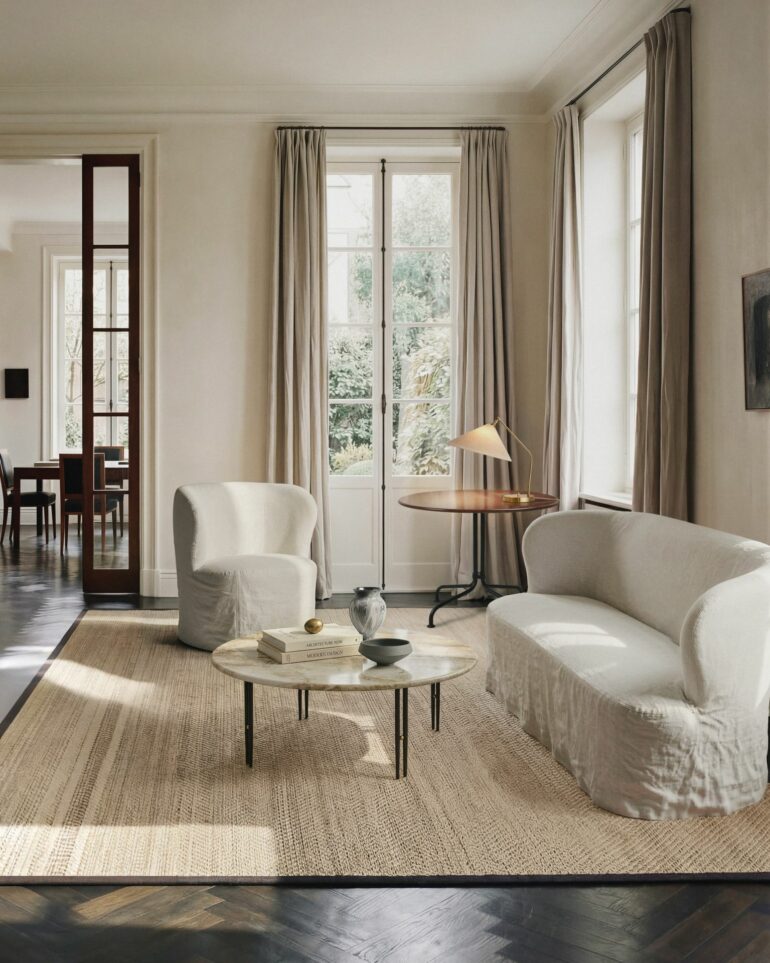
Finally, GUBI structured its presentation around four intimate living spaces: the living room, the dining room, the bedroom, and the studio. The brand approaches the contemporary interior as a skillfully orchestrated space, where furniture, light, color, and texture come together to create a harmonious daily rhythm.
New releases were displayed alongside must-have pieces from the archives within settings modeled after authentic ways of living: entertaining, retreating, creating, or, quite simply, just being. A universal vision, yet one whose relevance remains undiminished. In Copenhagen, GUBI poetically reminded us that, beyond the object itself, the excellence of design lies in its ability to enhance the way we inhabit the world.