
Make Texture a preferred source on Google to support us
Add Texture to GoogleIn Los Angeles, DATALAND is opening its doors as the first museum dedicated to artificial intelligence. It offers a unique immersive experience where visitors themselves become data, while exploring the blurred boundaries between art, science, and technology.
Digital architecture conceived as a living organism
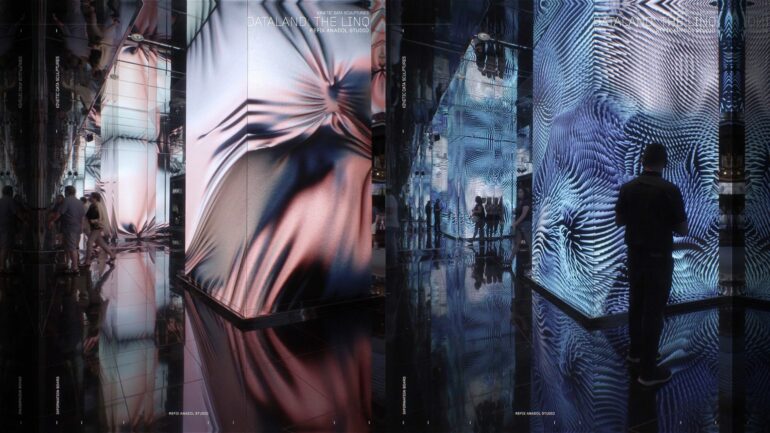
Opened on June 20 in the bustling cultural district of downtown Los Angeles, DATALAND stands as the first museum entirely dedicated to the art of artificial intelligence. More than just an exhibition space, the venue—founded by media artist Refik Anadol and cultural researcher Efsun Erkilic—bills itself as a true “digital ecosystem.” An ambitious concept that embodies both an aesthetic manifesto and a major technological challenge (dataland.art). Spanning nearly 2,300 square meters in the heart of The Grand LA—the architectural masterpiece designed by Frank Gehry—the museum features five immersive galleries.
The central concept behind this installation is as minimalist as it is resolutely contemporary: visitors are no longer simply there to observe; they become data in their own right. Upon entering, discreet wearable sensors measure visitors’ physiological signals to modify the visual, auditory, and olfactory environment in real time. According to the designers, this valuable data feeds into a digital memory called “Connectome,” ensuring that the space never truly resets between visits but evolves organically in response to its occupants (english.news.cn).
Nature as an Immersive Laboratory
The inaugural exhibition, titled “Machine Dreams: Rainforest,” explores the fascinating symbiosis between artificial intelligence and the natural environment. Drawing on soundscapes, custom scents, and interactive projections, this massive installation is based on the Large Nature Model. This AI system was trained using vast collections of ecological data gathered from sixteen tropical rainforests around the world, in partnership with prestigious scientific and cultural institutions. While the museum remains modest about the absolute comprehensiveness of this algorithmic database, its sensory impact is undeniable.
As the Los Angeles Times noted, DATALAND upends traditional museum conventions by relying on biometrics and multisensory stimulation. In doing so, the institution weaves artificial intelligence into the rich legacy of grand immersive machines, drawing a connection between the industrial magic of the 19th century and the most cutting-edge digital installations of our time (latimes.com).
Redefining the Creative Act
For Refik Anadol, DATALAND is above all a “living museum,” a space in constant flux born of the convergence of art, science, architecture, and engineering. Far from dystopian narratives, the artist dismisses the idea that a machine could supplant human creativity. Technology does not destroy the creator; it shifts and reposition them. In this vision championed by the museum, the algorithm does not create autonomously; rather, it becomes a unique co-creation partner for humanity (english.news.cn).
The result of more than three years of research and structured around more than 10 million lines of code, this extraordinary project brought together a cutting-edge, transnational, and multidisciplinary team. One question remains, inherent to our era: can we fully allow ourselves to be enchanted by this “poetry of data” without questioning the energy footprint, the heavy infrastructure, and the governance it requires? In response, DATALAND takes a radical gamble on total immersion, leaving it up to the visitor to let these final critical reflections emerge naturally once the charm of the experience has faded.