
Make Texture a preferred source on Google to support us
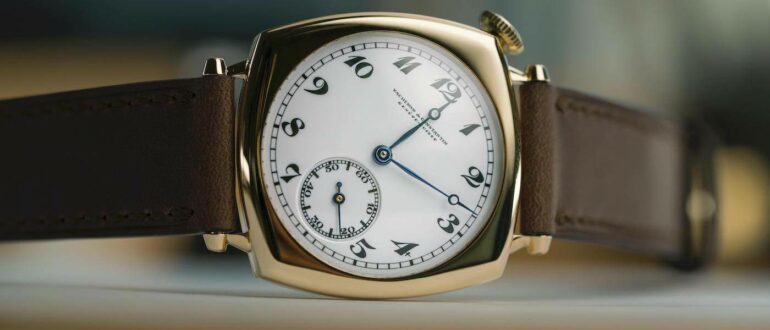
Add Texture to GoogleAt Watches and Wonders 2026, Vacheron Constantin unveils two new rose gold versions of its iconic watch, the Historiques American 1921. A subtle reinterpretation that combines contemporary warmth with absolute respect for the watchmaking heritage.
The unique allure of rose gold
Vacheron Constantin took advantage of the watch fair to bring one of its most daring models back into the spotlight: the Historiques American 1921. The Swiss watchmaker now offers this distinctive timepiece in rose gold, available in 36.5 mm and 40 mm case sizes. This choice of color breathes new life into this creation, born at the dawn of the 1920s, famous for its dial rotated 45 degrees and its off-center crown—a design originally conceived for perfect readability while driving.
The intention is not to reinvent the icon, but to refine it with a new sophistication. Whereas recent editions favored the elegant coolness of white gold or platinum, rose gold brings a decidedly modern warmth. The result scrupulously respects the original spirit, brilliantly avoiding the pitfall of a mere vintage pastiche.
Deeply rooted in design history
This timepiece traces its roots to a lineage that began in 1919, before being specifically adapted for the American market two years later. With its angled display designed for the wrists of gentlemen drivers, its cushion-shaped case, and its straight lugs, the American 1921 established a true aesthetic signature in the world of fine watchmaking.
The Geneva-based Maison carefully cultivates this heritage. Introduced to the Historiques collection in 2008 in a 40 mm size, the watch was subsequently released in a 36.5 mm version nine years later. By its centennial in 2021, the line had already expanded to include white gold models and a limited-edition platinum version, reflecting the enduring appeal of this distinctive design among connoisseurs.
A Commitment to Detail and Precision
These new models retain the founding codes of the original piece. The rose gold case frames a silver dial with a finely grained texture, punctuated by blue Arabic numerals and topped by 18-karat blued gold baton hands. The outer rim features a circular satin finish, while the small seconds sub-dial stands out with its concentric sunburst pattern. The ensemble is enhanced by a blue calfskin strap with a delicate patina.
With a thickness of 7.41 mm for the 36.5 mm model and 8.06 mm for the 40 mm model, these mechanical timepieces maintain absolute discretion. Here, elegance lies not in ostentation, but in the perfect balance of proportions. The magic of the American 1921 remains undiminished: this former driving instrument has evolved into a timepiece of distinction, now elevated to the status of a timeless classic.
The Nobility of the 4400 AS Caliber
The refinement of these two models owes much to their mechanical heart: the manual-winding Caliber 4400 AS. This ultra-thin movement, just 2.8 mm thick, comprises 127 components and beats at a frequency of 28,800 vibrations per hour, while ensuring an impressive power reserve of approximately 65 hours. A true technical feat, it is specially assembled to align the axis of the slanted dial with that of the small seconds and the crown.
This complex architecture perfectly illustrates Vacheron Constantin’s philosophy: preserving aesthetic uniqueness without ever compromising mechanical excellence. Visible through the sapphire case back, the movement features high-end finishes—including the iconic Côtes de Genève—and bears the prestigious Geneva Seal, the ultimate mark of fine craftsmanship.
The mark of a timeless classic
In an industry often in search of dramatic breakthroughs, Vacheron Constantin has chosen continuity—a decision of great wisdom. The American 1921 stands out as one of those rare creations whose silhouette tells the story of a century of design. Like a piece of Art Deco furniture, it transcends eras without losing any of its original magnetism.
Priced at 37,100 euros for the 36.5 mm model and 45,000 euros for the 40 mm version, these new models belong to the highest echelons of watchmaking, where the purity of form rivals mechanical virtuosity. Vacheron Constantin has brilliantly succeeded in its challenge: to elevate the obvious with a refinement that requires no artifice.