
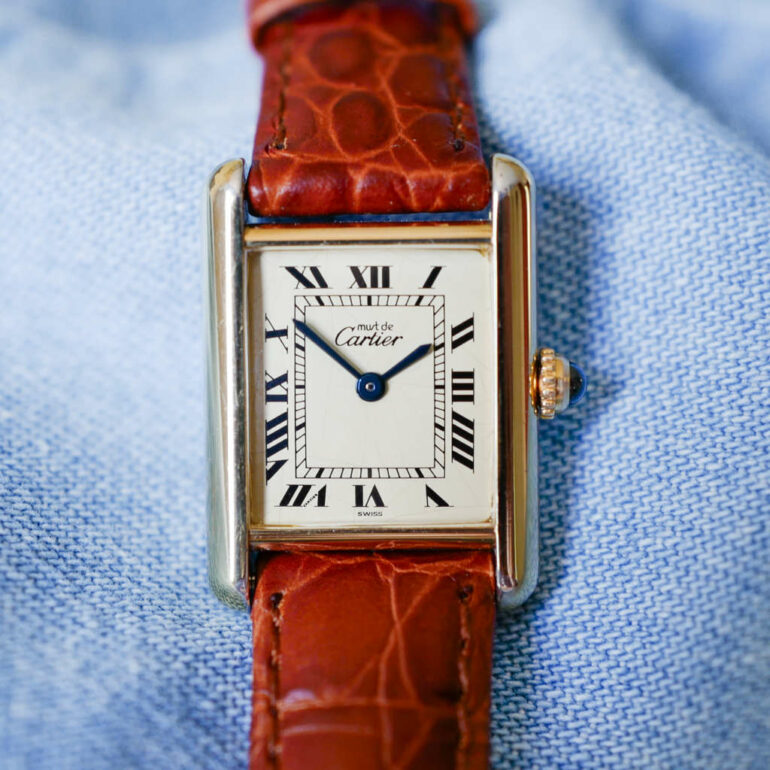
A unique collection of more than 300 vintage Cartier watches, spanning nearly a century of design, is set to be sold at several auctions scheduled through 2026. An extraordinary event that highlights the relentless pursuit of rarity and originality in the fine watchmaking market.
A tribute to patience and expertise
According to Sotheby’s, this exceptional collection will be auctioned in several sessions this year, with a total estimate well exceeding $15 million. Titled “The Shapes of Cartier: The Finest Vintage Grouping Ever Assembled,” the collection spans nearly a century of the house’s history, as noted by Bloomberg. It will begin its global tour in Hong Kong, before stopping in Geneva and then New York, with a grand finale scheduled for December 2026. (sothebys.com)
The conclusion is clear: the market now favors carefully documented rarity over immediate flash. Following the sometimes irrational frenzy sparked by ostentatious sports watches, collectors are sharpening their discernment and turning to more niche pieces that demand a deep understanding. With its cases featuring unique geometries and the legacy of its historic workshops, Cartier perfectly embodies this new quest for meaning.
A meticulously curated collection
This sale brings together the fruits of twenty-five years of research conducted by an anonymous collector. While the sheer size of the collection is impressive, it is above all its remarkable coherence that captivates. The lots highlight pieces with atypical cases, crafted in the secrecy of the workshops in Paris, London, and New York. (sothebys.com)
This rigorous selection reveals another facet of Cartier’s history. Far from being limited to the iconic Tank, the house has always cultivated a true art of watchmaking through form, deploying an almost architectural vision of time. Today, these creations stand out among connoisseurs as a signature that is both intellectual and stylistic.
The Crash, an icon of nonconformity
The first auction, scheduled for April 24 in Hong Kong, will feature a 1987 Cartier London Crash in yellow gold, estimated at between $400,000 and $800,000. Sotheby’s notes that this legendary model was created in 1967, the result of the visionary drive of Jean-Jacques Cartier and designer Rupert Emmerson. (sothebys.com)
The Crash stands out as one of the most unsettling yet most accomplished pieces in modern watchmaking. Its rugged silhouette has fueled many fantasies—from the aesthetics of Salvador Dalí to the legend of a watch melted in a car accident—but its origin truly stems from a creative choice of absolute audacity.

Geometric audacity beyond the obvious
This extraordinary catalog is not limited to its most high-profile pieces. Among the announced highlights, we discover a decagonal model from 1970–1971—one of only five known examples in the world—an asymmetrical version enhanced by blue enamel, and an asymmetrical Tank in white gold. A 1966–1967 Driver model, ingeniously designed to offer perfect readability behind the wheel, rounds out this collection. (sothebys.com)
The presence of these less conventional pieces lends the sale an extraordinary depth. It serves as a reminder that Cartier has transformed the watch into a veritable laboratory of forms and uses, flirting ahead of its time with the very essence of industrial design.
The Crowning of a Watchmaking for Connoisseurs
The times are smiling on Cartier. As the undisputed driving force behind the Richemont Group, the house enjoys an unrivaled cultural aura. Yet this global visibility sometimes masks the complexity of its watchmaking heritage. Today, the secondary market is responsible for elevating provenance, ultra-limited editions, and the mark of its most prestigious workshops to iconic status. (sothebys.com)
This auction thus stands as a rite of passage for connoisseurs. While the classicism of the Tank remains a cornerstone, the London models or the geometric experiments require a keen memory, a refined taste, and a certain humility. Through this collection spanning several decades, Sotheby’s reveals a scholarly facet of Cartier: that of a house capable of challenging certainties with discreet elegance, proving that a creation need not shout to captivate attention permanently.