
Make Texture a preferred source on Google to support us
Add Texture to GoogleThe Haggerty Museum of Art in Milwaukee unveils a spring season where space exploration engages with civic memory. A thoughtfully curated exhibition that offers a fresh, aesthetic reflection on civic engagement, a far cry from conventional displays.
A Spring Between Orbit and Civic Memory
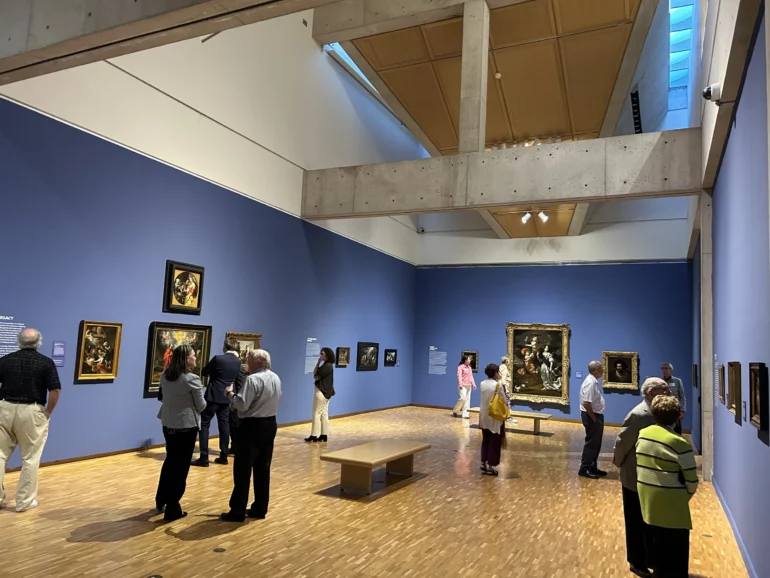
In Milwaukee, the Haggerty Museum of Art goes beyond mere publicity stunts. On the Marquette University campus, the institution is presenting four spring exhibitions united by a subtle common thread: the resonance of history through contemporary images and objects. The series, conceived in partnership with Imagine MKE, weaves unexpected connections between space exploration, revolutionary prints, political manifestos, and personal narratives. The result reveals a cleverly designed exhibition layout, a departure from traditional or overly conventional displays.
The starting point of this journey, the exhibition "This Side of the Stars," proves to be remarkably rich. It brings together a space collection and prints by Robert Rauschenberg, created in the wake of the Apollo 11 mission. The museum enriches this theme with a contribution by Jason Yi, a professor at the Milwaukee Institute of Art and Design. His work “Red Crowned Crane Tower” skillfully shifts our gaze toward the Korean Demilitarized Zone and its abundant biodiversity. Where exclusionary architecture and barbed wire promised barrenness, nature sketches a poetic and fascinating resilience.
Rauschenberg, the Moon, and the Long Shadow of the 20th Century
Rauschenberg’s presence is no accident. As we approach the centennial of his birth in 2025, the museum aptly highlights the impact of space imagery on postwar American art. John McKinnon, the institution’s director, highlights this resonance and invites the public to reinterpret the iconography of the lunar conquest—an approach all the more timely in the era of heated debates surrounding the Artemis II mission.
Far from being a mere retro-futuristic cabinet of curiosities, the exhibition places these works within a contemporary framework where technology, the environment, and cultural memory intertwine. This perspective subtly reminds us that humanity’s most dizzying advances are irrevocably accompanied by a profoundly earthly footprint.
The American Revolution, Posters, and Constructive Disagreements
The exploration continues in spaces dedicated to civic engagement. In anticipation of the 250th anniversary of the United States in 2026, two exhibitions juxtapose historical works with contemporary creations. "Defying Empire" unveils British and American prints from the Revolutionary era, while "Declaration of ____" creates a dialogue between modern prints and zines, keenly highlighting the persistence of forms of visual protest.
The institution is grounded in a strong premise: democratic vitality resides as much in its institutions as in the materiality of its media. While prints were widely circulated in the 18th century, zines and digital leaflets are their direct heirs today, trading solemnity for a palpable sense of urgency. This formal connection, though seemingly subtle, is undoubtedly one of the exhibition’s most compelling themes.
Local Roots and Transmission
The final section, "Let the Real World In," centers on a documentary video work spanning a decade, following the youth of Milwaukee. From their first summer workshops at the museum to their first vote as they enter their early twenties, the camera captures their civic dialogues, their commitments, and their aspirations. A portrait thus emerges of a generation approaching adulthood with a unique and complex perspective.
This local focus lends real depth to the exhibition. More than a mere commemorative celebration, the museum illustrates the transmission of civic issues, their confrontation with reality, and their inevitable transformation. An approach that allows the Haggerty Museum to elegantly sidestep the pitfalls of conventional tributes.
Open to the public free of charge Monday through Saturday from 10:30 a.m. to 4:30 p.m., this thoughtfully curated program reminds us that, in the artistic sphere as in the political arena, anniversaries only take on their full meaning when they invite us to reinvent the debate.