
Make Texture a preferred source on Google to support us
Add Texture to GoogleThis year’s Frieze New York showcase presents a program full of contrasts. Between the quiet consolidation of mega-galleries and the emergence of unexpected provocations—from David Zwirner’s new identity in Tribeca to the prehistoric fossils at Amanita— Art Week is redrawing the contours of a constantly shifting market, torn between status, narrative, and spectacle.
The Theater of Contemporary Art
New York’s Frieze Week opened amid the electric buzz and understated glamour that define its DNA. To the rhythm of exclusive openings and intimate dinners, the metropolis reenacted its usual ballet: one in which the gallery transforms in turn into a social salon, a luxurious showcase, and then a veritable epicenter of cultural power.
Tribeca: David Zwirner’s Strategic Foothold
In the heart of Tribeca, the opening of the exhibition “Statics of an Egg” officially launched David Zwirner’s new space, a location that was already the talk of the art world. Curated by Martin Germann, this exhibition highlights a highly subtle Japanese scene, centered on Yu Nishimura and Kenji Ide. Among the highlights, Nishimura’s previously unseen canvas, “in waiting,” offers a minimalist respite that elegantly contrasts with the frenzy outside.
Managed on a day-to-day basis by Marlene Zwirner, the space is a perfect continuation of the parent gallery, blending the gallery’s leading figures with emerging talents. No over-the-top displays here, but a measured consolidation: a way to sustain its influence in an ecosystem where a gallery’s aura rests as much on the mastery of its architecture as on the curation of its walls.
The Fossil: A New Narrative of the Unusual
A radical shift in tone at Amanita. The exhibition “A Land Before Time: Three Dinosaurs and a Gondola” orchestrates a daring confrontation between contemporary art and paleontology, showcasing three complete Maiasaura specimens. At the center of this dizzying temporal dialogue, a 1982 sculpture by John Chamberlain, “Gondola Marianne Moore,” suddenly lends an unexpected sculptural gravity to the ensemble.
Curated by Caio Twombly and Tommaso Rositani Suckert, with the collaboration of Freddy Leiva—a true bone dealer who facilitated connections with the Granada Gallery—this event highlights a striking reality of the contemporary art market: the work alone is no longer enough; the story surrounding it must captivate.
This staging transcends a mere visual find. It demonstrates that the New York art scene today resembles a formidable storytelling machine, where the unprecedented and the utterly rare compete to entice collectors in search of total experiences.
A fair conceived beyond the walls
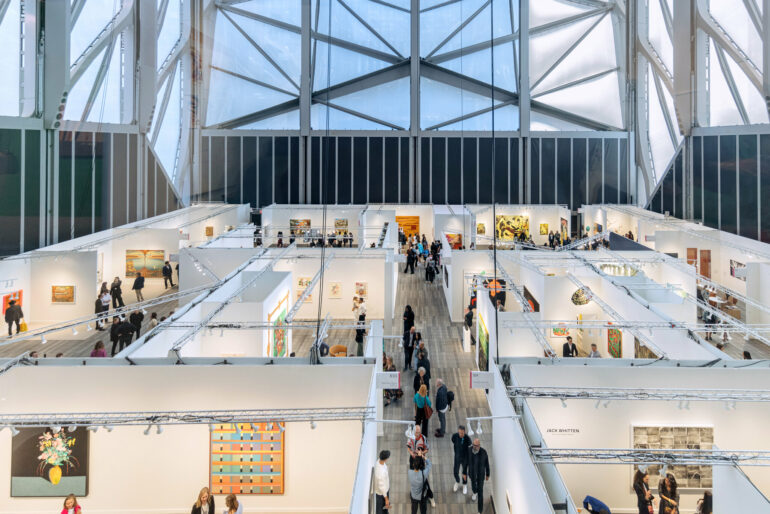
As the official epicenter of the event, The Shed hosted the 2024 edition with some sixty international galleries, showcasing major figures such as Christopher Wool and Huma Bhabha, while giving pride of place to immersive installations.
But this institutional geography reveals above all the dynamic of an event that now spills beyond its confines. Leading galleries are no longer limited to the confined space of a booth: they extend the fair beyond its walls, transforming Manhattan into a vast exhibition corridor. If David Zwirner has naturally taken over the aisles of Frieze with works by Nate Lowman and Franz West, it is to better orchestrate a strategy of multifaceted and omnipresent visibility.
The Assertive Elegance of Contrasts
It is in these interstices that New York reveals its unique sense of incongruity. Amid the ballet of VIPs, immaculate floral arrangements, and the murmurs of collectors, these objects emerge from another, almost geological, time. While the veneer of glamour might sometimes seem to crack under the weight of excess, the magic invariably works.
The challenge lies not in gratuitous extravagance, but in its purpose. In a week saturated with images, the artwork must still inspire wonder without sinking into mere entertainment. Between the quiet delicacy of a pointillist canvas and the earth-shaking presence of a prehistoric relic, Frieze Week confirms that the luxury and art industries have mastered the aesthetics of contrast more than ever, particularly when they sketch the contours of a legend.