
Make Texture a preferred source on Google to support us
Add Texture to GoogleIn New Delhi, the India Habitat Centre reaffirms its role as a vital platform for the Indian art scene. With *Master Strokes 2026*, the institution is hosting a group exhibition featuring thirty-six artists, curated by Kishore Labar. Spanning five days, the event blends diversity, heritage, and innovation in a space designed to foster the exchange of ideas. This project serves as both a panorama and a laboratory for experimentation: how can unique visual languages coexist without ever succumbing to uniformity?
Architecture in the Service of Openness
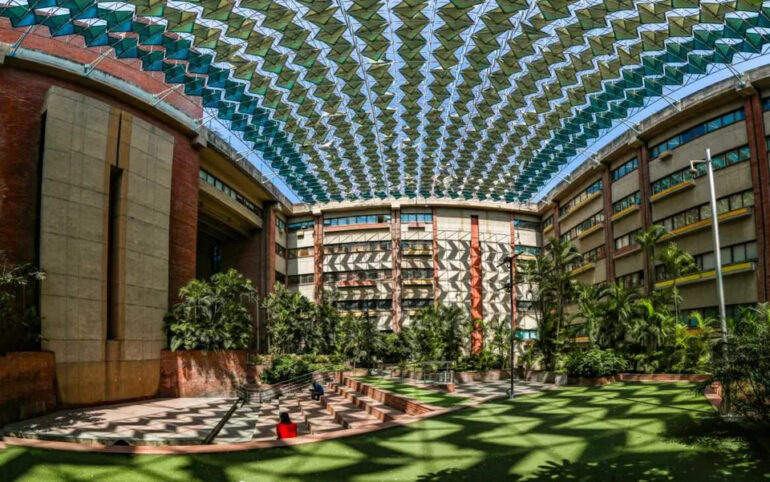
Since the early 1990s, the India Habitat Centre has held a unique place in the capital’s cultural landscape. Designed by HUDCO and conceived by architect Joseph Allen Stein, this venue deliberately breaks away from stereotypical conference centers and traditional art galleries. Its architecture interweaves courtyards, walkways, gardens, and open spaces. This spatial organization fosters an organic and fluid flow between urban reflection, cultural programming, and public life.
The building itself stands as a true manifesto. Its stone facades, shaded areas, and subtle transitions between interior and exterior intelligently respond to the local climate as well as the venue’s multiple uses. It is this flexibility that allows the center to host concerts, screenings, literary discussions, and exhibitions with equal ease. In a megacity where public space can sometimes be difficult to navigate, this permeability is invaluable.
Eclecticism as a Curatorial Approach
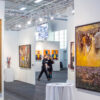
For Master Strokes 2026, the invited artists—including Anamika Rastogi, Ambika K V, Aneeta Saha, Pranav Kumar Saha, and Ayesha Lumba—present visions of great richness. The exhibition orchestrates a sensitive dialogue between painting, sculpture, photography, installations, and mixed media. This diversity is not merely an aesthetic choice; it supports a profound vision of art, conceived as a vibrant conversation rather than a static catalog of works behind glass.
Kishore Labar is presenting this approach for the seventh consecutive time. A remarkable consistency that lends the project a genuine sense of history and undeniable authority. In an ecosystem where ephemeral events follow one another and are sometimes quickly forgotten, this thoughtful repetition becomes a curatorial imperative in its own right.
Between heritage and contemporary resonances
Over the decades, the India Habitat Centre has forged a distinctive artistic identity, driven in particular by its Visual Arts Gallery, which opened in 2000. The space breaks down the boundaries between emerging creators and established figures, allowing works to navigate freely between folk traditions, modern practices, and hybrid forms.
While the exhibitions often explore urbanity, memory, ecology, or social tensions, they also elevate indigenous and rural traditions by grounding them in a resolutely contemporary discourse. Far from falling into the trap of museumification, this approach avoids the common pitfall of reducing vernacular art to tourist folklore or a culturalist stance.
The challenge of a decompartmentalized culture
The institution’s success also rests on its broad accessibility. The fact that many events are free and open to the public intrinsically links culture to a philosophy of sharing, in contrast to the sometimes exclusive codes of the contemporary art market. This generous model, however, presents a significant challenge: maintaining a broad-minded approach while ensuring impeccable critical rigor and coherence.
In this context, Master Strokes 2026 brilliantly illustrates the IHC’s mission: to foster dialogue among diverse practices within an architectural setting that invites both contemplation and exchange. The exhibition demonstrates that a cultural center can transcend its role as a mere container to infuse a genuine sense of urbanity.
Implicitly, the India Habitat Centre champions the precious idea of culture as a common good. A bold ambition, which finds here an architecture that is truly worthy of it.