
Make Texture a preferred source on Google to support us
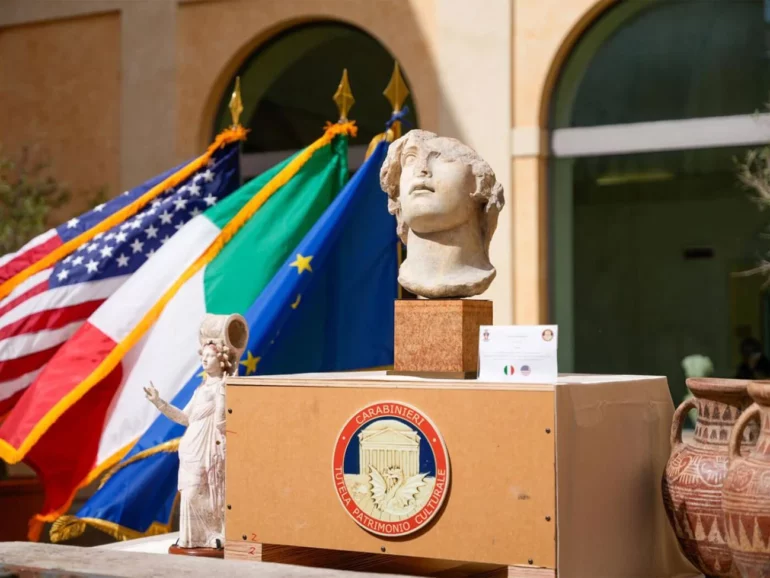
Add Texture to GoogleIn an unprecedented move, Washington has returned 337 archaeological artifacts to Rome that were obtained through illegal excavations, demonstrating strengthened cooperation in the fight against the illicit trade in cultural property.
A Restitution of Historic Proportions
The United States recently returned 337 stolen antiquities to Italy, marking one of the largest art repatriation operations in recent history. This initiative underscores the strengthening of a longstanding collaboration between Rome and Washington, now structured with exemplary rigor and method.
The artifacts, currently entrusted to the Carabinieri’s unit specializing in the protection of cultural heritage, span a fascinating historical spectrum. Roman sculptures sit alongside Greek, Etruscan, and Egyptian artifacts. This extraordinary diversity underscores how the antiquities trade has always blended archaeological passion, pure financial speculation, and, above all, the laundering of provenance.
Beyond the staggering inventory, it is the approach that is evolving. The investigations, often led from New York, have made it possible to dismantle the clandestine networks of a formidable organization, thereby identifying a colossal number of looted objects.
From clandestine excavations to the showcases of the art market
Italian authorities emphasize that a large portion of these treasures comes from illegal excavations or thefts committed within museums and prestigious historic sites. These objects then made their way onto the international art market, a world where the lack of transparency in provenance has long provided an ideal cover for illicit sales.
Among the recovered masterpieces is a majestic marble head of Alexander the Great, dating from the 1st century AD, stolen from a Roman museum in the 1960s. Investigators also recovered a delicate bronze sculpture from Herculaneum, two Egyptian basalt statuettes, as well as a precious collection of Roman coins, jewelry, ceramics, and architectural fragments spanning a period from the 5th century B.C. to the 3rd century A.D.
While the journey of these works may at times resemble the classic itinerancy of a collection, it is in reality a pure and simple dispossession of priceless heritage.
A Strategic and Technological Alliance
For several decades, Italy has waged a patient and relentless battle against this underground trade. The country has already succeeded in repatriating thousands of artifacts, representing a value in the tens of millions of euros.
This momentum has accelerated significantly in recent years thanks to the deployment of digitized databases, technological innovations, and unprecedented cooperation with U.S. courts. For example, the Manhattan District Attorney’s Office formally identified 221 of the items in this recent repatriation.

As early as 2023, Rome and Washington had strengthened their bilateral agreements to tighten U.S. restrictions on the import of Italian archaeological material, simultaneously intensifying customs surveillance and intelligence sharing. A diplomatic and legal arsenal that, though operating in the shadow of major museum institutions, has proven remarkably effective in cleaning up the art market.
Protecting heritage and identity
The U.S. Ambassador to Italy reaffirmed his country’s unwavering commitment to facilitating the return of these works to their homeland. In response, Italian Minister of Culture Alessandro Giuli rightly noted that safeguarding cultural heritage is above all an act of preserving memory—a vital legacy for future generations.
This historic restitution does not mark the end of this quest; on the contrary, it underscores the need for absolute vigilance in the antiquities market. Italian cultural institutions are also warning collectors and buyers: a lack of rigor in authenticating a piece’s provenance can today lead to errors with consequences that are as serious as they are costly.
The recently recovered treasures will first undergo meticulous scientific analysis before being returned, as far as possible, to their original setting in the heart of Italy.