
Make Texture a preferred source on Google to support us
Add Texture to GoogleThe 61st Venice Biennale, themed "In Minor Keys," emphasizes sensitivity, spotlighting artists from the Caribbean and often-overlooked narratives through an approach rooted in listening and nuance.
An orchestration of attention
As critic Hrag Vartanian notes in Hyperallergic, this 61st Venice Biennale stands out less as a show of force and more as a meticulously orchestrated exercise in attention. The exhibition “In Minor Keys” chooses to give a voice to what usually remains in the background: subtle narratives, less conventional forms of representation, and alternative interpretive lenses. This approach lends the event a rare coherence, without erasing the tensions inherent in an event of this scale.
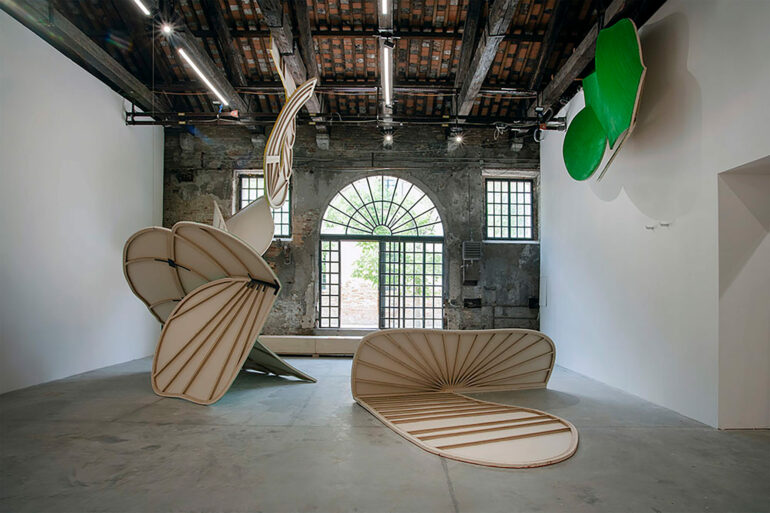
Bringing together nearly 110 artists spread across the Giardini and the Arsenale, the project’s ambition is evident in its scale. But it is truly in the intimate dialogue woven between the works that the exhibition comes into its own. Wangechi Mutu’s installations, or the fascinating resonance between Ebony G. Patterson’s complex sculptures and Kambui Olujimi’s North Star watercolors, illustrate this desire to awaken consciousness rather than dazzle with spectacle.
The Caribbean scene takes center stage
One of the most striking features of this edition is the prominent place given to Caribbean artists. Figures such as Ebony Patterson, María Magdalena Campos-Pons, Kamaal Malak, Edouard Duval-Carrié, and Annalee Davis occupy a central place, a prominence that has been noted by leading publications such as Artforum and ARTnews.
This focus is no accident. It refocuses the exhibition’s narrative on stories deeply rooted in memory, identity, and colonial legacies. The Haitian-born artist Edouard Duval-Carrié presents, notably, Poto Mitan, a work conceived to engage in dialogue with older paintings and bronzes, thereby extending an essential reflection on Haitian spiritual traditions and the national imagination.
The landscape as testimony
In the heart of the Arsenale, Annalee Davis unveils Let This Be My Cathedral, a mural herbarium composed of plants collected from her own garden, located on a former plantation in Barbados. The idea of a sanctuary runs through this work with an accuracy tinged with irony: while contemplation is rooted in the plant world, the landscape itself is never entirely innocent. The ecological details of the installation shed light on historical, economic, and social layers that the work invites us to decipher carefully.
This approach captures the very essence of In Minor Keys, which favors nuance over bombastic statements. The title, borrowed from minor keys, evokes a sensitivity to details that often escape the dominant grand narratives. In a Biennale sometimes threatened by visual saturation, this restraint feels like a welcome breath of fresh air. It does not erase the complexity of such a vast exhibition, but gives it a harmonious and accessible form.
A Scenography of the Intimate
The presence of quotations from poets and writers—from Refaat al-Areer to Toni Morrison, including Ben Okri—suspended within the exhibition space, enriches the overall atmosphere. Far from being mere intellectual embellishments, these literary fragments invite visitors to slow down and engage more deeply with the exhibition. This dialogue between text and image reminds us that a great exhibition is also judged by its ability to weave meaningful connections.
Ultimately, this Biennial feels less like a parade of art objects and more like a genuine musical score. While some notes rise powerfully, others vibrate discreetly in the background. The balance achieved amplifies voices long kept on the margins, without ever reducing them to mere illustrations of current trends. It is undoubtedly here that this edition finds its most lasting resonance.