
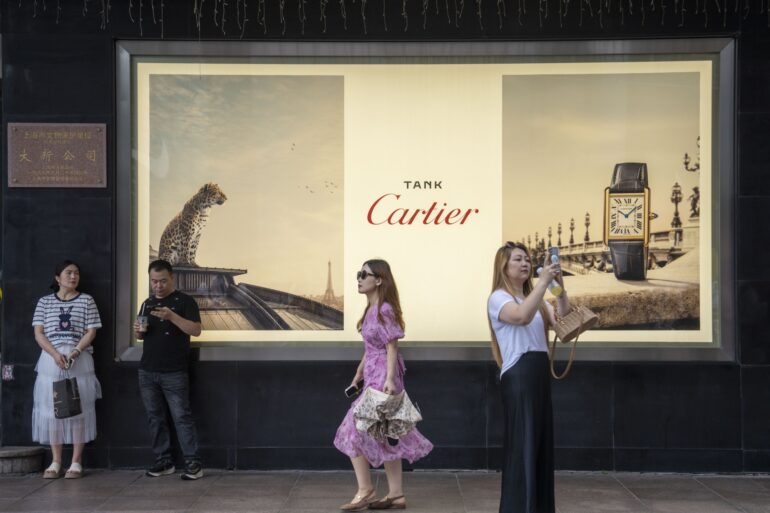
Following Donald Trump’s threat to “destroy the entire Iranian civilization,” the ensuing ceasefire offered a glimmer of hope for an end to the conflict in the Middle East. The U.S. president and Tehran agreed to a two-week truce, paving the way for an initial round of negotiations to be held in Islamabad. The agreement triggered a wave of relief in global markets, putting an end—at least for now—to weeks of near-uninterrupted selling: crude oil prices plummeted while major international stock exchanges posted sharp gains. And the sector that reacted most strongly was, unsurprisingly, fashion and luxury, with gains nearing seven percentage points.
A spectacular surge on the stock market for luxury giants
On the Milan Stock Exchange (Piazza Affari), right at the opening bell, the FTSE MIB index was up 3.78%, while luxury companies were significantly outperforming the average: Moncler gained 7.69% and Brunello Cucinelli 6.99%. In Paris, LVMH, considered a benchmark for the sector, rose 6.37%. On the CAC 40, French companies Hermès (+6.79%), Kering (+5.7%), and EssilorLuxottica (+5.47%) also soared. In London, Burberry jumped nine percentage points, and in Zurich, Cartier’s holding company, Richemont, posted a 6% gain. The positive trend continued throughout the morning, with Hermès, Burberry, and Moncler leading the list of the day’s biggest gainers at midday.
An expected rebound after a difficult first quarter
Today’s rebound must be viewed in the context of a first quarter that was already turbulent in itself, with the war posing an additional threat to the luxury sector, which is also grappling with falling demand and challenging market conditions in the key Chinese market, which is losing momentum following the post-Covid boom. Shares of the major players—LVMH, Kering, Richemont, and Hermès—had fallen by 10% to 20% since the first attacks in Iran on February 28, wiping out approximately $100 billion in market capitalization. This figure is cited in a note from Deutsche Bank, which describes it as a “cyclical discount” with valuations set to rebound quickly as soon as the macroeconomic outlook improves. The downturn in the luxury sector had already seen sharp declines over the past six months: Hermès fell 18%, LVMH 13%, Kering 13%, and Prada 14%.
The Middle East: A Vital Growth Engine
One key factor explains why the luxury sector is so sensitive to events in the Middle East despite its seemingly marginal market share. The Middle East accounts for about 6% of global luxury sales but serves as a strategic growth engine during a period of stagnation in other major markets. The return of affluent tourists to the Gulf, who account for the bulk of luxury spending in the region, will likely trigger a rapid recovery in duty-free channels and a reduction in the high logistics costs associated with the war. Analysts, however, are urging caution: this truce represents only a temporary pause, not a definitive solution to the conflict.