
Immersion and authenticity: the successful venture of a new Balearic hotspot
Taking on the name of the neighborhood where you’re setting up shop is a risky endeavor that requires an intimate understanding of its DNA and way of life. That’s exactly the challenge taken on by Terreno Barrio, a hotel that has just opened its doors in Palma de Mallorca. Far from being a mere haven for passing tourists, the hotel soaks up the vibrant energy of its surroundings to offer travelers and Mallorcans alike a true immersion in the island’s culture and design.
From the Golden Age to the Rebirth of a Legendary Neighborhood
The history of the El Terreno neighborhood is worthy of a novel. As early as the 19th century, wealthy families were building their summer homes on its green hills. Its golden age spanned the 1950s to the 1970s, a glamorous era when silver-screen legends such as Alain Delon, Grace Kelly, and Marlene Dietrich frequented its elegant bars and intimate clubs. The arrival of mass tourism then shifted the center of gravity toward the Paseo Marítimo, gradually consigning the steep, narrow streets to obscurity. After a scandalous interlude in the 1990s, marked by a nightlife that was at times excessive, and several decades of stagnation, the area is now experiencing a spectacular revival.
An architectural complex open to the city
Riding this wave of renewal, entrepreneur Lydia Piñero acquired a building dating from 1935, designed by local architect Francesc Casas, along with an adjacent plot. The view is exceptional: “From here, you can see Bellver Castle, one of the few circular medieval fortresses in Europe, built in the 14th century,” she notes. With the forest as a backdrop and the new Paseo Marítimo below, the location called for a large-scale project. In collaboration with the architecture firm Ohlab, founded by Paloma Hernaiz and Jaime Oliver, she envisioned a hybrid living space: 41 rooms, a spa, a screening room, a rooftop pool, as well as spaces accessible to everyone, such as a café, teleworking areas, and shops on the ground floor.
Urban integration guided every stage of the design. The historic building, which houses some of the guest rooms and the restaurant, is conceived as the “stage,” while the new wood-clad structure is envisioned as a “bazaar.” Between these two volumes, the former private property has been transformed into a public pedestrian alley, recreating a vital link between the city’s upper districts and the waterfront. A powerful way of signifying that the hotel belongs first and foremost to its local residents.
The triumph of local sourcing and Mallorcan craftsmanship
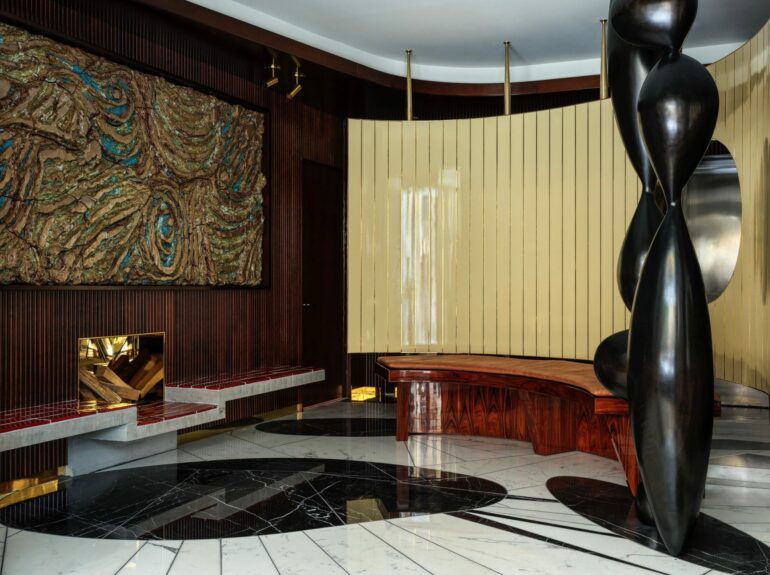
To design the spaces, Ohlab assembled a veritable pool of local talent. The eco-friendly approach is remarkable: the rubble from the iconic nightclub that occupied the neighboring lot was crushed and transformed into a stunning terrazzo that now adorns the bathrooms and common areas. For her part, artist Sylvia Sánchez Montoya designed imposing drapes made from recycled local sheep’s wool, elegantly concealing the restaurant’s open kitchens.
Balearic artisans are celebrated in every detail. The brass counters, custom walk-in closets, and mirrors are the result of a collaboration with local design studios such as 2monos. For the lighting—crucial to the atmosphere of Mallorcan nights—the designers turned to the manufacturer Contain, categorically refusing to delegate this task to outside consultants. Leading names in regional craftsmanship, such as Huguet, Introvl, and Adriane Escarfullery, have also left their mark on the establishment.

Art, gastronomy, and social diversity
The visual experience is enhanced by works of art scattered throughout the hotel. Painter Pedro Oliver has placed his abstract motifs accented with neon touches above the beds, while Albert Pinya has transformed the new public alleyway with striking murals. On the culinary front, the Destape restaurant is helmed by Brazilian-born chef Gabriel Conti. He offers a menu that showcases regional ingredients—from monkfish to turbot and prime cuts of beef—cooked on a sizzling grill.
More than just a luxury hotel, the venue champions a genuine vision of accessible hospitality. While Destape’s dining offerings are sophisticated and refined, an adjacent space allows passersby to enjoy a simple coffee, and a takeout counter will soon bring new life to the alley. The stated goal is to bring together different budgets and tastes under one roof.
While the first phase of the project is already welcoming guests with its period rooms, delicious dining options, and the exclusive Dos Rombos
club, this pioneering concept proves that it is possible to reconcile tourism with the local economy. With its full opening scheduled for early summer, the establishment brilliantly demonstrates that it fully deserves its name and its place at the heart of the neighborhood.
More information at: terrenohotel.com