
Make Texture a preferred source on Google to support us
Add Texture to GoogleCreated by Lawson Fenning, the Bosque collection blends Japanese Metabolist heritage with modern architectural lines. It offers seating that is both flexible and timeless, rooted in a design approach that is understated and resolutely timeless.
The Bosque collection, conceived by the American studio Lawson Fenning, draws on a Japanese cultural heritage that extends far beyond a mere aesthetic pursuit. According to Dezeen, founders Grant Fenning and Glenn Lawson drew inspiration from the 1960s Metabolism movement to design a range of seating that resembles less traditional furniture and more an organic, discreet extension of the surrounding architecture.
A Subtle Architectural Presence
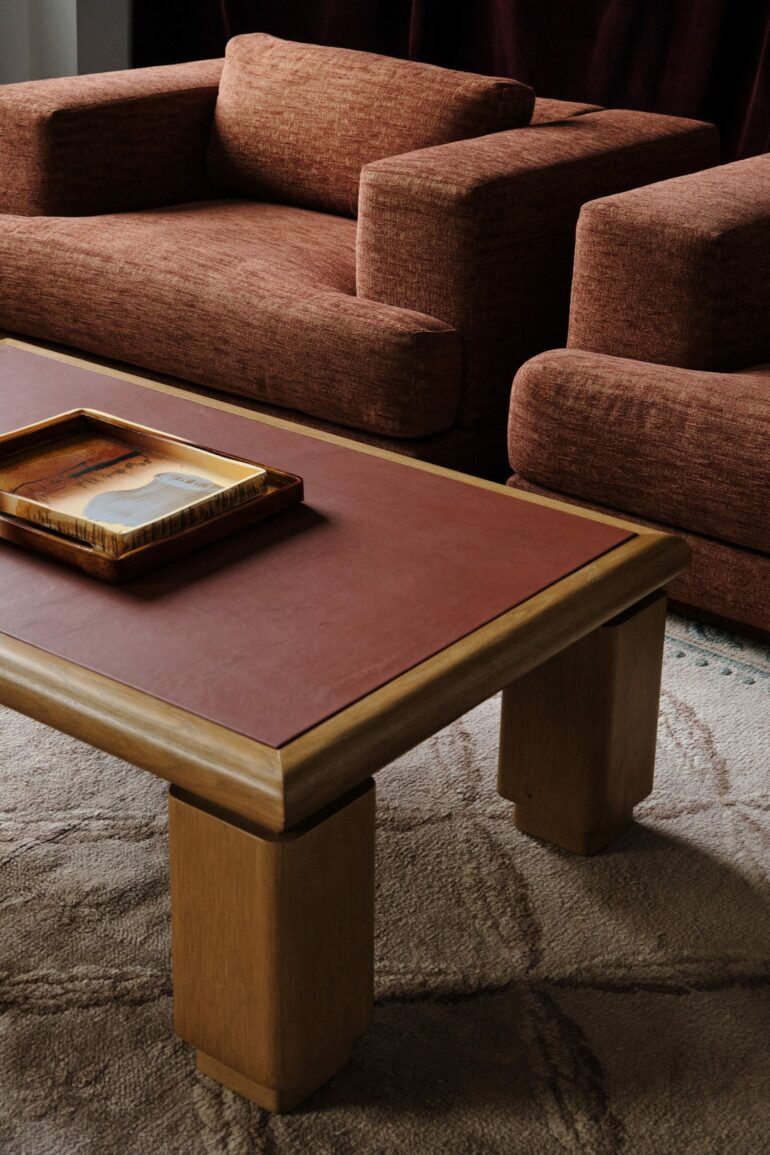
The result consists of a low-profile sofa, a lounge chair, and a swivel seat. Their silhouettes assert themselves with a beautiful confidence—almost massive—without ever feeling heavy. The collection seeks that rare balance between permanence and flexibility. The designers describe the pieces as “grounded”—anchored to the floor, almost built-in—but above all designed to be embraced and lived with on a daily basis.
This paradox is not insignificant. It has its roots in the Japanese Metabolism movement of the 1950s and 1960s, a movement that viewed the city as a living organism, capable of evolving, transforming, and expanding. While iconic projects such as the Nakagin Capsule Tower and the Shizuoka Press and Broadcasting Center served as concrete manifestations of this movement, Bosque translates its structural language to a domestic scale—one that is infinitely more intimate.
From Urban Utopia to the Intimacy of the Living Room
The designers say they sought to preserve the clarity of the original movement while freeing themselves from its rigidity. In an interview, Glenn Lawson explains that the goal was to transform this idea of permanence into a softer, more welcoming form. A key distinction: whereas Metabolism envisioned open and sometimes radical systems, Bosque adopts a more serene, eminently civilized approach.
This connection to interior architecture is also evident in the treatment of volumes. More than just pieces placed within a room, the chairs seem designed as true structural elements. The ambition is clear: to make furniture a fragment of architecture in its own right, while ensuring absolute comfort.

American craftsmanship and premium materials
Entirely manufactured in the United States, the Bosque line is available in oak or walnut, upholstered in textured fabrics or leather. This material approach, imbued with classic understated elegance, deliberately avoids ostentation. It anchors the collection in a stylistic language that is more enduring than spectacular, proving that an ambitious theoretical vision can be brought to life with precision.
In the realm of contemporary high-end furniture, this approach revives other Japanese-inspired designs, often characterized by modularity, floor-level seating, or continuous lines. As seen in &Tradition’s Isole collection or the designs by Time & Style and CondeHouse, this Japanese influence remains very much present. Bosque follows in this tradition but distinguishes itself through a perspective that is more architectural than strictly modular.
The Luxury of Restraint
While the project captivates with its obvious coherence, it does not seek to artificially overturn established conventions. The reference to Metabolism here is relevant and elegant, avoiding the pitfall of mere cultural tokenism. The true strength of this collection lies in the concrete translation of an urban vision into interior furniture. A measured ambition, to be sure, but one that lends it undeniable presence.
Rather than succumbing to the temptation of the spectacular, Bosque opts for restraint—a stylistic exercise that is often far more challenging to master. In a market readily saturated with ostentatious designs, this simplicity stands out as the very essence of understated luxury. A promise of elegance—provided, of course, that it stands the test of time as well as its concept.