
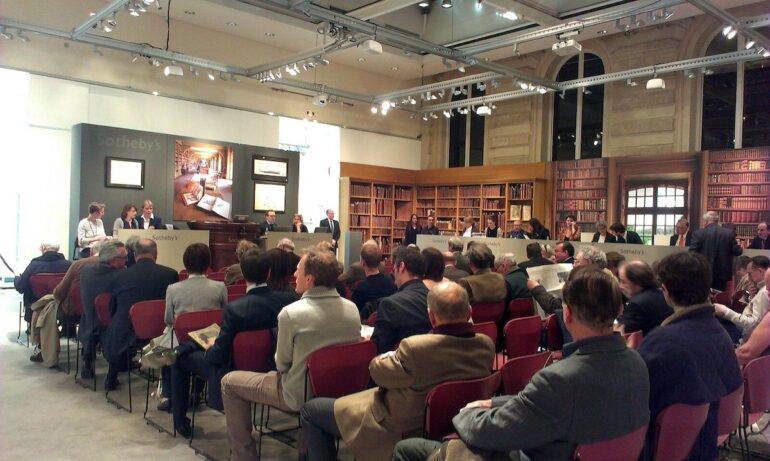
In the Italian market for auctions of valuable goods, Affide stands out as one of the leading operators. The company is the primary player in the pawnbroking sector, supervised by the Bank of Italy and operating 39 branches covering nearly the entire country. "Affide was founded with the goal of adding value to people’s valuables, which are often also cherished memories," says Andrea Rotunno, the company’s commercial director. "In this sense, we value assets that are not only economic but also emotional."
A rapidly expanding structured market
In 2025, Affide held more than 350 annual auctions, handling more than 50,000 pieces of jewelry and watches and involving approximately 20,000 buyers, with volumes exceeding 46 million euros and an average hammer price of around 1,350 euros per lot. These figures outline a structured and gradually expanding market. A sector which, as Andrea Rotunno points out, represents only part of the business: "Auctions stem partly from unredeemed financing, accounting for about 5% of the total; on the other hand, from consignment auctions, where clients themselves entrust us with their valuable items so that they can be showcased and sold under the best conditions." There is therefore still significant room for maneuver and consolidation within the business.
The transition to “phygital” and the success of digital
The sector’s evolution is also driven by a significant generational shift. People under 40 now account for 20% of buyers, reflecting a growing openness to alternative purchasing methods compared to traditional channels. "Thanks in particular to digital communication, we are reaching a younger audience that is sensitive to issues of circularity and reuse," explains the executive. It is within this context that the company has adopted the "phygital" model, which combines the full digitization of auctions—with over 10,000 registered users on the online platform —and a strong physical presence across the country, where appraisal and verification of items take place.
The adoption of online auctions is not merely a strategic choice for digital transformation; it represents a genuine evolution in the way people collect and purchase jewelry. This format has indeed made sales sessions more accessible, faster, and more appealing, attracting an increasingly broad audience and reinforcing Affide’s role as a leader in the pre-owned jewelry sector. "While the allure of jewelry is timeless, the way people buy it at Affide is evolving: online auctions demonstrate how digital technology can be a valuable tool, capable of expanding the reach of our sales and reaching new customers. It’s not just about economic value, but also an ethical and sustainable consumption model, aligned with the principles of the circular economy,” the company states. The sales director adds: "Digital technology is also a fundamental driver of transparency: the entire process is traceable and the bidding is clear, protecting both the seller and the buyer."
Technical Expertise and Opportunities in the Secondhand Market
The core of the operational model rests on the high level of technical expertise of Affide’s in-house team, composed of expert appraisers and gemologists. The appraisal process combines a rigorous scientific method with technical expertise and includes optical analyses of gemstones, mechanical inspections for timepieces, a meticulous check of manufacturer codes, and assessments of the condition of the items. "We also offer a free appraisal service, as we believe it is essential for people to be aware of the true value of the items they own," says Andrea Rotunno.
On the demand side, the auction channel presents a strategic opportunity to access vintage, iconic, or discontinued pieces, often characterized by high-quality craftsmanship. This trend is also driven by the current market context: “The rising cost of gold is weighing on contemporary production,” the manager notes, “while we offer unique items, often passed down from generation to generation, of a quality that is difficult to replicate today.” Economic conditions are generally very competitive compared to traditional retail, while the public auction system ensures transparency in price formation.
The offering also stands out for its high accessibility, with a significant portion of lots estimated at less than a thousand euros and initiatives targeting a younger audience, as was the case with last February’s “Young Sale” (Asta Young), characterized by very affordable starting prices.

Circular luxury, a popular model
More broadly, the auction sector is part of the emerging paradigm of circular luxury, where the reuse and revaluation of high-end products align with sustainability principles. Data from the Affide-BVA Doxa 2024 Report reveals that 21% of Italians choose secondhand jewelry, a figure that rises to 29% among 18- to 39-year-olds. Furthermore, 64% of consumers view these items as a form of investment. “We operate fully within a circular economy framework: we breathe new life into objects that are no longer used, making them desirable once again,” the manager continues.
Future Outlook: Themed Sales and New Categories
In terms of offerings, Affide also features fully online themed sales. "The goal is to develop more and more themed sales," explains Andrea Rotunno, "to make it easier for collectors and enthusiasts to find what they’re looking for, while highlighting specific product categories." Upcoming events include the new "Precious Promises" sale, dedicated to engagement rings and scheduled for April 30 to May 14, 2026, as well as "Designer Watches," focused on fine watchmaking, with the catalog available starting June 11 and closing on June 25. Participation in the sales is designed to be inclusive and accessible on a national and European scale, with free registration via the digital platform and the ability to submit bids until the auction closes.
In this context, Affide’s model reflects a broader evolution in the market for luxury goods, where digitization, technical expertise, and a commitment to transparency converge to attract new audiences. As for the outlook, the focus remains on strengthening the core business, coupled with an evolution of the offering. "Regarding pawnbroking, we will continue to work on improving service quality and simplifying the customer experience, particularly through technology," explains Andrea Rotunno, who does not rule out expanding into new areas. "We are considering introducing new categories of luxury goods beyond jewelry, in order to gradually expand the scope of our collateral."
At the same time, the development of auctions will continue with a focus on specialization: "The idea is to offer sales that are increasingly aligned with our identity as experts in precious goods, with themed events designed to simplify access to specific product categories. Today more than ever, jewelry represents a family asset: it is not necessarily intended to be sold, but can also be used to obtain liquidity and finance personal projects," concludes Andrea Rotunno.