
Make Texture a preferred source on Google to support us
Add Texture to GoogleAccording to several corroborating sources and industry analysts, the Geneva-based manufacturer’s decision to suspend deliveries of the iconic “Pepsi” GMT-Master II could signal a permanent halt to its production. This rumor, unsurprisingly, is fueling speculation and driving prices to new heights on the gray market.
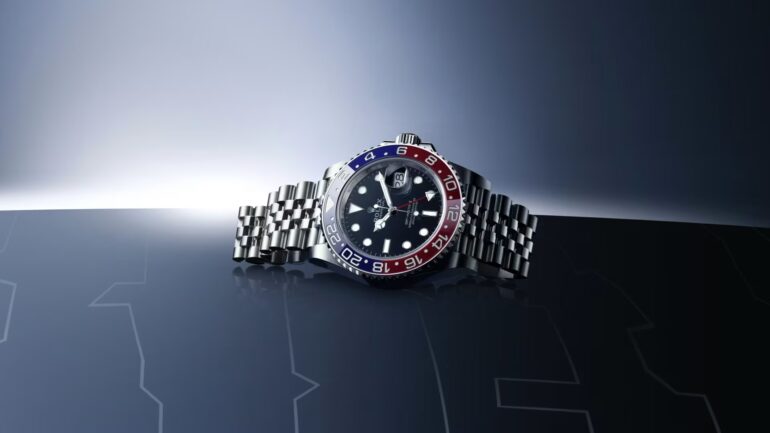
According to information reported by WatchPro, Rolex has reportedly notified some of its authorized retailers of the suspension of shipments of the steel GMT-Master II, recognizable by its two-tone red and blue bezel. More than just a temporary suspension, this announcement is interpreted by many as a harbinger of an end to production. Notably, some customers who had been on the waiting list were invited to reconsider their choice and look at other models—a move that immediately drew collectors’ attention to the secondary market.
The Discrepancy Between the Official Catalog and Reality
While the watch still appears, for now, on the official website of the brand with the crown, the reality in stores seems quite different. According to Luxury Bazaar, several authorized dealers have already removed this model from their online catalogs. This dichotomy raises a legitimate question: Is Rolex orchestrating a temporary disruption in its distribution, or is it preparing for a permanent withdrawal? This strategic ambiguity only deepens the mystery.
The impact on value is immediate. Data aggregated by EveryWatch confirms a significant increase: the median price among resellers, which stood at around 48,500 AUD at the beginning of the year, is now approaching 50,700 AUD. With a list price of around AUD 19,900, the timepiece is trading at more than two and a half times its official price. The gap is widening as supply becomes scarcer, confirming that speculation is in full swing amid insatiable demand.
Technical Challenges or Tactical Adjustment?
Several theories are being put forward to explain this shortage. The technical explanation keeps resurfacing, citing the complexity of producing the two-tone Cerachrom ceramic bezel, although the manufacturer has never confirmed these alleged difficulties. Other observers favor the theory of planned obsolescence ahead of the upcoming Watches and Wonders fair. Given that Rolex often favors evolution over revolution, the introduction of an updated version seems the most rational hypothesis.

The frenzy isn’t limited to the Pepsi version alone. Through a classic spillover effect, demand has shifted to other variations, notably the “Batgirl” (black and blue bezel on a Jubilee bracelet). The latter is seeing its price climb to just under 40,400 AUD on the secondary market—more than double its retail price. When a major model becomes unavailable, the desirability—and value—of the entire GMT ecosystem is heightened.
In this climate of uncertainty, potential buyers should exercise caution, while current owners would be well advised to hold onto their models. The consensus among analysts suggests that clarification will likely come during the April announcements, a pivotal moment when Rolex unveils its new releases. Whether it’s a technical adjustment or a strategic overhaul looking ahead to 2026, the secondary market will continue to call the shots until an official announcement is made.