
Make Texture a preferred source on Google to support us
Add Texture to GoogleThe new Royal Pop collection, born of a collaboration between Swatch and Audemars Piguet that is unexpected to say the least, invites us to rethink luxury watchmaking. Scheduled for release in May 2026, this versatile, playful, and decidedly accessible timepiece challenges the conventions of an industry often wedded to its myths, while offering a new way of experiencing time.
A Partnership Beyond Conventions
While few enthusiasts would have dared to imagine it just a few years ago, the partnership between Swatch and Audemars Piguet is now a reality. Named Royal Pop, this collection translates the iconic DNA of the Royal Oak into a pocket watch with a deliberately playful design. Although the exact release date varies across media outlets between mid-May and late May 2026, the intent behind this launch is very clear.
More than the product itself, it is its symbolic significance that captures the imagination. On the one hand, Swatch reaffirms its ability to democratize watchmaking through widespread distribution and bold design choices. On the other hand, Audemars Piguet is willing to demystify its aesthetic to bring it into a more universal realm, while preserving its iconic design elements.
The architectural icon in a travel-friendly version
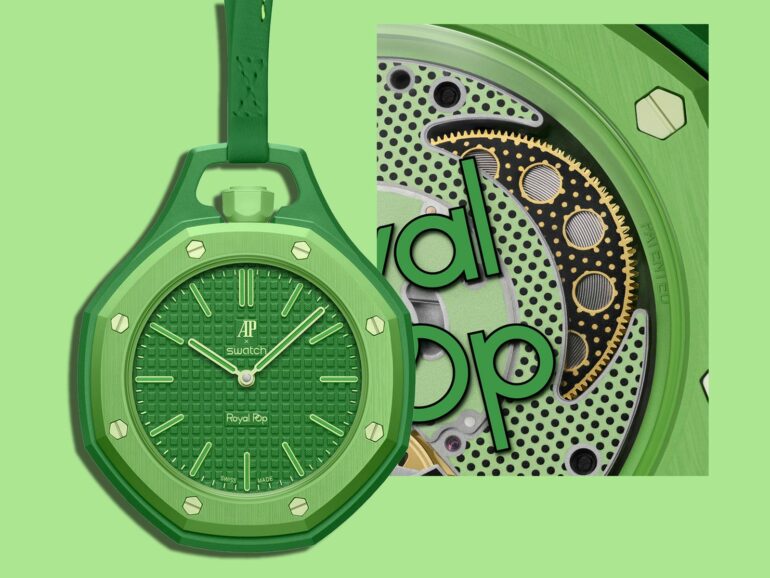
Available in eight models, the Royal Pop line embraces the octagonal silhouette, hexagonal screws, and the famous tapestry-patterned dial that have made the Royal Oak legendary since the 1970s. However, this time the timepiece breaks free from the wrist to explore new ways of wearing it.
Conceived as a contemporary pocket watch, the Royal Pop is designed to be worn however you please. Its 40-mm case, crafted from Bioceramic, comes with a clip system and a calfskin leather strap. This modularity evokes a nostalgic sense of the stylistic experiments of the 1980s.
Far from being a mere stylistic exercise, this approach marks a true cultural shift: the watch moves beyond its role as a traditional timepiece to become a versatile and highly stylish accessory.
The Pop Spirit and Bold Colors
The collection’s name sets the tone. By opting for bold hues, Swatch and Audemars Piguet place this project squarely in the tradition of Pop Art, while carefully avoiding the pitfall of caricature. The use of multilingual names further underscores the exclusive and collectible nature of these pieces.
The nod to the 1986 Swatch Pop proves particularly apt. That pioneering model already played on the concept of interchangeability. The Royal Pop reinterprets this flexibility by infusing it with the geometric precision of the Swiss manufacture. The result is a fascinating hybrid, endowed with genuine conceptual depth that proves luxury can be playful without losing any of its splendor.
The SISTEM51 Movement Reimagined
On the mechanical side, the case houses Swatch’s SISTEM51 caliber, available for this occasion in a hand-wound version. Beating at a frequency of 3 Hz and offering a power reserve of approximately 90 hours, the movement also incorporates a Nivachron hairspring—a cutting-edge technology that Audemars Piguet has mastered to perfection.

This strategic choice enables mass production at prices that defy the standards of haute horlogerie, although the issue of long-term maintenance—specific to Swatch’s gem-set movements—may arise. As a rough guide, prices on the Australian market are reportedly around $630 for the two-hand version and $670 for the small-seconds model. This pricing confirms the nature of this piece: a desirable collector’s item rather than a timepiece for purists.
The Paradox of Accessibility
To establish the legitimacy of this project, Audemars Piguet has taken care to specify that all of its profits will be reinvested in the preservation and transmission of watchmaking expertise. This welcome philanthropic dimension adds an extra layer of significance to the launch.
However, the market’s reaction remains the real unknown. Swatch’s previous forays into this type of collaboration have generated endless lines and a speculative frenzy. The Royal Pop could well suffer the same fate, illustrating the modern paradox of watchmaking: the more accessible an object is intended to be, the more its artificial scarcity fuels desire.
Ultimately, this collection serves as a full-scale test. How far can a historic watchmaker venture without eroding its prestige? And how far can Swatch stretch its successful formula? First impressions are promising, but we’ll have to wait until spring 2026 to see if these promises truly stand the test of time.