
Make Texture a preferred source on Google to support us
Add Texture to GoogleThe unexpected collaboration between Swatch and Audemars Piguet on the “Royal Pop” series has sparked a global craze. This launch is fueling the trend toward speculation and the cult of rarity in the luxury watch industry, while raising questions about the enduring prestige of the major watchmakers.
Anatomy of an Orchestrated Desire
The lines outside Swatch stores on Saturday, May 16, were a familiar sight in the contemporary luxury market: a limited-quantity launch, a carefully staged sense of scarcity, and the almost instantaneous emergence of a secondary market where prices skyrocket. With the “Royal Pop” series—the result of this bold collaboration—the Swiss brand has created a decidedly hybrid object, straddling the line between a collector’s timepiece and a highly desirable fashion accessory. In stores, the listed price ranged from 350 to 400 CHF depending on the model. On online platforms, bidding was already heating up, easily reaching the 800 to 2,000 CHF mark—and even higher.
This palpable tension is not merely anecdotal. It reflects a profound shift in the watchmaking landscape, where the watch has broken free from its primary function to become a status symbol, and then a volatile financial asset. And very often, a complex fusion of these three dimensions.
The Secondary Market: Speculative Fever
According to data from Chrono24, demand for these pieces has literally exploded as soon as they hit the market. This is a trend the platform consistently observes whenever a prestigious institution lends its cultural prestige to a drastically limited production run. While Swatch had already tested this formula with the MoonSwatch in 2022, the phenomenon has taken on a new scale here by targeting Audemars Piguet, a manufacturer historically rooted in the most exclusive segment of haute horlogerie.
The equation is simple—and purely speculative: buy early, resell immediately, and secure an instant profit. This is the prime hunting ground for “flippers”—resellers who treat time like a stock market asset. A trend that digitalization has amplified tenfold, making global price benchmarking and lightning-fast transactions possible.
However, the secondary market does not thrive solely on these fleeting frenzies. Tom Beitschall, Head of Europe at Chrono24, rightly points out that the majority of collectors purchase a watch to wear on their wrist, not to speculate. The hype surrounding new releases remains a niche phenomenon—loud, certainly, but limited in scope.
The Paradox of Rarity and Prestige
The Swatch Group has mastered the art of building anticipation to perfection. According to reports in the international press, the “Royal Pop” watch’s unavailability online and its release in dribs and drabs acted as a powerful catalyst. From Paris to New York, via Milan and London, the fervor in front of store windows has at times turned into a stampede, occasionally forcing preventive closures or the intervention of law enforcement.
For Audemars Piguet, the balancing act is more perilous. Wulf Schuetz, a Zurich-based expert, believes that while Swatch can get away with playing the “limited availability” card, a luxury watchmaker risks its credibility. The dilution of scarcity directly threatens prestige; an icon that has become too familiar sees its desirability erode. Preserving exclusivity remains the cornerstone of Audemars Piguet’s identity.
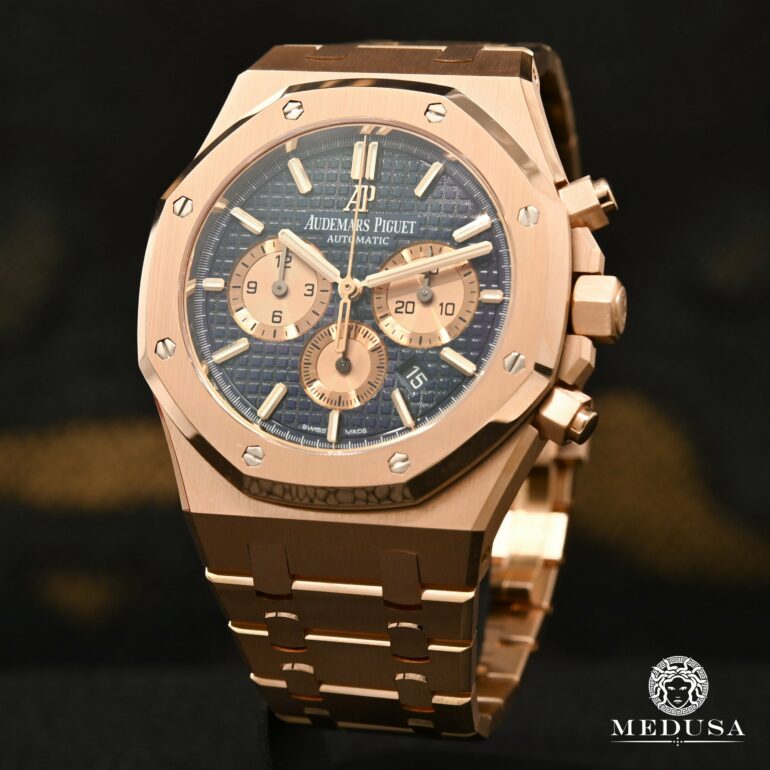
The history of luxury teaches us this: ubiquity is often the precursor to disaffection. The Royal Oak, the brand’s ultimate icon, rests on a reputation that is as immediate as it is exclusive. The “Royal Pop” playsfully embraces this heritage, teetering on the edge of irreverence without ever desecrating it.

The timepiece: from a tangible asset to an object of passion
Purists are quick to point out that investing in watchmaking is a complex art. Unlike traditional financial products, a watch generates no dividends. Its value depends on a fragile ecosystem, influenced by its condition, its traceability (the famous “box-papers-warranty” trio), market liquidity, the prestige of the dial, and the inevitable volatility of trends.
While iconic stainless-steel sports watches from Rolex, Patek Philippe, or Audemars Piguet dominate the market with values that have become virtually absolute benchmarks, niche pieces or those with grand complications require more patience to find a buyer. In an uncertain economic climate marked by inflation, the watch stands out as a reassuring safe haven: a tangible, aesthetically pleasing asset that is infinitely more liquid than a masterpiece painting.
However, wear and tear follow their own rules. A watch worn daily, without the rigorous maintenance required by its intricate mechanics, sees its value plummet. Conversely, being left completely untouched in a safe is not an end in itself. Even when viewed through the lens of investment, a watch must remain an object of passion. True luxury lies in this privilege: even if the market shifts, a cherished work of art remains on one’s wrist.
The meteoric rise of “Royal Pop” ultimately hinges on a striking aesthetic, hyper-localized distribution, a legendary signature, and carefully managed virality. But the watch market remains a stage for unpredictable fluctuations, marked by sudden obsessions and unexpected revivals. This is precisely what makes it one of the most fascinating sectors of contemporary luxury today.