
Make Texture a preferred source on Google to support us
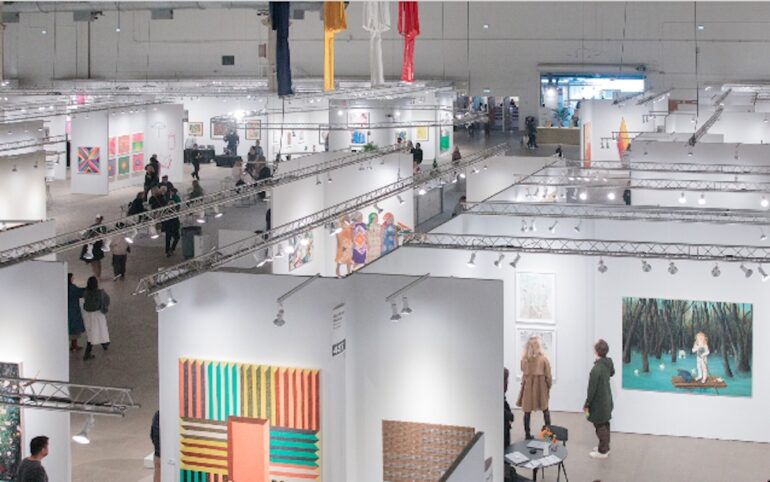
Add Texture to GoogleThe 2026 edition of EXPO CHICAGO showcases an unprecedented level of geographic and cultural diversity. Throughout its halls, the fair emphasizes the importance of memory, resilience, and identity in contemporary creation, while questioning the accessibility standards of these major art events.
An open-minded artistic landscape
At EXPO CHICAGO 2026, diversity goes beyond mere lip service to become a tangible reality on the exhibition stands. F Newsmagazine notably highlights the striking presence of artists from South Korea, Japan, Mexico, and other regions. This openness contrasts with a recurring trend at major fairs, which often tend to favor Europe at the expense of a true plurality of the contemporary art scene.
This is precisely where the fair derives its relevance: by rejecting the mimicry of a single center to reflect the shifting geography of today’s art. Chicago lends itself perfectly to this. A city of transit, commerce, and major collections, it offers a setting where narratives circulate as freely as the artworks.
Mitochondria Gallery: Echoes of the Diaspora
Among the spaces that caught our attention, the Houston-based Mitochondria Gallery stands out. Far from being a mere exhibition space, the gallery asserts itself as an international platform dedicated to African artists and their diaspora. A mission that comes into its own through a thoughtfully curated exhibition.
The exhibition highlights the distinct approaches of two Nigerian artists: Chika Idu and Ejiro Fenegal. Idu’s work explores the notions of movement, transition, and the future. Her canvases from the "Swimmers" series, depicting young Black children moving through water, create an image that is both poetic and powerful, where the act of crossing becomes a metaphor for heritage.
For his part, Fenegal sculpts works inspired by traditional Nigerian hairstyles and real-life figures. His pieces in reconstituted marble celebrate the strength, leadership, and resilience of African women. The result skillfully avoids the coldness that often lurks in sculptural realism, infusing it with genuine vitality.
Material in the Service of Memory
Recent projects by the Mitochondria Gallery shed light on the themes of these works. With "Tracing the River Back," the gallery approaches the home as a shifting space, intimately linked to memory, migration, and identity. This conception of a place in perpetual flux resonates deeply with the creations of Idu and Fenegal, who weave a sensitive link between the intimate and the collective experience.
At the same time, “Place of Repose III” explores the cultural significance of rest. Here, the motif moves beyond the purely decorative to evoke living conditions, sanctuaries, and new ways of inhabiting the world.
The fair keenly demonstrates that technical mastery has value only if it is imbued with memory. Virtuosity for its own sake impresses for a moment, before eventually running out of steam.

The singular fragility of the intimate
The autobiographical lens also runs through the work of Maya Fuji, presented by the Charlie James Gallery. Each canvas seems to capture a specific moment in the artist’s daily life: waking up, a scene shared with her sister, a bike ride. Her narrative approach, infused with the aesthetics of anime and manga, creates a welcome distance while preserving the subject’s evident fragility.
Often depicting herself nude, Fuji imbues her canvases with an almost disarming candor. At a time when artificial intelligence tends to smooth over and standardize the imagination, this act of self-revelation reminds us that art remains a matter of singularity, biography, and personal risk-taking.
Accessibility: The Other Challenge of Excellence
The picture for this edition is nevertheless somewhat nuanced. The visit can prove taxing, particularly for people with disabilities. The distances to be covered are vast, and rest areas are often lacking. While wheelchairs are available, their availability is not always guaranteed.
This issue is fundamental. The scope of an international art fair is not measured solely by the quality of the works on display, but also by its ability to welcome all audiences under optimal conditions. If art celebrates life, the infrastructure must do the same through its hospitality.
Ultimately, EXPO CHICAGO 2026 stands out as a solid and inspiring edition. By placing artists at the heart of its program and embracing a resolutely diverse perspective, it distinguishes itself from many similar events. In an art market sometimes threatened by superficiality, this event reminds us that a compelling work of art lies not only in its aesthetics, but in its ability to convey a story and a vibrant human presence.