
Make Texture a preferred source on Google to support us
Add Texture to GoogleThis major museum project in Multan aims to tell the city’s fascinating history through an immersive journey. By combining meticulous reconstructions, theatrical set designs, and exceptional craftsmanship, the institution promises to showcase the cultural and commercial heritage of a city with many layers.
A scenography conceived as a living narrative
In Multan, the building of tomorrow transcends a simple collection of display cases. According to The Nation and the Associated Press of Pakistan, the project sketches an authentic timeline, weaving intimate connections between archaeology, commerce, art, and the history of conflict. Far from the classic antiquities museum, the goal is to orchestrate a true sensory experience, inviting visitors to journey through the ages rather than merely glancing at them.
The very architecture of the site is intended to be a poetic and vibrant interpretation of Multan, capturing its essence—a blend of spirituality, trade, and heritage. This ambition finds a majestic echo in a city recognized as one of the oldest settlements in South Asia, further legitimizing the creation of this new showcase.
The art of immersion: dioramas and vestiges of daily life
According to The Nation, the exhibition promises to captivate visitors with the precision of its dioramas. Upon entering, a three-dimensional war scene featuring cavalry, soldiers, and traditional weaponry will offer a striking glimpse into the region’s historical struggles. Other spaces will subtly evoke the atmosphere of ancient markets and the poetry of everyday life across the ages.
This curatorial approach seeks to bring history to life with impeccable accuracy. The artistic directors and archaeologists in charge of the interior design have opted for rigorous realism, ensuring absolute authenticity so as never to betray the complexity of the original narratives with overly simplistic staging.
Strategic Crossroads and a Tribute to Craftsmanship
The future museum will evoke the strategic significance of Multan, an epicenter of trade and spirituality. An exceptional numismatic gallery will showcase rare coins from prestigious dynasties, highlighting the economic power of a city where the flow of wealth shaped the contours of urban power—an aspect sometimes overshadowed by its religious or military history.
The institution will also highlight artistic craftsmanship, the true soul of the region. The famous Kashikari, a ceramic with its characteristic blue hues, will be celebrated alongside regional arts and crafts. The city, shaped by its successive historical layers, thus reveals itself as the sanctuary of an ancestral craft whose elegance endures to this day.
Vernacular architecture for a legacy in the making
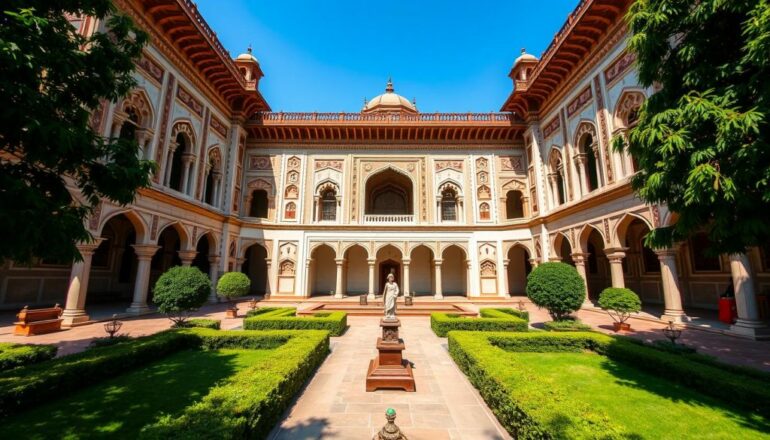
With a budget exceeding 111 million Pakistani rupees, the project celebrates local Islamic architecture. The design evokes the majesty of a grand dome, punctuated by delicate cupolas and a red-brick façade adorned with traditional motifs. The space will be organized around four major galleries dedicated to archaeology, war, Islamic art, and the arts and crafts, complemented by an archaeological research laboratory, a café, and spacious outdoor areas.
Babar Baig, quoted in the local press, notes that the meticulous work of labeling the artifacts is still in its early stages. For his part, Muhammad Hassan expects the work to be completed by the first half of May 2026. This opening will mark the advent of an unmissable cultural landmark, eagerly awaited by residents and visiting art lovers alike.
Authenticity Beyond Folklore
The approach is fully in line with the principles of contemporary museography: enhancing the narrative of a region while highlighting the physicality of the object. While LBF’s virtual museum dedicated to Multan demonstrates that digital technology enriches the transmission of knowledge, nothing compares to the physical emotion evoked by the texture of a glazed ceramic or the roughness of an ancient stone.
The mission of this new cultural temple is to harmoniously weave together sanctity, commercial epic, conflicts, and artisanal refinement. The success of this endeavor will lie in its ability to honor this aesthetic diversity, while avoiding any excessive formality that might alter the purity of local memory.