
Make Texture a preferred source on Google to support us
Add Texture to GoogleSet to open in 2026 in Los Angeles, the Lucas Museum of Narrative Art stands out as an innovative space that blends classical art, popular culture, and visual storytelling, in an ambitious project designed by architect Ma Yansong.
An architectural and landscape masterpiece
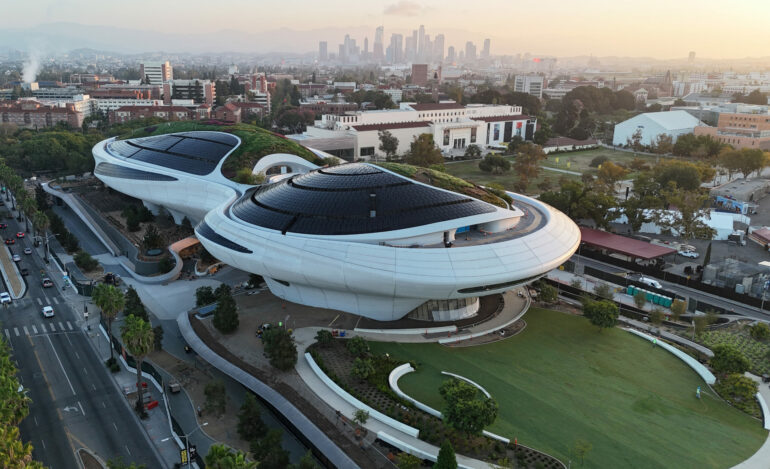
It is in the heart of Exposition Park, in Los Angeles, that the Lucas Museum of Narrative Art will unveil its spaces on September 22, 2026. Founded by George Lucas and Mellody Hobson, the project centers on a monumental building spanning nearly 30,000 square meters, designed by Ma Yansong of MAD Architects in collaboration with Stantec. Far from being merely a sculptural feat, the institution is set within a vast, lush campus spanning over four hectares, designed by landscape architect Mia Lehrer of Studio-MLA.
The museum has a clear ambition: to establish the image as a universal language, from the dawn of art history to the cinematic era. A meaningful endeavor in a metropolis that has mastered the art of forging its own mythologies. In Los Angeles, narrative art refuses to be confined within four walls; it radiates from screens, facades, and the collective memory.
Exhibition Design in the Service of Narrative
With over 40,000 works, the permanent collection will be unveiled through an initial selection of 1,200 pieces. These will be distributed across some thirty galleries spanning more than 9,000 square meters of exhibition space. The exhibition will explore universal themes ranging from love to family, from work to adventure, without overlooking childhood, the concept of community, or sports.
This thematic structure gives the visit an almost literary quality. The institution’s goal is to illustrate how visual narratives have shaped our societies, from ancient sculptures to comic books, from Renaissance painting to cinema. The collection will thus bring together illustrious names such as Norman Rockwell, Frida Kahlo, N.C. Wyeth, Maxfield Parrish, Robert Crumb, Frank Frazetta, and Jack Kirby.
The Elevation of Popular Arts
The future museum will naturally devote extensive spaces to cinema, showcasing costumes, props, and sketches from, among others, the Lucas archives. At the same time, entire sections will highlight comics, manga, mural art, and documentary photography. This diversity reflects an era in which cultural prestige has broken free from traditional constraints.
The spotlight on socially engaged artists such as Judy Baca, Diego Rivera, and Carrie Mae Weems also underscores the political, civic, and social significance of the image. The museum aims to bridge popular culture and art history by dismantling traditional hierarchies. It remains to be seen whether this dialogue between genres will unfold with the promised subtlety, thereby avoiding the pitfall of mere proliferation.

Californian Resonances
The opening of the Lucas Museum is part of a particularly intense local artistic buzz. Take, for example, the Venice Family Clinic Art Exhibition and Auction, which this year brings together more than 150 major artists such as Ed Ruscha, Helen Pashgian, Kenny Scharf, and Frances Stark. This charity event helps fund healthcare access for more than 45,000 Californians, particularly in the Inglewood and South Bay neighborhoods.
At the same time, Julien’s Auctions is hosting the “Roberta Flack: Style, Art & Music” auction to benefit the singer’s foundation. Among the treasures up for auction are a Bösendorfer piano, designer jewelry, stage outfits, and valuable documents related to the civil rights movement. This buzz proves that art, legacy, and solidarity remain inseparable on the West Coast.
A curatorial challenge in the city of mirages
The Lucas Museum is thus taking root in a city saturated with images and imagination. Its true challenge lies in its ability to transform this profusion into a coherent narrative with a decidedly educational purpose. A noble ambition that comes with its share of risks: the desire for exhaustiveness could sometimes smooth over the nuances that are the very essence of these exceptional collections.
If the institution delivers on its promises, it could establish itself as the legitimate sanctuary of popular art history. If not, by limiting itself to exhibiting a few mainstream icons, the project would run the risk of being nothing more than yet another lavish backdrop in the world capital of entertainment.