
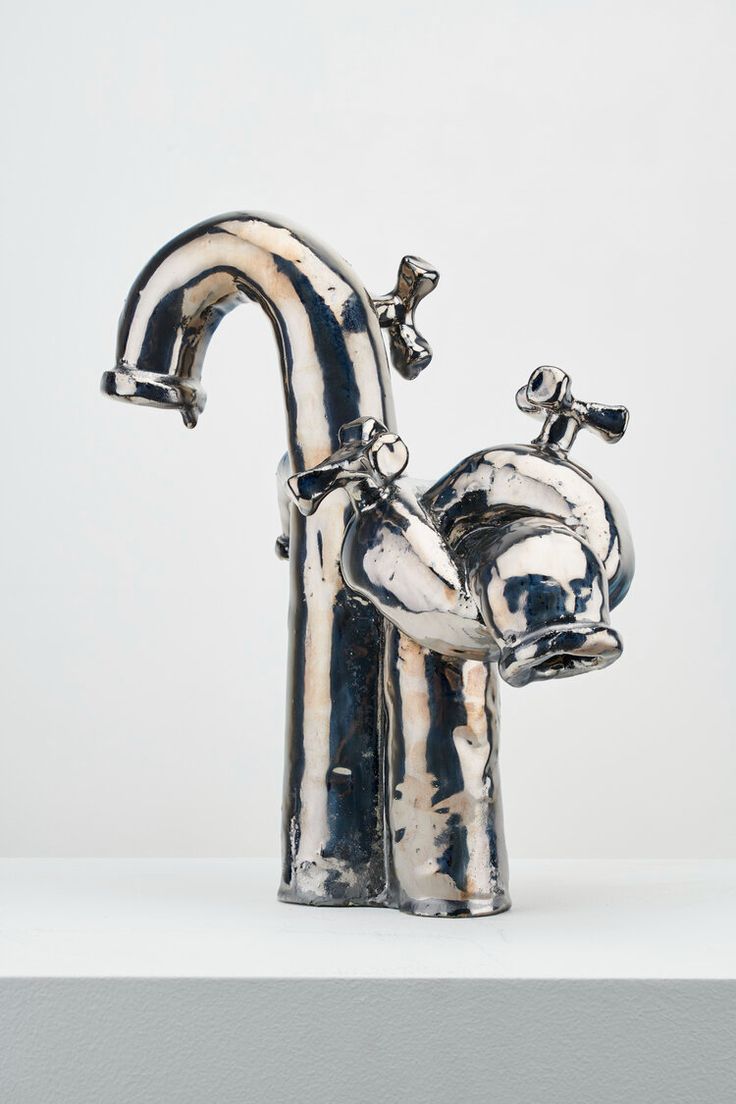
American artist Woody De Othello, a master at breathing life into the most mundane objects, is now making a majestic mark in museums and at international art fairs. Through his expressive sculptures, he boldly redefines the place of the trivial within institutional spaces, transforming the everyday into a true aesthetic experience.
The Recognition of an Intimate Vocabulary
Woody De Othello’s name now resonates far beyond the circles of connoisseurs. As the American press has noted, prestigious institutions are successively incorporating his works into their collections, proving that a visual language long associated with the private sphere is now breaking into the halls of major museums. The Metropolitan Museum of Art is thus exhibiting *Tools* (2022) for the first time. This unique work features a headless figure sitting cross-legged on a massive, asymmetrical bronze ladder about a dozen meters long. Resting on its rungs are various familiar objects: a remote control, a coffee cup, a pocket mirror, shoes, a retro phone, and gardening tools. By exaggerating the proportions of each component, the artist imbues them with an almost anthropomorphic expressiveness, greatly amplifying the emotional impact of these household artifacts. Meanwhile, the Hirshhorn Museum and Sculpture Garden is set to unveil, in its redesigned gardens, a monumental lime-green sculpture over two meters tall depicting a fan.
This meteoric rise in the art world confirms the scope of Othello’s artistic approach: beyond creating unconventional objects, he builds a complex vocabulary around domestic memory, spirituality, and the emotional weight hidden within the mundane. His work transforms the trivial into a true mental architecture.
The Sculptural Grammar of Everyday Life
At Art Basel, the artist unveiled his largest installation to date in the Unlimited section. Titled *Two sides that hold truth*, this piece stands as a deep blue wall pierced with niches, housing more than fifty motifs in ceramic, wood, stone, and glass. Phones, mirrors, fans, and vases compose a series of miniature scenes. Woody De Othello conceives this work as a contemporary altar. Far from being merely decorative, this arrangement establishes a silent dialogue between the viewer, the object being contemplated, and the surrounding space. Brendan Dugan, founder of the Karma Gallery, emphasizes that using architecture as a pedestal transforms the perception of both the artwork and the art market. By changing the scale, the entire framework for interpreting his work is reinvented.

Space as a Sensory Sanctuary
This exhibition design echoes *Coming forth by day*, an immersive exhibition presented at the Pérez Art Museum Miami. Curator Jennifer Inacio conceived an initiatory journey beginning with a hallway designed as a room in a family home, where the works seem to have stepped straight out of an interior steeped in memories. The journey continues through majestic rooms where Woody De Othello creates a dialogue between monumental sculptures, walls covered in ceramic tiles, herbal scents, and sound installations. This installation, described by Wallpaper magazine as a true guided meditation, engages the entire body. The integration of scent and sound highlights the sensory dimension of the artistic experience, offering a vibrant alternative to mere visual contemplation.
A Psychological Resonance of Forms
Born in Miami to Haitian parents, De Othello draws on his roots and masterfully works with ceramics, bronze, and wood to infuse everyday objects with an almost organic presence. Under his hands, objects transcend their status as mere accessories to become vessels for emotions, memories, and psychological tensions. It is therefore no coincidence that the Met chose to place his creations in dialogue with those of modernism’s leading figures, such as Picasso and Matisse, in an exhibition dedicated to 20th-century portraiture. His forms are now interpreted by institutions as indirect portraits, tangible imprints of human experience.
The conclusion is clear: Woody De Othello is no longer merely a creator of objects; he has established himself as an artist of space, attention, and the threshold. Behind the apparent modesty of his subjects lies a formidable ambition, proving that the most discreet forms are often the ones that ultimately take center stage.