
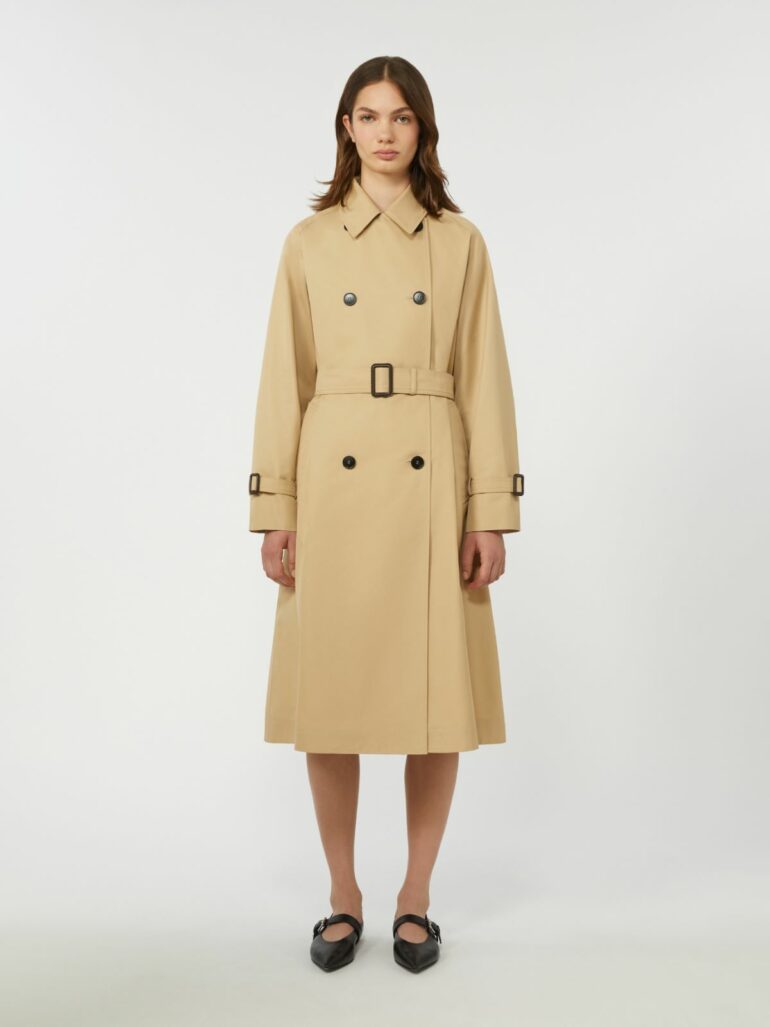
The trench coat, a symbol of practicality and timeless elegance, continues to captivate with its modern variations while remaining true to its technical and historical roots. A signature piece that embodies, season after season, the perfect balance between tradition and innovation.
The trench coat belongs to that category of garments that have managed to retain their purpose, come rain or shine. Created to withstand the rain, inspired by the demands of the military and, above all, by the need for protection without restricting movement, it has never truly strayed from this primary function. Its success rests on a foolproof formula: a precise cut, a reliable fabric, and a structure sturdy enough to weather the seasons without losing its elegance. In a well-curated wardrobe, the trench coat is no mere supporting actor. Quite the contrary—it orchestrates all the other pieces around it.
The Aesthetics of Function
Its stylistic vocabulary is, above all, one of utility: a belt, shoulder tabs, storm flaps, and a protective collar. These details are not mere ornamentation but serve a specific function. They have stood the test of time because they consistently meet a practical need that still resonates today. Brands that excel in this field do not simply offer a silhouette; they cultivate a true discipline of garment-making, where the line, the drape, and durability take precedence over mere aesthetic artifice.
A good trench coat should never appear fragile, nor should it be too fitted or too short. It must allow for a thick sweater to be worn underneath and drape with poise, while offering formidable protection without weighing down the wearer’s stride. It is in this subtlety that the great designers distinguish themselves.
Burberry: Guardian of the Original Code
For Burberry, the trench coat has remained the nerve center of its creative universe since its founding. The British house claims to have invented gabardine in 1879, a tightly woven cotton fabric designed to breathe while repelling the elements. This material not only gave the trench coat its technical credentials but also shaped its iconic silhouette. The Heritage Kensington, Chelsea, and Waterloo models revisit this original aesthetic through variations in cut, ranging from clean, structured lines to more fluid silhouettes.
The Kensington features a classic, assertive structure. The Chelsea, on the other hand, refines and cinches the silhouette. The more generous Waterloo proves ideal for layering. Burberry thus reaffirms its position as a leader: that of a house that does not merely capitalize on a symbol, but maintains the technical integrity of its icon.
Mackintosh and Aquascutum: British Precision
Mackintosh and Aquascutum offer a completely different take on the trench coat—one that is decidedly more understated, discreet, and even delicately austere. Mackintosh prioritizes precision and minimalism, with clean lines and a focus purely on weather protection. Aquascutum, founded in the 19th century, built its legend on the absolute waterproofness of its fabrics, long before rainwear made its way onto the runways. Today, their designs appeal to those seeking an authentic historical connection, even if it sometimes takes a more discerning eye to unearth their masterpieces.
What these brands rightly remind us is that the trench coat is not merely a product of marketing allure, but a shield designed to withstand the harshness of the elements.

Contemporary Interpretations: Prada and Ralph Lauren
Ralph Lauren and Prada each offer a unique take on this classic. At Ralph Lauren, the trench coat transforms into a masterfully staged piece—more cinematic than utilitarian—tailored for high-society chic rather than the trenches. The approach is successful because it retains that essential restraint that avoids the pitfall of a literal, costume-like interpretation. At Prada, the philosophy differs radically. The Milanese house envisions the trench coat as a canvas for modern expression—often highly technical, deliberately minimalist—blending radical lines with deeply urban materials.
This contrast in approaches illustrates a fundamental truth about luxury fashion: far from being at odds, Burberry’s attachment to its historical roots and Prada’s avant-garde vision prove that the trench coat is a blank canvas capable of embracing multiple cultures and aesthetics.
The Art of Investment: Choosing Your Piece
When purchasing a trench coat, prioritize nuance and proportions over the brand label. Neutral tones—honey, sand, khaki, navy, or black—remain safe investments. A mid-calf or just-below-the-knee length not only ensures optimal protection but also exudes a timeless elegance that will stand the test of time. The shoulders should maintain a clean line, without veering into formal stiffness or excessive nonchalance. Finally, the fabric takes precedence: genuine cotton gabardine remains the gold standard for striking the perfect balance between structure and flexibility.
If the search were to be boiled down to a single piece, Burberry remains the most comprehensive option. To face the rain with absolute purism, Mackintosh is the obvious choice. Aquascutum will appeal to purists seeking a rich heritage, while Ralph Lauren will satisfy the desire for a highly narrative aesthetic. Finally, Prada will appeal to those who demand a bold, architectural modernity.
The trench coat endures precisely because it does not seek to disguise its nature. It protects, it shapes, it stands the test of time. The very essence of timeless luxury.