
Make Texture a preferred source on Google to support us
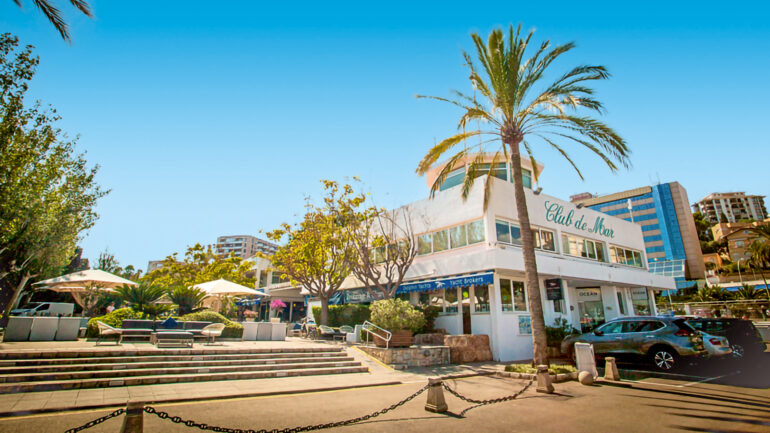
Add Texture to GoogleThe Club de Mar-Mallorca, a symbol of luxury yachting since 1972, underwent a complete renovation between 2020 and 2025. Blending modernity with tradition, this transformation strikes a subtle balance between maritime elegance and Mediterranean hospitality.
An Architectural Renaissance Overlooking the Bay
In Palma, the Club de Mar-Mallorca has long been the discreet showcase of exceptional yachting. Founded in 1972 and officially inaugurated four years later, it has hosted the yachts of historical figures and Hollywood stars, from Queen Elizabeth II to Richard Burton and Elizabeth Taylor. While the extensive renovation completed around 2025 has reshaped its contours, this sophisticated aura remains intact. Today, it is reinterpreted through a more refined, architectural, and decidedly tactile stylistic language.
The project has profoundly transformed the character of this Balearic institution. Four interconnected buildings now house two restaurants, a private members-only lounge, and a spa. Outside, the club is adorned with spectacular landscaping, highlighted by a 300-square-meter vertical garden. The complex evokes a miniature harbor where contemporary forms seem to have been arranged with mathematical precision; an aesthetic that is initially surprising but quickly reveals perfect harmony.
Nautical Elegance According to Marta de la Rica
The interior design was entrusted to Marta de la Rica. Far from limiting herself to a mere accumulation of thematic accessories, the Madrid-based designer—who has led her studio since 2014—sought to weave a genuine coherence between colors, materials, and geometric forms, avoiding the trap of literal nautical symbolism.
The result brilliantly avoids the cliché of overly polished nautical luxury. The lacquered surfaces evoke, in subtle touches, the brilliance of the legendary Riva motorboats, while teak and sycamore wood create the hushed atmosphere of a luxurious cabin. The palette, vibrant with red, blue, and yellow, draws from the International Code of Signals—the universal chromatic language of sailors. Elegant stripes, upholstered benches, and custom details structure the space with a sophistication that reimagines the genre’s conventions.
The Weight of Memory, the Art of Contrast
To enhance these new spaces, the club has reopened its own archives. Model sailboats, antique barometers, anchors, and diving helmets are incorporated into a display that lends historical depth to the space. For Marta de la Rica, incorporating these time-worn objects is a way to breathe extra soul into immaculate architecture. This is a valuable approach in a world where high-end design often succumbs to the temptation of the brand-new.
This philosophy is a natural extension of her previous projects, in which the designer excels at creating a dialogue between antiques, works of art, and custom-made furniture. A signature style already proven with major collectors, such as during the restoration of a 16th-century residence for Countess Pino Gil de Biedma, or for the Cristine Bedfor, her first hotel project in Málaga.
The Quest for Warm Modernity
Funded by the members themselves to the tune of 82 million euros, this colossal transformation reflects a clear vision championed by its president, Borja de la Rosa Maura: to reposition the club among the Mediterranean’s most must-visit destinations. The architectural challenge was bold, requiring the apparent coldness of concrete, glass, and aluminum to be combined with an intimate, almost domestic atmosphere.

It is precisely this tension that gives the project its strength. While the building’s contemporary grandeur commands respect, the interior design works to soften its edges. A lesson in the Mediterranean art of living: in Mallorca, a land of sumptuous villas and secluded harbors, true prestige rejects austerity in favor of a higher form of conviviality.
A lookout facing the horizon
Marta de la Rica’s personal roots also shed light on this vision. Although she admits to sailing rarely, the designer draws on her memories of summers in Mallorca, when she would sail along Cape Formentor with her grandfather. This island memory acts as an intangible thread, infusing the space with nuances linked to the horizon, light, and mineral textures. Nothing is literally autobiographical; rather, it is a poetic inspiration that guides her spatial design.
Today, the designer showcases her talent to a discerning clientele stretching from Menorca to Manila. Through The Lab, her studio’s experimental offshoot, she recently unveiled “Of Marble and Metal,” her first furniture collection, as well as a line of summer tableware. And while her upcoming creative projects are expected to explore working with wool, her project in Palma is already establishing itself as a major work.
For at the Club de Mar-Mallorca, it is the experience of the moment that takes precedence. From the upper terrace, the view takes in the Bay of Palma, the rooftops of the old town, and the majesty of the cathedral. This is where the timeless magic of great yacht clubs lies: offering, from the very heart of its home port, the eternal illusion of a grand departure.