
Make Texture a preferred source on Google to support us
Add Texture to GoogleTwenty years after the first generation, Omega unveils a fourth edition of its iconic Planet Ocean collection, combining modernity, lightness, and technical advancements to carry on its maritime heritage while breaking new ground.
Here it is: twenty years after launching the first Planet Ocean, Omega presents an all-new fourth generation, marking a truly remarkable evolution for this iconic collection of dive watches. The brand claims to have completely reimagined its design language, featuring a more streamlined architecture, a slimmer profile, and significant technical advancements. All of this while preserving the bold and technical spirit that defines the Planet Ocean—a watch deeply rooted in the Swiss watchmaker’s maritime heritage.
A legacy deeply rooted in the history of diving
The Planet Ocean collection draws its roots from Omega’s rich history of diving watches. From the Marine, launched in 1932—which was the very first watch designed specifically for civilian divers—yes, that’s historic, all the way to the 1957 Seamaster 300, which was designed for professionals, Omega has established itself as a major player in this field. The Planet Ocean, introduced in 2005, marks a very significant milestone in this tradition, with water resistance extended to 600 meters—nearly double that of the Seamaster Diver 300M—while featuring a design that pays homage to the past: black dials, bold Arabic numerals, arrow-shaped hands, and a practical diving bezel—all elements that evoke the spirit of the original Seamasters.
More than twenty years of continuous innovation
Since its inception, the Planet Ocean has been the scene of several interesting technical innovations. In 2009, Omega introduced the Liquidmetal bezel, a material that combines aesthetics with scratch resistance—a true feat in materials science. Next came ceramic bezels, followed by the Caliber 8500 with a Si14 silicon balance spring, which offers greater resistance to magnetism. In 2014, Omega succeeded in creating the first bezel made of genuine orange ceramic—a major challenge for the watchmaking industry. Entering the Master Chronometer era in 2016, Omega also refined its cases, introduced 18K Sedna™ gold, and created bezel rings combining ceramic and rubber. And then there was the Deep Black collection, which uses a specialized ceramic for optimal resistance at depth—you know, to go even further. More recently, the Ultra Deep, designed for a record-breaking dive into the Mariana Trench—at a depth of over 10,900 meters—pushed the limits to the extreme, and the collection was expanded in 2022 with a special steel alloy, O-MEGASTEEL.
A redesign that makes all the difference: slimmer, more modern
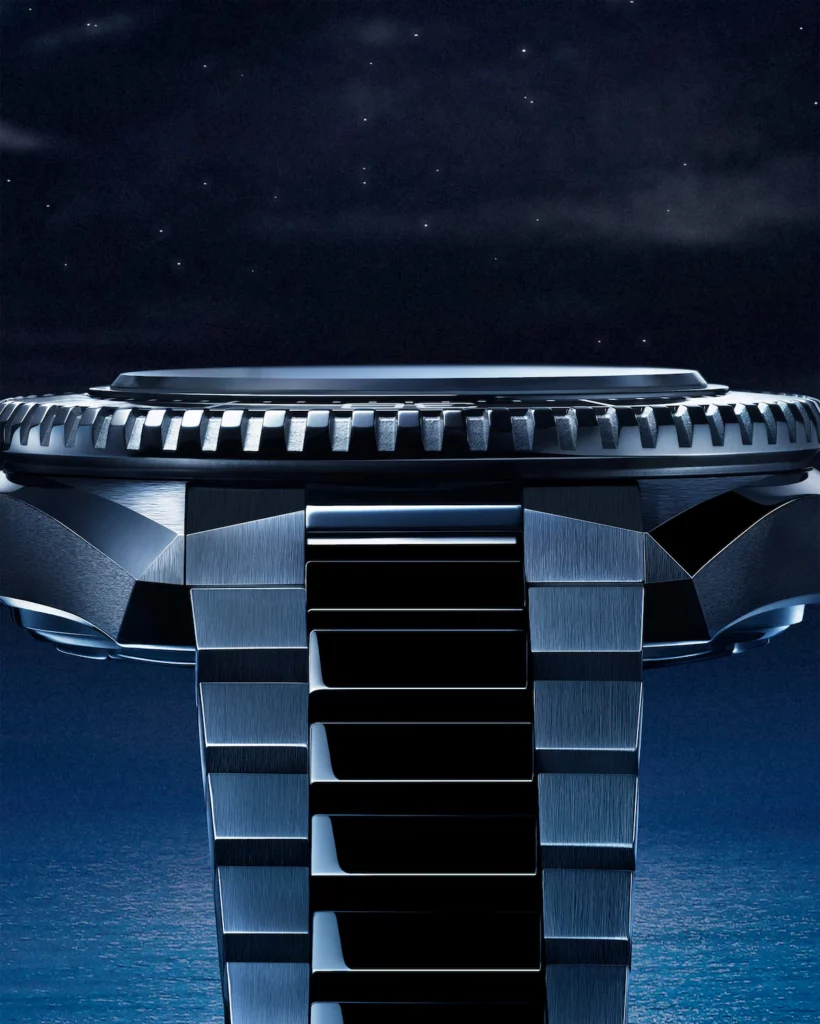
With this fourth generation, Omega has radically changed its visual style. The new case, composed of two main parts—a sculpted body and an inner titanium ring—features a sleeker, cleaner silhouette. By removing the traditional helium escape valve—once an iconic feature—the watch has a very clean, minimalist look. The diameter remains at 42 mm, but the case is thinner: it has been reduced from 16.1 mm to just 13.79 mm. The flat sapphire crystal and titanium caseback further lighten the watch while enhancing its durability. The caseback also features an engraved design with the famous Omega seahorse, a symbol of a long maritime tradition.
This new case is paired with a redesigned bracelet that integrates seamlessly with the watch’s structure. The alternating brushed and polished surfaces on the flat links, combined with slender proportions, contribute to enhanced comfort, along with a six-position micro-adjustable system and an extension for diving in a wetsuit. Those who prefer a slightly less classic style can also opt for a rubber strap with a folding clasp—practical and sporty. All versions feature a matte black dial, paired with arrow-shaped hands and hour markers filled with Super-LumiNova for excellent visibility underwater. The Arabic numerals have also been reimagined: they are more open, square, and echo the structure of the original 2005 design, as well as the new case architecture.

Seven Master Chronometer models in a variety of colors
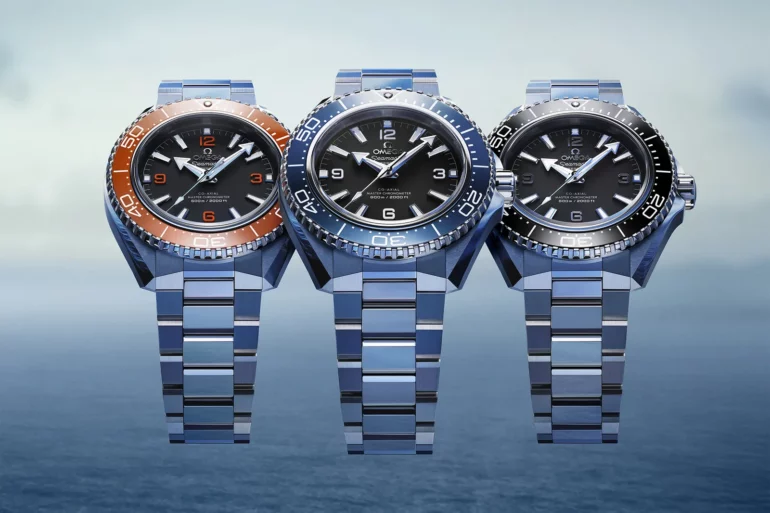
Orange has been an iconic color of the Planet Ocean since its inception. Crafting it in pure ceramic is a true challenge for watchmaking, and Omega has succeeded this year with a shade that’s more vibrant than ever. It is the result of a highly precise ceramic manufacturing process that lends a fresh brilliance to several models. This is a fine demonstration of the brand’s expertise, which thrives on combining bold aesthetics with technological innovations.

This new generation features seven models equipped with the Omega Co-Axial Master Chronometer Caliber 8912. This automatic movement offers a 60-hour power reserve and meets very demanding standards for precision, performance, and resistance to magnetism, certified by METAS. Three versions feature a vibrant orange on the numerals and ceramic bezel, with a choice of a steel, black rubber, or orange rubber strap. Two others feature a deep blue with white numerals and a blue bezel, available with a steel or black rubber strap. Finally, two monochromatic black models with rhodium-plated numerals are also available, with a steel or black rubber strap, for a more understated style.
This update to the Planet Ocean encapsulates more than eighty years of expertise in diving watchmaking and twenty years of evolution specific to this collection. Sleeker, lighter, and thinner, yet also more technical and expressive, this watch marks a turning point. Omega celebrates its past while looking resolutely toward the future, perfectly balancing heritage and innovation. In fact, it is a true icon of contemporary diving watches, appealing to enthusiasts and modern explorers alike.