
Make Texture a preferred source on Google to support us
Add Texture to GooglePiaget unveils a watch inspired by Andy Warhol, blending gemstone marquetry with artistic heritage, in a limited edition of 50 pieces, reflecting the interplay between luxury, art, and history.
Piaget playfully reinterprets Andy Warhol’s work—this time on the wrist—by transforming a self-portrait collage into a collector’s watch. The piece seeks to continue a historic dialogue between the watchmaker and the artist, while asserting its own mastery of jewelry craftsmanship.
According to Piaget, the “Collage” watch draws its inspiration from Warhol’s 1986 Polaroid self-portrait, as well as from the shared history between the artist and the brand. The brand recalls that, at a Sotheby’s auction in 1988, it acquired several of Warhol’s watches, which were among his many timepieces. This shared memory serves, so to speak, as the starting point for this capsule collection.
A case and movement that tell the brand’s story
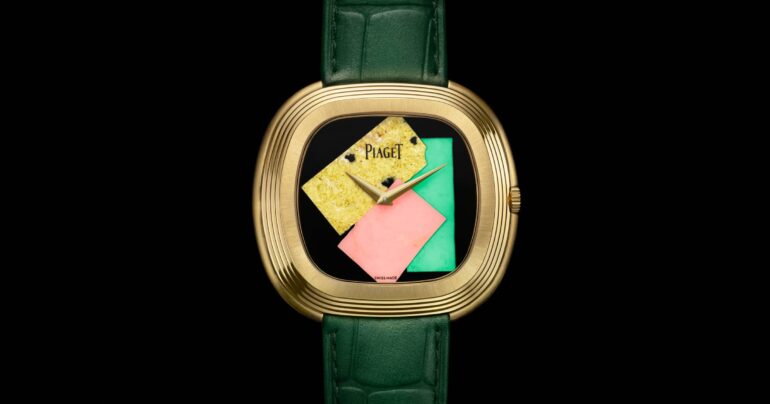
The watch features a 45-mm 18-karat yellow gold case, a design chosen to evoke a Piaget worn by Warhol in the 1970s, according to the brand’s press kit. The Piaget 501P1 automatic caliber powers this watch. The movement offers a 40-hour power reserve, Piaget notes, and reflects the brand’s tradition of creating slim and elegant watches.
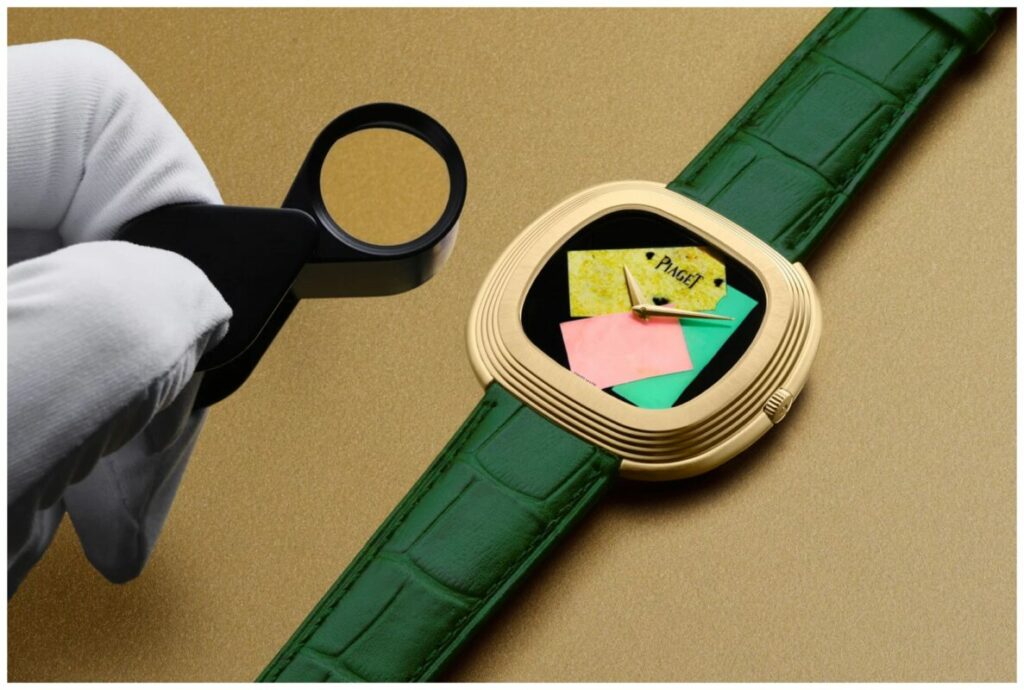
The dial is not a direct reproduction of Warhol’s works—far from it—but rather an interpretation of their color palette and fragmented style. The watch’s inlay features black onyx, green chrysoprase, pink opal, and yellow Namibian serpentine, according to Piaget and several specialized media outlets. These materials are assembled into fine geometric pieces to evoke the fragmented texture of the original collage.
The case back is engraved with Warhol’s portrait and signature, again according to the official press release. The dark green leather strap completes the look without overshadowing the dial. The interior features Côtes de Genève finishing, as Piaget notes.

Limited Edition and Availability
Piaget has announced an ultra-limited series of 50 pieces, sold exclusively in-store, according to its official press release. Several specialized magazines and boutiques confirm this limited run. As for the price, reports vary: The Watch Pages and LuxuryBazaar cite $78,000, while Time+Tide lists the price at 128,000 Australian dollars. It’s best to verify these details at a Piaget boutique before making a decision.
This model sits at the intersection of watchmaking and fine art. It showcases expertise in mineral marquetry—a rare and delicate technique in watchmaking, it should be noted. However, transforming an iconic work of art into a watch face also raises questions—particularly aesthetic and ethical ones. According to the Andy Warhol Foundation for the Visual Arts, the project was carried out in collaboration with Piaget, which, in their view, legitimizes the use of the archives and motifs. Still, this watch is primarily aimed at collectors who can afford it.
Andy Warhol completely redefined the boundaries between art and consumer culture—it’s somewhat of his trademark. His well-documented passion for watches adds a layer of historical irony to this endeavor. By transforming a self-portrait into a wearable object, Piaget takes up this Warholian idea: making art wearable, making it desirable.
The Piaget “Collage” is both a conservative and somewhat daring endeavor. It celebrates this shared history while showcasing highly sophisticated jewelry craftsmanship. For enthusiasts, it represents a tangible manifestation of the dialogue between fine watchmaking and contemporary art. For the market, this watch also illustrates the tensions between art as a value and market value.