
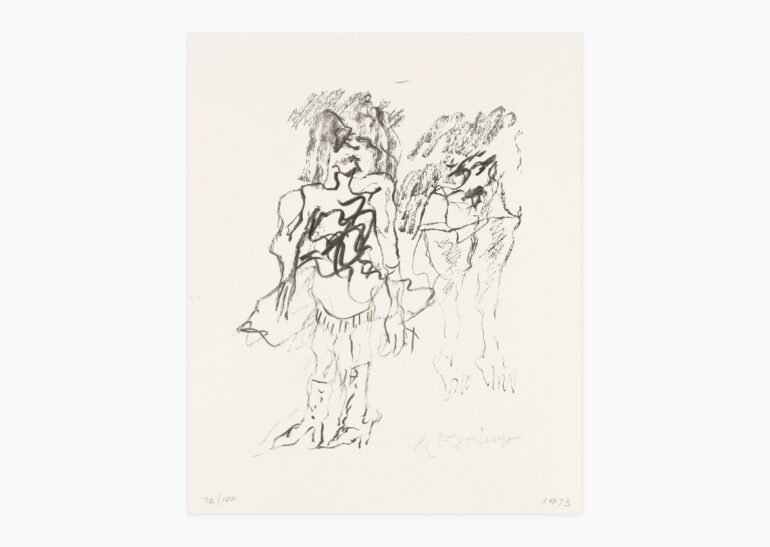
The Art Institute of Chicago is presenting a major retrospective of Willem de Kooning through 2026, highlighting the crucial importance of drawing in the development of his work, which straddles the fine line between figuration and abstraction.
A Celebration of the Foundational Line
Through September 20, 2026, the Art Institute of Chicago is presenting “Willem de Kooning Drawing,” a masterful exhibition bringing together more than 180 drawings from prestigious public and private collections. The first solo retrospective dedicated to the artist at the institution since 1969, this event—organized in partnership with the Rijksmuseum in Amsterdam—invites visitors to rediscover an artist whose genius is too often confined to his monumental canvases. (artic.edu)
The decision to highlight the graphic arts is by no means incidental here: they constitute the very foundation of de Kooning’s artistic practice, the medium through which the master ceaselessly pushed the boundaries of representation. Born in the Netherlands in 1904 and trained in the rigor of classical European traditions, the artist left for New York at age 22, embracing the frenzy of the American avant-garde. This journey gives rise to a palpable tension from the very threshold of the exhibition, illustrating a constant dialogue between absolute mastery of the line and the feverish freedom of gesture. (artic.edu)
A Choreography of Movement
The exhibition unfolds as a true stylistic transformation, transcending a mere succession of works behind glass. The exhibition begins with studies of great figurative precision, gradually shifting toward a more dynamic visual vocabulary, where the line accelerates, poised in an unstable balance between grounding and effervescence. At the heart of this exploration are masterpieces such as “Excavation” (1950), a jewel of the Art Institute’s collections, and the iconic “Woman I” (1950–1952), on exceptional loan from MoMA. The latter epitomizes the period when the artist intensified his exploration of the female figure—a series that was once controversial but is now hailed as a landmark in 20th-century art history.
The institution has also taken the bold step of recreating the atmosphere of the Sidney Janis Gallery in 1953, a pivotal year in which de Kooning unveiled his “Woman” series. By bringing together 15 of the 22 original works—including the masterful pastel and charcoal piece “Two Women with Still Life” (1952)—the exhibition demonstrates that on paper, the artist’s brushwork is just as accomplished as on canvas. Beneath the tumult of forms, buried narratives emerge, revealing the subtle alchemy between what is sketched and what is painted.
Paper as an Intimate Laboratory
The true tour de force of this exhibition design lies in its apparent clarity. While de Kooning left behind more than 2,000 cataloged drawings—and undoubtedly many more if we count his discarded flashes of inspiration, as the Chicago Sun-Times points out— the fluidity of the chronological approach spares the visitor the pitfall of an intellectual labyrinth, a common trap in monographs dedicated to Abstract Expressionism.
Beyond mere celebration, the Art Institute offers a critical and nuanced perspective. Willem de Kooning is revealed here not merely as the painter of flamboyant compositions, but as a relentless explorer for whom the blank page served as an inexhaustible space for experimentation. The exhibition highlights this timeless dimension of his art: the fascinating ability to preserve the visible trace of a state in perpetual flux, where the line oscillates tirelessly between nothingness and the promise of a revelation.