
Make Texture a preferred source on Google to support us
Add Texture to Google
Patrick Stassi
, CEO of Kiabi
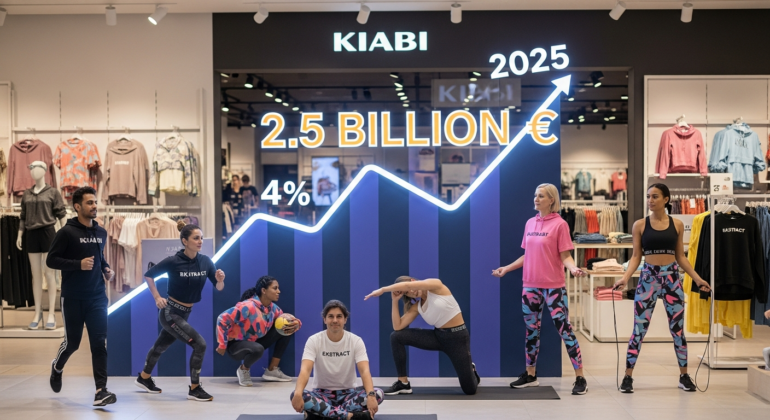
, proudly unveiled the French retail giant’s 2025 revenue figures during the annual meeting with the international press, held at the company’s headquarters in Lille. The discount retailer posted total revenue of 2.5 billion euros, representing 4% growth compared to the previous fiscal year. This performance is driven by the 25 million customers who shop at the company’s 648 stores across 37 countries.
There are multiple reasons for this growth, despite a 1.5% decline in the fashion sector in France. The CEO notably highlighted the new “K” logo, inspired by the brand’s iconic coat hanger and reinterpreted in an open form, symbolizing the strategic evolution that has been underway for several years. What emerged from this day of meetings and workshops was Kiabi’s transition from a single brand to a rapidly expanding platform of brands and services. In addition to the eponymous fashion brand, the company now includes the Kiabi Home
line, the children’s shoe brand Kitchoun
, the secondhand project Beebs
, the B2B label Wekrew
, and—on sale starting this month—the newcomer Ekstract
, unveiled yesterday at Kiabi Village.
Ekstract: Entering the World of Sports and Wellness
With this new brand, Kiabi is officially entering the world of sports and wellness, catering not only to professionals but especially to those who simply enjoy spending time being physically active. Technical fabrics, flexible silhouettes, and a minimalist aesthetic are the key elements of a collection that moves away from the conventions of pure performance. Ekstract will be available starting in February in France, Spain, and Italy—Kiabi’s top three markets—as well as in Belgium and Portugal.
True to its positioning, the average price of items is 15 euros. The Spring/Summer 2026 collection includes tops, shorts, leggings, T-shirts, windbreakers, sweatshirts, bags, caps, and fanny packs. Clothing and accessories for men and women focused on practicality, always in line with the excellent value for money for which Kiabi is renowned. The name “Ekstract” captures the need to treat yourself to “extra” moments for yourself, by freeing yourself from the clutter of everyday life.

At the same time, Kitchoun has earned the trust of parents thanks to the involvement of a specialized osteopath in the design of shoes recommended by the French Union for Foot Health. Wekrew, meanwhile, is aimed at associations, schools, businesses, and public organizations looking to customize a line of unisex basic clothing. Beebs operates on an omnichannel model: in-store, dedicated solutions allow customers to drop off their secondhand items and convert them into store credit.
New Services and Rollout of the “Kolors” Concept
“Our services are expanding with the ‘En Famille +’ subscription and the ‘Kolors’ store concept, which will be rolled out in 2026. We have also volunteered to implement environmental labeling on our product pages to inform customers about the impact of their purchases and enhance the customer experience,” explained Patrick Stassi.
He was referring to the loyalty program launched in 2024, which already has more than 11 million members. The program expanded last year, starting in France, where, for 15 euros per year, customers can choose a favorite department (women’s, men’s, children’s, or baby) to receive a permanent 10% discount, as well as a 5% discount in other departments, both in-store and online. The “En Famille +” program has already attracted 140,000 members.

The Kolors concept, which has been active since 2023 through various pilot phases in France and abroad, was implemented in 14 stores between 2023 and 2025. These successive stages made it possible to incorporate feedback from field teams and customers, refine the concept, and make it fully scalable. The end of 2025 marks a key milestone with the launch of the first orders, paving the way for a phased rollout beginning in 2026 across the entire network.

The CEO has repeatedly emphasized the growing importance of omnichannel retailing, citing the success of the new Kiabi app, which has already been downloaded more than 3 million times. Among the new features is “E-Reservation,” a free service that allows customers to reserve in-store items online, try them on before buying, and pay only afterward, with no upfront payment required. Kiabi claims to be the only fashion retailer to offer this service.
CSR Commitment and Inclusivity
Through the Kiabi Foundation, the French company seeks to restore confidence in young people facing social, educational, or psychological challenges. Among its initiatives is a partnership with L’École des XV, which uses rugby as a tool for social inclusion and academic success. In terms of sustainability, in addition to the secondhand program, the partnership with the Organic Cotton Accelerator guarantees traceable organic cotton sourced from more than 24,000 regenerative farms, while also ensuring fairer compensation for producers. The increasing use of single-material fabrics facilitates recycling, while the polyester used is now systematically recycled. The denim collection produced in France in collaboration with the Denim Center in Neuville-en-Ferrain combines European cotton with recycled cotton.
In terms of inclusivity, the brand offers collections ranging from size 34 to 60 and develops specific lines to address particular life situations. The “So Easy” collection is designed for children and adults with temporary or permanent disabilities. Kiabi has also developed a line of post-surgical lingerie designed to support women affected by breast cancer. Finally, in 2022, Kiabi launched its “Marketplace,” an example of its diversification strategy featuring 230 partner brands, expanding its offerings beyond its core business to target new sectors such as baby care, toys, and shoes.

2026 Goals and Focus on the Italian Market
By 2026, the company aims to expand its retail network with 40 new stores and 10 new locations—including shop-in-shops and marketplaces—starting with seven in Belgium, 10 in Spain and Portugal, two in Switzerland, and 20 across Africa and the Middle East. Kiabi will also enter seven new markets.
What about Italy? “In 2026, we will open two new stores and reopen the Parma location, the first to adopt the new Kolors concept,” explained François Haimez, head of Kiabi’s international division. “In March, a major event will celebrate Kiabi’s 30th anniversary in Italy through a dedicated campaign. Italian customers have historically been very fond of the children’s and baby collections, which are more in line with your market than those for men and women.”
During the day, it became clear that the Italian market is particularly challenging for Kiabi, especially due to the steady rise of new fast-fashion players, from Primark to newcomers Sinsay and Pepco. “Currently, however, we are stepping up our country-specific styling efforts to meet the demands of specific markets and compete with local rivals such as OVS, the current market leader.”
Kiabi has more than 40 stores in Italy, almost exclusively in shopping malls. For now, given the low profit margins, no plans are in place to open stores in city centers following the closure of the Naples store on Piazza Garibaldi. “To compete with our rivals, we’re expanding our product range to meet the needs of a larger number of potential adult customers. In kidswear, we’re among the market leaders, as confirmed by the success of our Kitchoun shoe line. As for Kiabi Home, we’re a bit behind in Italy, but starting this year, we’ll be offering home furnishings that are no longer limited to French standard sizes. The secondhand initiative will begin in a pilot phase at three stores. On the e-commerce front, we are very satisfied: the new app has significantly increased sales, with double-digit growth,” concluded François Haimez, reassuring customers that prices for end consumers will remain stable and will not change for products of the same quality.