
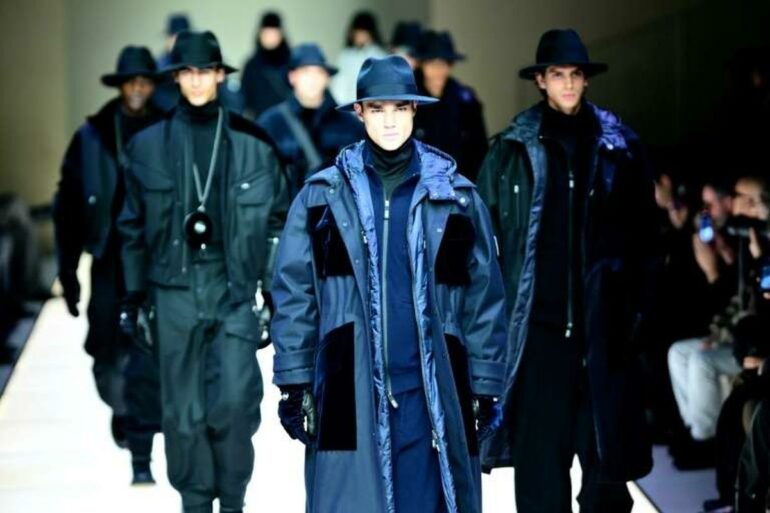
A fashion house that prioritizes evolution over radical change
The House of Armani focuses on gradual refinement by emphasizing texture and light. While maintaining its understated elegance, the Italian label reaffirms Leo Dell’Orco’s growing influence amid a process of cautious and perfectly controlled transformation.
Giorgio Armani’s latest men’s fashion show revolves around an idea that is by no means new, yet remains as fruitful as ever: the cangiante. It is this uniquely subtle way of altering the appearance of a garment without changing its silhouette. The house explains that its pieces retain their lines while transforming depending on the light, movement, or angle of view. This is a stylistic language we know well at Armani, where the fluidity of the cut invariably takes precedence over showy effects. (armani.com)
For this season, the true innovation lies not so much in the garment’s structure as in its surface appearance. The fabrics gently capture the light, lending an unexpected depth to pieces that, at first glance, appear remarkably understated. Deep blues, soft greens, and dark neutrals do not seek to make an immediate statement. Above all, they play on gradual revelation, much like a masterpiece that reveals its nuances as you draw closer. (armani.com)
The Leo Dell’Orco Era: Preserving a Legacy
The noticeable change stems in particular from the growing recognition of Leo Dell’Orco’s role. After several decades of a discreet yet essential presence alongside Armani, he now takes center stage in the leadership of the men’s line. According to Vogue, this new collection could be seen as the first runway show under the Giorgio Armani label without an immediate mention of the founder, who passed away in September 2025. Dell’Orco confided to Vogue that it is difficult to continue nurturing such a legacy without falling into imitation. He nevertheless emphasizes one guiding principle: the house preserves what it calls its “aristocracy of minimalism.” A subtle elegance that eschews ostentation in favor of a masterful use of materials. The color palette remains anchored in grays, charcoal, and terracotta tones, with a desire to infuse it with greater radiance and iridescence, while maintaining perfect clarity in a context where its fundamentals are evolving with finesse. (vogue.com)
The Eloquence of the Tactile
AE World highlights a collection that gives pride of place to sensory fabrics for winter: brushed cashmere, velvet, and chenille are featured in fluid silhouettes. Enveloping coats and loose-fitting pants are delicately balanced with suede shoes or structured boots. The accessory lineup is enriched with generously sized bags, crossbody styles, graphic belts, and wide-brimmed hats. The collaboration with Alanui, embodied by a geometric jacquard cardigan, attests to the obsessive attention to detail. These elements chart a cautious yet refined course, aimed at enriching the Armani aesthetic without ever betraying its essence. (vogue.com)

Vogue also notes a play on prints that seem to evoke antiquity, the Renaissance, and absolute modernity all at once. It is a layering of time rather than a simple juxtaposition. At Armani, the men’s wardrobe remains a quest for measured precision, favoring chiaroscuro over blinding light, with a self-assured classicism that draws its strength from its own convictions. (vogue.com)
This runway show does not mark any radical break, but orchestrates an adjustment of extreme finesse. The house moves with quiet confidence through a period of significant change, which is undoubtedly its greatest strength. In Italy, great institutions endure not through upheaval, but through precision and intuition. Armani cultivates these two virtues, perpetuating a quiet elegance while continuing to explore its own principles. (vogue.com)
Note: The reference to Giorgio Armani’s death in September 2025 comes from an article in WhoWhatWear (7), not from Vogue, which avoids mentioning this event.