
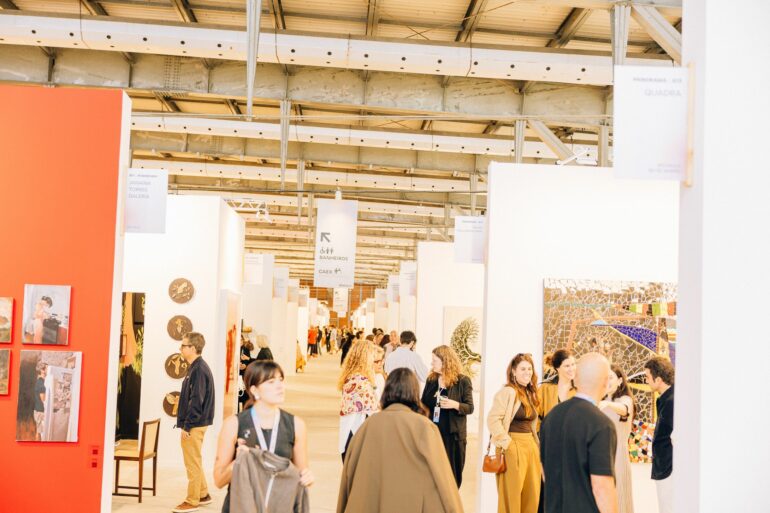
Under the bright light of the Marina da Glória, where the concrete of modernist architecture meets the waters of Guanabara Bay, the atmosphere of the 16th edition of ArtRio oscillates between commercial buzz and an electric tension. From September 16 to 20, 2026, Rio de Janeiro’s international contemporary art fair has established itself as the barometer of a country in the midst of profound change. Within the walls of the 76 exhibiting galleries, the hushed calm of the art deals contrasts with the political turmoil rumbling outside, just two weeks before a presidential election whose outcome is polarizing the entire nation.
A Market Driven by a New Guard
The Brazilian art market is in remarkable health, defying macroeconomic uncertainties. According to data from the Art Basel/UBS report, the country’s galleries recorded a 21% increase in sales in 2025. This momentum is not solely driven by established high-net-worth individuals but reflects a profound renewal of the buyer base. The study highlights that in Brazil, 23% of active collectors began acquiring artworks within the last five years. This is the highest proportion recorded worldwide, revealing the emergence of a generation of people in their thirties and forties for whom art is as much a means of expressing identity as it is a conviction-driven investment.
This vitality was evident as early as September 15, 2026, at the pre-opening dinner, where the first sales contracts were signed even before the official opening. Under the artistic direction of Maria Luz Bridger, the fair successfully channeled this demand. While the Panorama section brings together the heavyweights—such as the Nara Roesler, Mendes Wood DM, and Fortes D’Aloia & Gabriel galleries—a seaside pavilion was specifically dedicated to solo and duo presentations. This format, offering more affordable prices, directly addresses the appetite of these new entrants for contemporary art—a particularly buoyant segment this fall—while the secondary market for the masters of Brazilian modernism remains more selective and reserved.
The Shadow of Brasília Over the Marina da Glória
It is impossible to ignore the timing. ArtRio 2026 is taking place amid a climate of marked institutional tensions. The first round of the presidential election, scheduled for early October, is stirring up strong emotions. The showdown between incumbent President Luiz Inácio Lula da Silva, who is running for reelection, and Flávio Bolsonaro—whose father, Jair Bolsonaro, is serving a prison sentence for attempting a coup following the events of 2022—dominates public discourse. Recent legal clashes within the Supreme Court, centered on anti-corruption investigations, are perceived by visitors as the epicenter of an indirect confrontation between the two camps.
In the fair’s aisles, politics is sometimes displayed ostentatiously: at the opening on September 16, some supporters’ badges were visible on the lapels of collectors’ jackets. This climate is weighing on overall sales volume, with some local buyers exercising temporary caution while awaiting the election results. Nevertheless, fair organizers and dealers from São Paulo, Brasília, and Belo Horizonte note that this caution is tempered by the strong sales recorded from the very first hours, proving that art remains a safe haven—or at least a source of continuity—in a shifting political landscape.
The Support of International Institutions
The other major takeaway from the 2026 edition is the growing international reach of ArtRio. For the first time, the fair received an official visit from Sheikha Al-Mayassa bint Hamad Al Thani, president of Qatar Museums. Her presence, noted by all industry professionals, signals an unprecedented interest among major Middle Eastern collectors in the South American art scene. She was not alone in touring the booths at Marina da Glória; this year’s lineup of institutional representatives reflects extensive work on global acquisition networks.
Among those present were Manuel Segade, director of the Museo Reina Sofía, as well as leading representatives such as Scott Stover from the Centre Pompidou and Sydney Picasso from the Tate. Interest in Brazilian art—and more broadly in artistic expressions from the Global South—was further underscored by the presence of John de Beauval (Tate—African acquisitions), Rebecca Lowery of the Wexner Center for the Arts, and Melissa Blanchflower of Turner Contemporary. This gathering of museum directors and curators underscores that, despite internal political turmoil, Brazil remains a vital source of forms and ideas for international institutions.
The event also benefits from its strong local roots, particularly thanks to its partnership with MAM Rio (Museum of Modern Art of Rio de Janeiro), located just a stone’s throw from the fair. This connection between the market and the institution reinforces the credibility of an event that, at 80 BRL per admission (approximately 13 euros at the current exchange rate), attracts a diverse audience far beyond the narrow circle of insiders. Transactions will continue through September 20, confirming that while politics may divide the country, the art market continues to chart its own course of growth.