
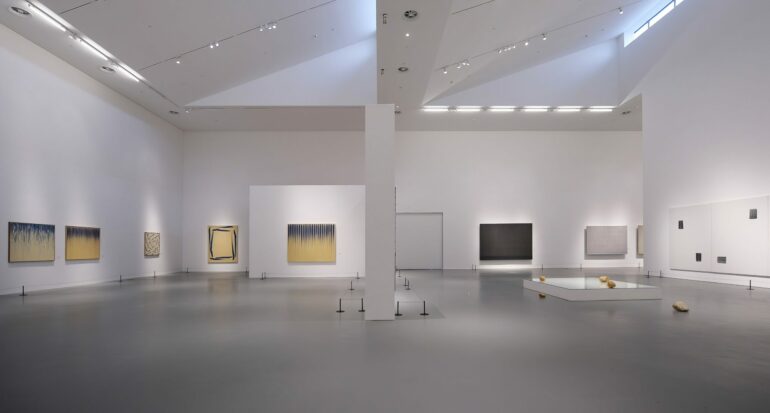
In Seoul, the urban landscape is about to immortalize in concrete and glass the legacy of a generation of builders of the invisible. Dansaekhwa, the monochrome painting movement that emerged in the 1970s, no longer belongs solely to the hushed rooms of international auction houses or Manhattan galleries. Between 2025 and 2026, a wave of new institutions and artist-studios will transform the South Korean capital into a veritable sanctuary dedicated to these pioneers of abstraction. From Park Seo-Bo to Yun Hyong-Keun, the transition from the private sphere to the public realm marks a turning point for the preservation of an aesthetic rooted in the repetition of the gesture, chromatic restraint, and the withdrawal of the artist’s ego. These new places of remembrance, often located on the very sites where the works were created, offer an immersive experience of the materiality of hanji paper and jute canvas.
Park Seo-Bo’s Blue Monolith in Yeonhui-dong
August 21, 2026, will mark a pivotal date for the PARKSEOBO FOUNDATION with the opening of the PARKSEOBO MUSEUM SEOUL. Located in the Seodaemun district, the building stands in the immediate vicinity of the historic residence and studio of the painter, who passed away in 2023. Designed by architect Choi Moon-kyu, a professor at Yonsei University, the structure takes the form of a massive blue cube, topped by a ribbed glass block. This 2,000-square-meter complex, spread over five levels, was designed to house an exceptional collection: a donation of 3,000 works selected by the artist himself.
Under the leadership of Sam Seungho Park, chairman of the foundation’s board of directors, the institution will be more than just a mausoleum. The inaugural exhibition, titled “Park Seo-Bo & Huong Dodinh: Emptiness, Fullness,” will juxtapose 25 pieces by the Korean master with 17 works by the French artist of Vietnamese origin, Huong Dodinh. This programming underscores the foundation’s commitment to situating Dansaekhwa within a global aesthetic dialogue, far beyond the borders of the Korean Peninsula. While this Seoul-based project is nearing completion, the foundation’s other ambitions have met with mixed fortunes: the public museum project in Yecheon was abandoned, while the construction project begun on Jeju Island in 2023 has faced delays, and the completion date remains uncertain to this day.
Yun Hyong-Keun’s Preserved Intimacy in Mapo
A few kilometers away, in the Mapo district, another, more intimate experience awaits art lovers. On September 1, 2026, Yun Hyong-Keun’s home will open its doors to the public for the first time since the artist’s death in 2007. The history of the site is closely tied to the lineage of Korean modern art. The land was acquired in 1963 by Kim Whanki, a mentor and Yun’s father-in-law. Yun moved there in 1967 before having the current house-studio—designed by his brother, architect Yun Do-Geun—built in 1983.
The restoration, led by the Estate of Yun Hyong-keun with support from the PKM Gallery, prioritized strictly preserving the creative atmosphere. On the ground floor, the studio retains its original traces: a concrete floor stained with paint, along with the brushes and tubes used by the painter. The site will not be open year-round; after an inaugural period ending on October 17, 2026, the house will operate on a seasonal basis, opening only in the spring (April–June) and fall (September–November). The admission fee is set at 20,000 KRW, or approximately 13.50 €.
Kim Tschang-Yeul’s Light in Pyeongchang-dong
The Pyeongchang-dong neighborhood, in the Jongno District, is home to the residence of Kim Tschang-Yeul, famous for his obsessive depictions of water droplets. Occupied for 33 years until his passing in 2021, this 512 m² residence completed its architectural transformation in late March 2026. The interior design reflects the artist’s quest for silence. The main studio, located on the second basement level, is completely windowless, receiving light only from above through a single skylight, creating an atmosphere conducive to the technical meditation characteristic of Dansaekhwa.
Although the Jongno local government had aimed to open the site to the public by the end of May 2026, the final visiting arrangements and permanent hours will depend on confirmation from the site’s future managers. While awaiting this immersion into his private space, a major posthumous retrospective is being held at the National Museum of Modern and Contemporary Art (MMCA Seoul) from August 22 to December 21, 2025, offering a chance to grasp the scope of his work before exploring his living space.
Ha Chong-Hyun and the Power of the Medium in Paju
On the outskirts of Seoul, in Paju, the opening of the Ha Chong-Hyun Art Center on September 1, 2025, marked the first milestone of this new institutional era. Housed in a converted former publishing building spanning nearly 3,000 m², the center is managed by the eponymous foundation chaired by Ha Yoon, the artist’s son. The venue is dedicated to exploring six decades of work by Ha Chong-Hyun, born in 1935.
The space allows visitors to physically experience the “Conjunction” series and the painter’s signature technique, “baeapbeop.” This unique process involves pushing paint through the reverse side of a coarse hemp canvas, causing the material to emerge through the fabric’s weave. With its industrial scale and technical specialization, this center complements the network of more intimate studio-homes in the city center, offering a comprehensive perspective on a movement that has redefined the relationship between the body, the medium, and time. To understand the historical significance of these approaches, the Asian Art Museum’s resources provide additional insight into the evolution of these practices within the broader Asian art scene.