
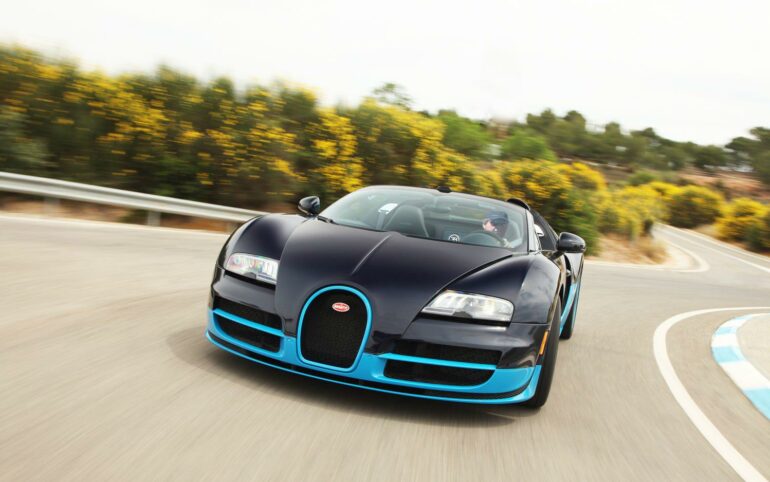
Behind the wheel of the Bugatti Veyron 16.4 Grand Sport Vitesse, one thing becomes clear with quiet conviction: more than two decades after the first sketches of the Veyron line were drawn, the car’s ability to astound remains undiminished. This roadster, unveiled for the first time at the Geneva Motor Show in March 2012, embodies the convergence of two technical extremes from the Molsheim-based brand. It is the union of the Grand Sport’s convertible chassis, introduced in 2008, and the mechanical excess of the 2010 Super Sport. In Alsace, engineers have designed a vehicle that defies the laws of thermodynamics and pure speed, all while offering the pleasure of driving with the wind in your hair.
An Unparalleled Engine Design
The beating heart of the Grand Sport Vitesse is the 8.0-liter W16 engine (exactly 7,993 cm³). This masterpiece of mechanical engineering features four turbochargers that are larger than those in the original Grand Sport. The power gain is massive: an additional 199 chevaux, bringing the total to 1,200 ch (1,200 PS) at 6,400 rpm. Torque follows this upward curve, peaking at 1,500 Nm, available across a range from 3,000 to 5,000 rpm. To handle such a massive outpouring of power, Bugatti had to thoroughly redesign the cooling system.
The car features no fewer than ten radiators. Managing the fluid flow is a logistical feat in itself: three radiators are dedicated to the engine, another to the intercooler (which is itself oversized on this version), while two units handle the air conditioning. The rest of the cooling system is divided among the transmission fluid, the differential, the engine oil, and, more uniquely, the hydraulic fluid required to operate the movable wing. The latter acts not only as an aerodynamic aid but also as an air brake during sudden decelerations.
The permanent all-wheel-drive system distributes this power through a seven-speed semi-automatic dual-clutch transmission designed by specialist Ricardo. The structure, essential for maintaining rigidity despite the absence of a fixed roof, is based on a monocoque and body panels made entirely of reinforced carbon fiber.
The Open-Air World Record
While the top speed is electronically limited to 375 km/h in standard driving mode for on-road use, the Grand Sport Vitesse reveals its true potential on a closed circuit. Under these controlled conditions, it is capable of reaching 410 km/h. Bugatti, in fact, etched this model into automotive history on April 6, 2013. On the Ehra-Lessien test track, Chinese driver Anthony Liu pushed the roadster to a speed of 408.84 km/h (254.04 mph).

This performance, certified by the independent German organization TÜV, earned the Grand Sport Vitesse the title of the world’s fastest production convertible. To celebrate this achievement, the brand released a limited edition called the “World Record Car” (WRC). Only eight units were produced, recognizable by their two-tone black-and-orange livery. Upon its release in 2013, this special edition was priced at approximately 1.99 million euros before taxes, compared to 1.69 million euros for the standard version.
The Rarity of a Carbon Monolith
Of the 450 Veyrons produced between 2005 and 2015, across all variants, only 150 were roadsters. Among these, the Grand Sport Vitesse version is the most exclusive, with only 92 units rolling off the assembly line in Molsheim. This rarity explains its sustained value on the secondary market today. While a WRC edition was worth approximately 2.5 million U.S. dollars at the time, transactions observed between 2024 and 2026 now place the model’s value between 2.5 and 3.5 million euros, depending on the exclusivity of the configuration and the mileage.
Owning such a vehicle entails operating costs commensurate with its performance. A simple tire change illustrates this extravagance: a set of specialized Michelin PAX tires costs between $25,000 and $40,000 (or approximately €22,000 to €36,000). The vehicle’s weight, although not officially disclosed due to customization options, is estimated to be between 1,888 kg and 1,990 kg depending on the configuration of the removable Targa roof and the extensive use of transparent carbon fiber.
The Veyron’s story came to a symbolic end with this model. The 450th unit, named “La Finale,” was, in fact, a Grand Sport Vitesse. Unveiled at the Geneva Motor Show in March 2015, it marked the end of a decade of technical dominance. Named *Car of the Year* by *Robb Report* magazine in 2013, the Grand Sport Vitesse is not just a record-breaking machine; it is the culmination of an era in which Bugatti redefined the limits of internal combustion engine engineering before the shift toward hybridization.