Make Texture a preferred source on Google to support us
Add Texture to GoogleIndustrial design has a relationship with memory that is ambiguous, to say the least. Focused by its very nature on mass production and material innovation, it rarely dwells on what has been lost. But sometimes the genesis of a piece of furniture is rooted in a much more intimate sense of time. This is the path that British designer Michael Young is taking today. Exactly thirty years after his first sketches for the Japanese brand IDÉE, the designer is making a return imbued with a special depth, unveiling three previously unseen pieces developed in collaboration with MUJI.
Far from the typical seasonal launches, this collection—available in Japan since mid-November—bears the marks of a long-standing dialogue. The aesthetics and engineering of these chairs and tables were not conceived in the sterile vacuum of a design studio. They took root over the course of long dinners in Tokyo and during secluded work sessions at Takigahara Farm. The key figure in these ongoing exchanges was Teruo Kurosaki. Founder of IDÉE and a central figure in Japanese design, he passed away on March 23, 2026, at the age of 76. The collection, abruptly cut short by his absence, had to be completed without the guidance of the man who had initiated it.
The Legacy of an Avant-Garde Pioneer
Teruo Kurosaki’s influence extends far beyond the boundaries of his own company. When he launched IDÉE in 1982, he did more than simply establish a publishing house: he opened a cultural breach. In a Japan undergoing rapid economic and aesthetic transformation, his flair enabled him to identify the international avant-garde and adapt it to the Japanese market. The very young Philippe Starck, Marc Newson, and Tom Dixon found in him an essential strategic partner for breaking into this new territory.
For Michael Young, this collection fills a void. Two full decades had passed without a single joint project between the studio and the brand. The development of these three pieces of furniture therefore had a dual purpose: to mark the thirtieth anniversary of their first professional encounter and to advance IDÉE’s creative direction without succumbing to sterile nostalgia. The British designer’s words are unequivocal regarding the role played by his mentor, readily admitting that the success of this project owes everything to Kurosaki’s input. Supported by designers Ben McCarthy and Oscar Lahiff, as well as the Japanese brand’s technical team, Young chose to complete this collaborative project while keeping his client’s original requirements intact.
Engineering in the Service of Wear and Tear
The physical realization of this triptych relies on the unique approach of Michael Young Studio. Based in the bustling cities of Hong Kong and Tokyo since its founding in 1993, the studio systematically brings together a European formal sensibility with the massive production rhythms of Asian manufacturing.
Here, the industrialization phase is not viewed as an imposed constraint. An in-depth study of domestic behaviors, the choice of materials, and the anticipation of manufacturing methods dictate the direction of the design well before the prototyping stage. This direct confrontation with the harsh reality of machinery serves a fundamental purpose: to ensure the objects’ material and stylistic longevity. Young frequently highlights this tension inherent in his discipline, noting that a demanding industrial design is judged by its ability to immediately trigger a purchase, while ensuring its relevance decades later. Escaping fleeting allure requires precision in execution and a taste for experimentation that tolerate no approximation.
The Discreet Aesthetics of Japanese Interiors
Available through a select network comprising six IDÉE stores and some thirty MUJI branches, the collection centers on pieces designed for highly specific domestic uses.

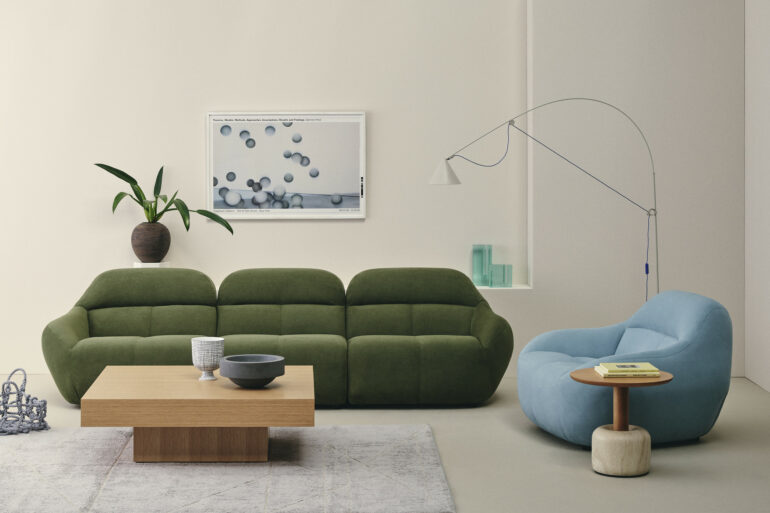
The Kagen Soho sofa perfectly illustrates this commitment to local roots. It takes its name from the concept of “ii kagen,” a linguistic expression denoting the art of finding the right balance. The dimensions of the frame have been meticulously recalibrated so as not to overwhelm the limited space of apartments across the archipelago. Ergonomics walks a fine line here, constantly seeking a balance between the firm support the body requires and the essential comfort it needs. The designer’s promise is crystal clear: the chair’s sole purpose is to bring a smile to the faces of the family who uses it every day.
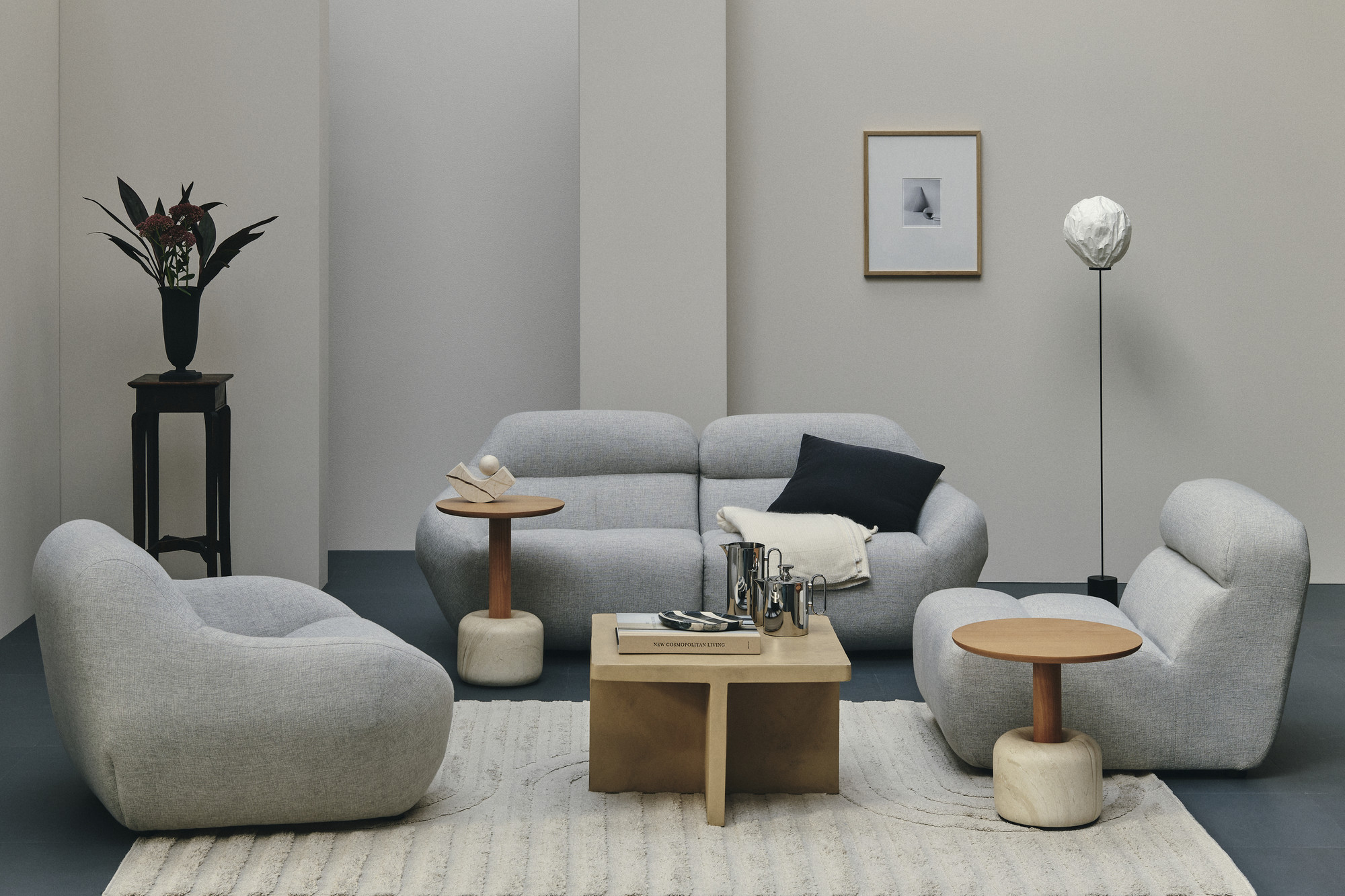
In contrast to this unified approach, the Skrabble Sofa champions a form of spatial freedom. This modular model is based on a bold premise: a piece of furniture does not have to dictate the architecture of a room. Its independent modules can be combined, separated, and reconfigured to suit the owners’ needs, whether they’re gathering together or spending time apart. The sofa chooses to harmonize with the other objects in the living room rather than dictate their arrangement.
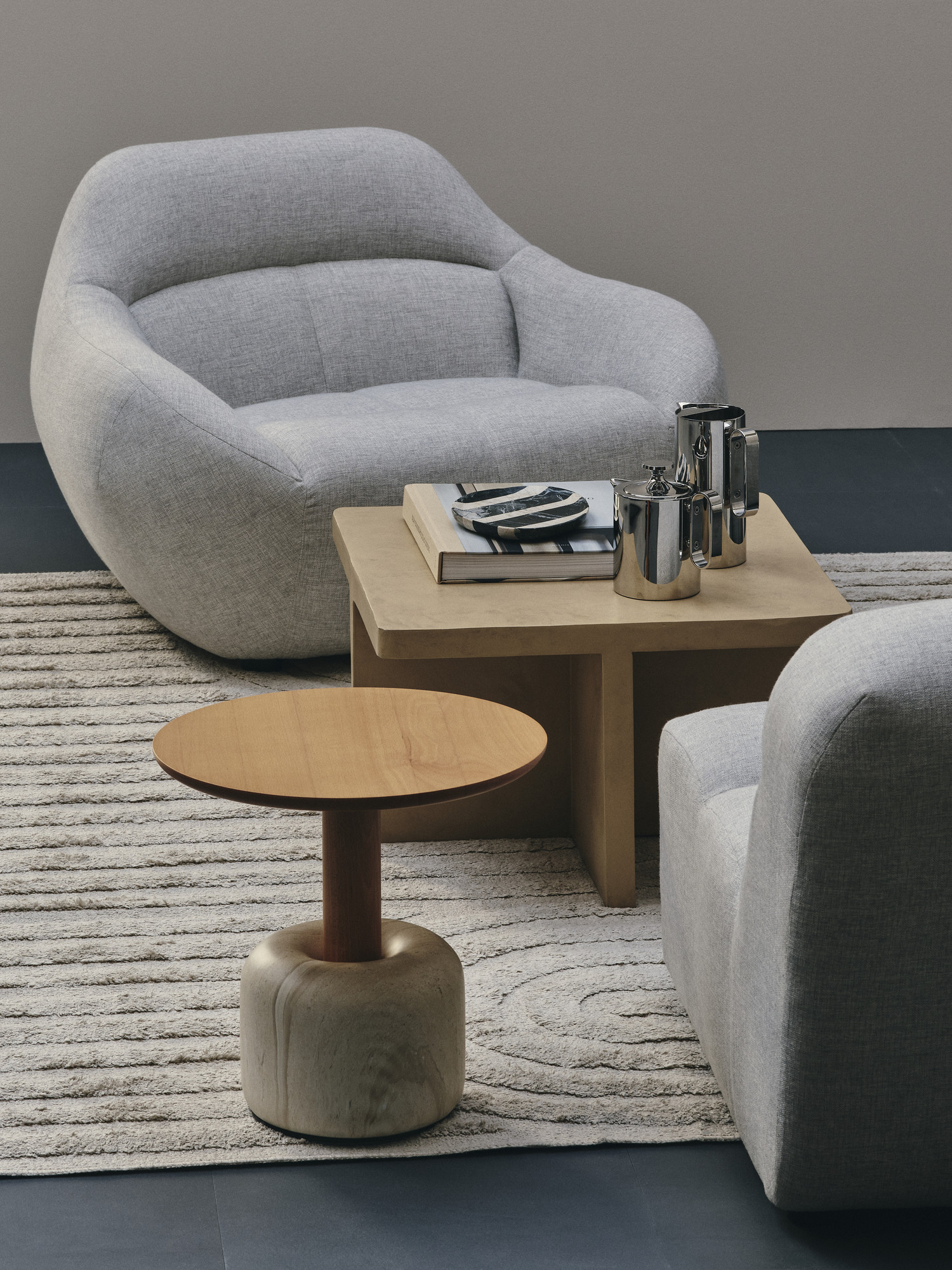
Finally, the Peg Table rounds out the collection with a focus on texture. Available as a coffee table and a side table, it explores the passage of time. Its solid base is cast in a mortar designed to visually replicate the irregular porosity of travertine. It supports a tabletop carved from warm solid beech. The original idea behind this contrast originated on the streets of Omotesando three decades earlier, when a remark made to Michael Young suggested that stone awakens and comes to life only when one has owned it long enough. The table’s wood and mortar are designed to absorb this slow-unfolding history, accumulating the marks of a shared intimacy.
A Presence Beyond the Institutional Sphere
The British designer’s body of work has long been recognized by the institutional circuit. His creations have gradually found their way into the permanent collections of San Francisco’s SFMOMA, London’s Victoria and Albert Museum, Hong Kong’s massive M+, and the Design Museum in Ghent. These acquisitions place his technical approach within the broader spectrum of heritage preservation.
However, the relevance of a piece of furniture can never truly be assessed under the white light of an exhibition gallery. The pieces developed with MUJI claim an entirely different status. By overcoming the shock of a foundational loss, the team gathered around this project has succeeded in capturing the living trace of an unfinished conversation. These chairs and tables step out of the realm of memory to quietly become part of the daily lives of those who acquire them, transforming a personal tribute into a series of objects ready to begin their own existence.