Make Texture a preferred source on Google to support us
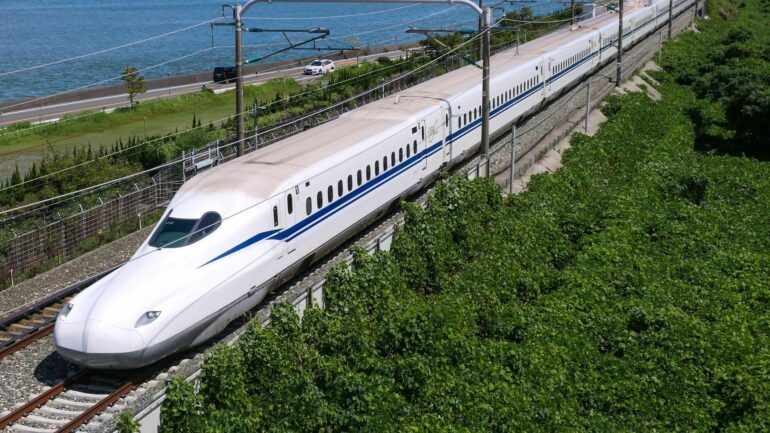
Add Texture to GoogleThe hubbub of Tokyo Station—that beating heart where thousands of paths intersect every second—fades away in an instant. The motion is simple, almost surgical: a QR code is scanned by a reader, and the wall slides open. In an instant, the frenetic bustle of the platforms fades behind you, giving way to a hushed silence. You don’t simply take a seat aboard the Tokaido Shinkansen; you step into a bubble of serenity designed to defy speed. For the first time in the history of this legendary line connecting the capital to Nagoya, Kyoto, and Osaka, the concept of transportation takes a back seat to that of private space. Until now, the discerning traveler had to make do with the already very respectable comfort of the “Green Car.” Now, the Supreme Class concept redefines the rules of Japanese rail travel by introducing individual cabins—true sanctuaries of wood and light— hurtling at 285 km/h through the archipelago’s landscapes.
The Architecture of Silence
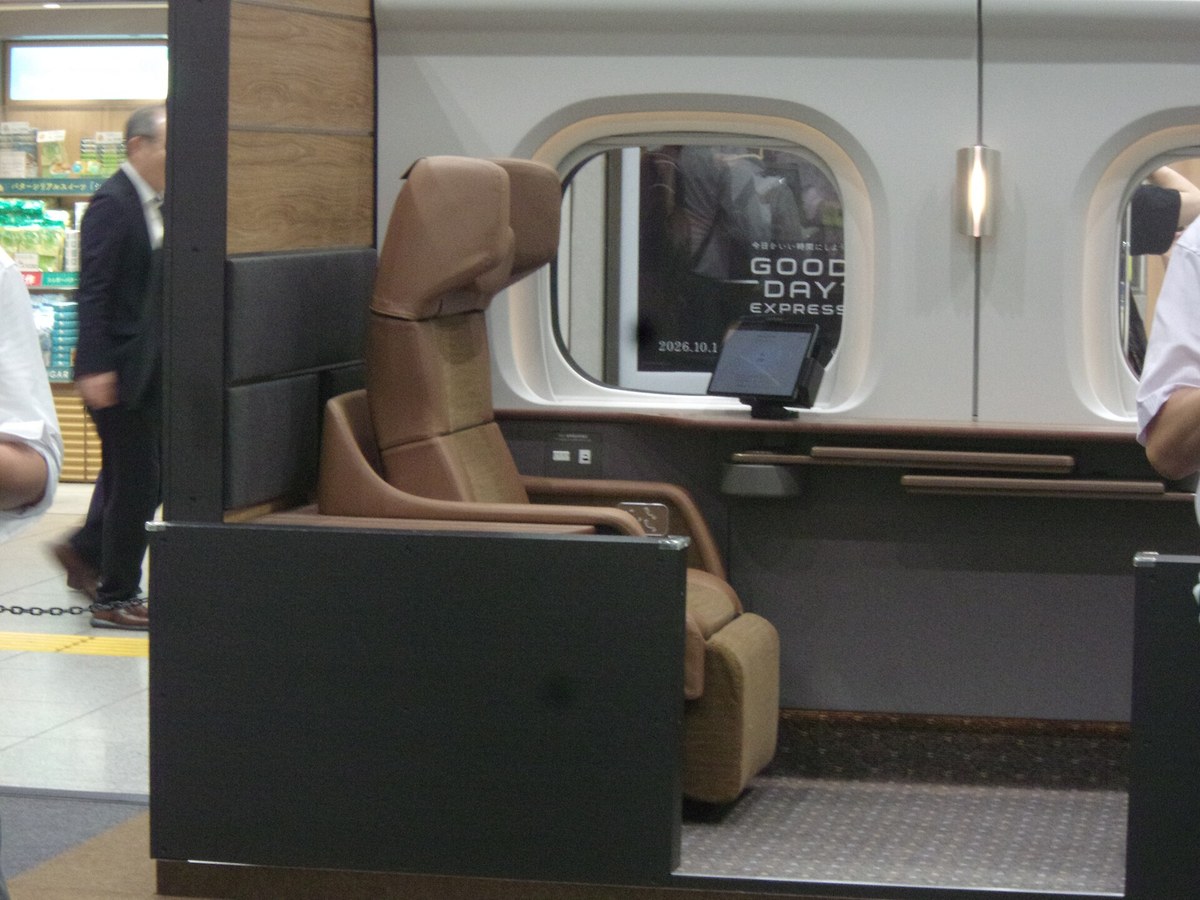
Inside these new compartments for one or two people, the atmosphere evokes the intimacy of a contemporary ryokan or a private jet more than that of a traditional train car. The space is designed as a cozy cocoon where every square centimeter has been optimized. Wood, a ubiquitous element in the finishes, adds an organic texture that contrasts with the high-tech design of the Shinkansen N700S. To the right of the seat, a discreet niche provides a place to stow luggage, while a coat rack holds jackets and coats, freeing the living space from any visual clutter. The feeling of openness is enhanced by two large windows that frame the passing view of the outside world like so many moving paintings.
At the heart of the experience lies a unique interface: a control panel that puts the passenger in charge of their immediate surroundings. With a swipe of the finger, you can adjust the seat’s recline—which features a heating function for chilly mornings—as well as the airflow intensity and, most importantly, the lighting. The cabin offers pre-programmed moods tailored to the time of day or the desired activity: “Business” for focused lighting, “Relax” to dim the lights, or “Night” to immerse oneself in darkness as the train cuts through the Japanese night. This tablet also serves as a link to the onboard staff, allowing passengers to order refreshments or track the train’s progress on an interactive, real-time map.
An invisible technological immersion
Innovation in Supreme Class isn’t something you see—it’s something you feel and hear. One of the standout features of this new design is the PSZ (Personalized Sound Zone) system. To avoid noise pollution and the sometimes cumbersome use of headphones, Bluetooth speakers are built directly into the headrests. Thanks to patented technology, the sound is projected with such precision that it remains confined to the passenger’s personal space, without ever spilling over into neighboring compartments. Whether you choose to listen to the jazz tunes from Ryo Fukui’s album *Scenery*—whose 1976-style textures seem to blend perfectly with the passing scenery—or watch a movie, the audio clarity is exceptional.
For those who use their commute as work time, connectivity has been elevated to a level never before seen in rail travel. For the first time, the train uses 5G-compatible glass antennas developed by AGC. This system ensures stable, unlimited Wi-Fi, even when the train passes through geographically complex areas or enters tunnels. It is this attention to invisible details—network stability, acoustic precision, and seat temperature control—that transforms a utilitarian journey into a truly luxurious experience, where technology takes a back seat to comfort.
The Ritual of Contemplation
As the train pulls away from Tokyo’s urban jungle and heads southwest, onboard service begins. It is still early—7:30 a.m.—and the temptation of a Kamoshibito Kuheiji sake or a shochu will likely have to wait until mid-afternoon. The choice falls on a Colombian Geisha coffee, renowned for its finesse. Service is announced by a discreet chime—the cabin bell. A crew member, in an impeccable uniform, brings a tray with steaming coffee alongside a slice of baumkuchen. This spindle cake, much loved in Japan, is made here with premium green tea from Uji, near Kyoto. It’s a gourmet treat that complements the spectacle unfolding outside the window: the impeccably manicured tea gardens of Shizuoka roll by, forming green waves stretching as far as the eye can see.

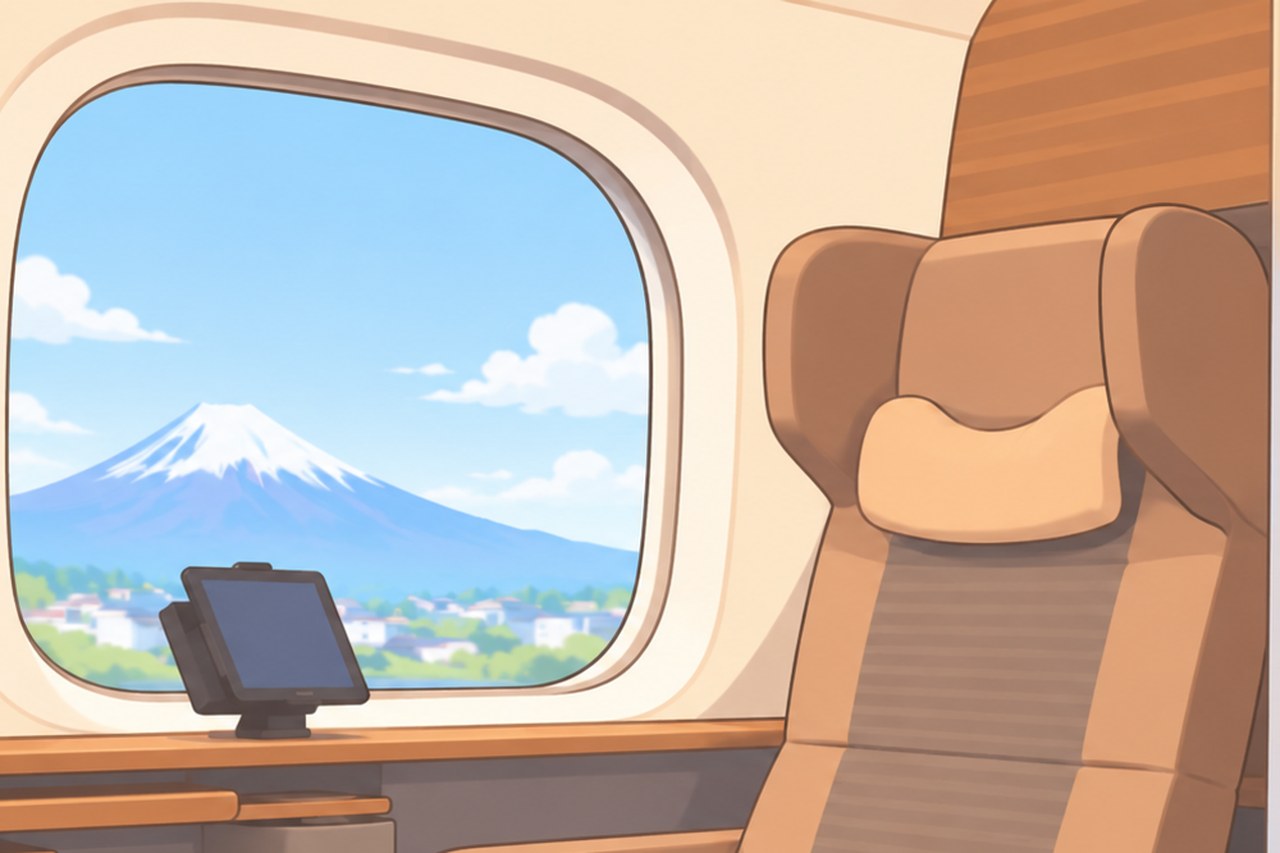
Suddenly, the massive silhouette of Mount Fuji comes into view. That morning, under a cloudless sky, the sacred volcano reveals itself in a rare state of bareness, completely devoid of its usual snow cap. Seeing it this way, perfectly framed by the windows of the private compartment as the train speeds toward Nagoya, offers a striking contrast between the immutability of nature and human hypermobility. To make the moment even more special, some passengers might choose to listen to Utada Hikaru’s song “Intentions,” the track that accompanied the service’s official launch. It’s worth noting that no full meals are served on board; Japanese tradition encourages passengers to select their own bento at the station before departure, turning lunch into a private and sophisticated picnic in the heart of the cabin.
The Strategy of Solitude
The creation of Supreme Class is no accident, but a direct response to the upheavals of recent years. Shunsuke Niwa, president of JR Central, developed this project as the coronavirus pandemic emptied the Shinkansen trains. Faced with rows of empty seats, a reevaluation became necessary. While legendary punctuality and absolute safety remained the cornerstones of the Japanese rail network, they no longer seemed sufficient on their own to attract a clientele whose expectations had shifted toward greater exclusivity and social distancing. The idea was to “think outside the box” and offer an experience centered not on the masses, but on the individual.
This move toward a higher-end service is being rolled out gradually. While the current carriages already connect Tokyo to Hakata Station in Fukuoka, on the island of Kyushu, the service will continue to expand starting next year. New semi-private seats with rigid shells, capable of swiveling to face each other, will be introduced. The price of this privacy remains exclusive: a one-way trip from Tokyo to Nagoya in a private cabin costs 32,440 yen (about 183 euros). That’s the price of silence and the guarantee of not being disturbed in a world increasingly saturated with distractions.
Upon arriving in Nagoya, stepping back onto the platform and facing the station’s crowds creates a slight culture shock. You leave the wood-paneled comfort of the cabin to return to the raw efficiency of mass transit. Yet the essence lies elsewhere. With this new service, JR Central proves that luxury does not necessarily lie in the accumulation of superfluous accessories, but in a certain form of simplicity and control over one’s time. By offering solitude as the ultimate privilege, the Shinkansen reimagines rail travel, transforming it into an introspective interlude where the destination almost ends up mattering less than the comfort of the journey itself.