Make Texture a preferred source on Google to support us
Add Texture to GoogleOn the felt-covered sorting tables of brokers in Geneva or Antwerp, the scene repeats itself with unsettling regularity. When a dealer unfolds his white paper to reveal a large D-Flawless diamond, the buyers examine the cut with clinical precision and mentally calculate the international price. The transaction remains smooth and mathematical. But the moment he opens a second envelope, releasing the electric glow of a tourmaline or the saturated red of a Tanzanian spinel, the atmosphere immediately becomes tense. Financial rationality gives way to instinct. Long confined to a supporting role or reserved for a few extravagant special orders, colored gemstones are now forcefully challenging the supremacy of the white diamond in high-end jewelry workshops.
The Wear and Tear of Standardized Perfection
For most of the twentieth century, the diamond industry dictated an unrelenting narrative. Shaped by formidable marketing that elevated the white stone to a universal symbol of romantic commitment and social status, the market thrived on rigorous standardization. Thanks to the four criteria of gemological grading—weight, clarity, color, and cut—it became easy to classify a carbon crystal with the detachment of a publicly traded stock. This rational approach ensured the liquidity of center stones, but it ultimately drained the mystery inherent in exceptional jewelry. A perfect ten-carat gem catches the eye with its brilliance, yet it remains fundamentally identical to any other stone in the same category.
Faced with this commoditization, today’s collectors—who are more knowledgeable about mineralogy—deliberately seek out geological serendipity. They turn away from the predictability of transparent carbon to seek out the uncertain nuances and fascinating irregularities of colored gemstones. This profound shift in tastes is not only reshaping the storefronts of Place Vendôme; it is redefining the very notion of rarity in the collective unconscious of luxury.
The Irrational at the Heart of Auction Houses
Major auctions orchestrated by Christie’s or Sotheby’s act as seismographs for this new hierarchy. The appearance of an unheated Ceylon sapphire or a Colombian emerald with a unique crystalline structure sends all the experts’ estimates through the roof. The battle among bidders becomes fierce, fueled by the deep-seated certainty that they will likely never again encounter such a concentration of rarity. The absolute uniqueness of the color defies any attempt at a comprehensive valuation.
Moreover, the scientific vocabulary used to describe these hues lies entirely outside the strict lexicon of diamond dealers. Gemologists use the term “pigeon’s blood” to describe a Burmese ruby of deep red tinged with the slightest hint of blue. They use the term “royal blue” to describe a sapphire whose chromatic density seems to absorb the light in the room. These expressions illustrate the impossibility of reducing a colored gemstone to a simple mathematical equation.
Mapping Depleted Deposits
This surge in prices is based on a physical reality: colored gem deposits are infinitely rarer and more fragmented than diamond deposits, which are often mined on an industrial scale. The mining geography of colored gemstones takes on the air of a myth. A Kashmir sapphire—recognizable by its velvety appearance caused by microscopic rutile inclusions—comes from no recent mining operation. The Himalayan mines, perched at high altitudes, have been closed and inaccessible since the late nineteenth century. Every transaction involves the transfer of a piece of this sealed-off heritage.
Similarly, emeralds mined from the legendary Muzo mines in Colombia bear the complex marks of their formation. This network of internal inclusions, which the industry once dismissed as “defects,” is now celebrated by connoisseurs, who prefer to use the term “garden.” The stone’s geographic origin and traces of crystallization directly attest to its identity, making it impossible to counterfeit without the trained eye noticing.
The dazzling comeback of unique gemstones
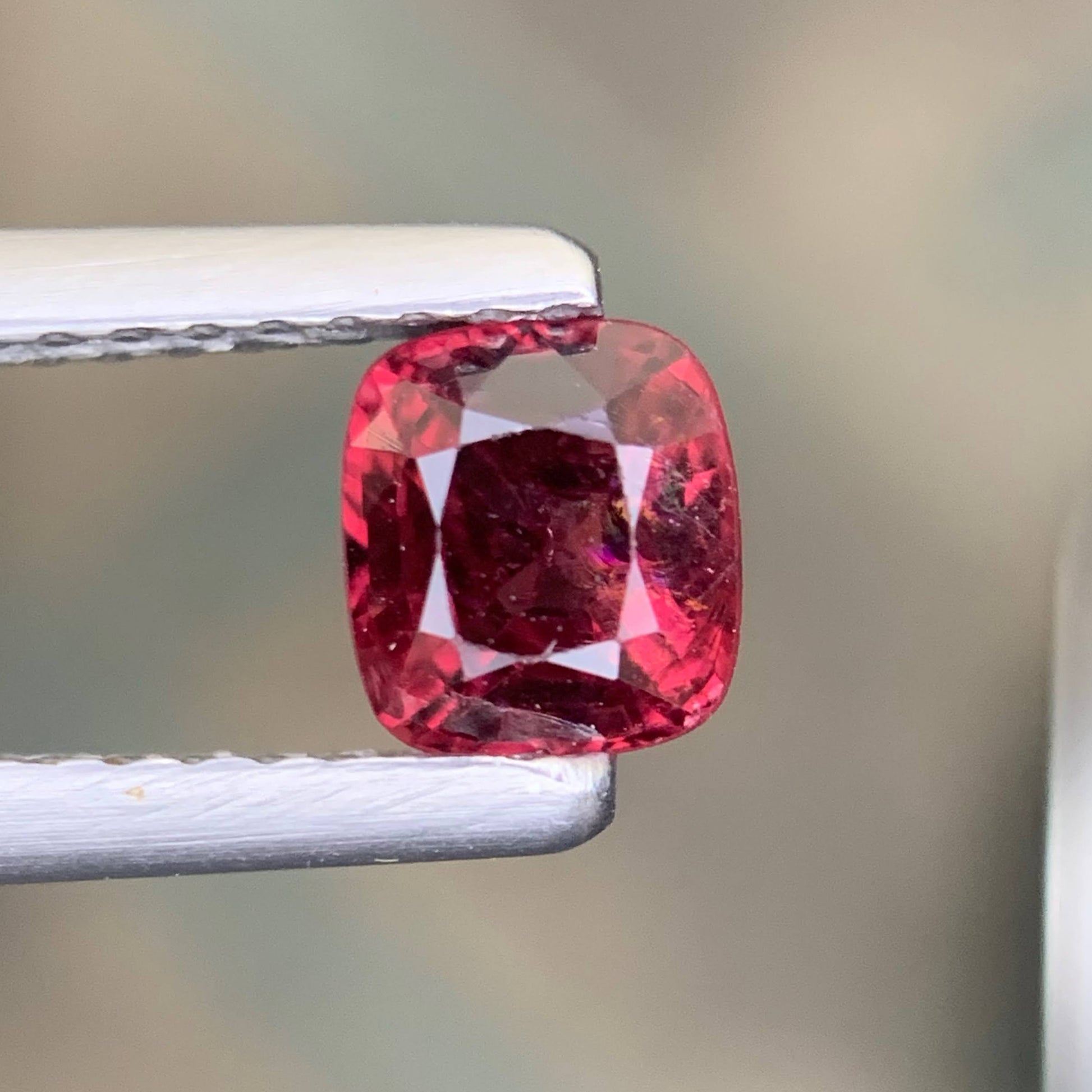
The current craze extends far beyond the classic trio of ruby, sapphire, and emerald. The market has definitively abandoned the derogatory term “semi-precious stone” to make room for minerals that were once overlooked. Spinel perfectly embodies this turnaround. For centuries, the human eye could not distinguish it from a ruby. The European imperial crowns provide a striking illustration of this: the famous Black Prince’s Ruby, the centerpiece of the British Crown Jewels, turns out to be a gigantic red spinel.
Long undervalued, this mineral now captivates with its authenticity. Unlike many corundums, which are heat-treated to intensify their color, spinel is not heated. The red crystals mined in Burma or the bright pink specimens unearthed in Mahenge, Tanzania, possess a natural fluorescence that makes them appear to glow with their own light in the darkness of a living room.

The discovery of Paraíba tourmaline in Brazil in the late 1980s also pushed the boundaries of jewelry color. The extremely rare presence of copper and manganese in its matrix produces a neon blue-green—almost electric—of unexpected intensity. Since the modest original deposit was completely depleted within a few years, the price per carat of a beautiful Brazilian tourmaline easily exceeds the market value of a white diamond of equivalent weight.
An Aesthetic Reinvention in the Workshops
Faced with these spectacular materials, design is reinventing itself and the structure of jewelry sets is evolving. The diamond subtly shifts into a supporting role: it becomes a dazzling border or a neutral backdrop designed to highlight the volume of a central colored stone. The major houses are embracing radical contrasts, breaking with monochromatic classicism. At Cartier, the boldness of compositions combining sapphire, ruby, and emerald takes on a contemporary flair. The striking combination of a green emerald and a block of black onyx—a bold nod to the opulent era of Art Deco—forms the centerpiece of recent collections.
Avant-garde workshops and independent designers are pushing the geometric experiment even further. Color directly dictates the alloy used for the setting. Artisans employ unexpected metals, such as bronze, aluminum, or tinted titanium, with the sole aim of precisely mirroring the hue of a tsavorite garnet or a sapphire. A piece of fine jewelry is no longer seen as a display of wealth, but as a sculptural work in which the metal yields to the gem’s chromatic demands.
The Quest for Intimate Traceability
The act of purchasing meets new intellectual demands. Behind the acquisition of an exceptional stone lies the desire to claim a specific fragment of Earth’s history. Reports issued by prestigious independent laboratories, scrutinizing geographic origins, are dissected by future owners with a newfound acuity. A notation confirming the total absence of heat treatment on the certificate of a Burmese sapphire instantly multiplies its value, thereby validating its absolute authenticity.
The assessment of rarity rests on a precarious fine line, far removed from industrial evaluation criteria. A Padparadscha sapphire from Sri Lanka is fascinating only if it manages to capture the perfect balance between the rosy hue of a lotus flower and the orange glow of a setting sun. The slightest variation in light alters its appearance, making its observation endlessly shifting. What captures the discerning eye of contemporary collectors is no longer the immaculate transparency of frozen carbon, but the wonder of a mineral that took the earth several million years to form—and that no human hand will ever be able to reproduce exactly.