Make Texture a preferred source on Google to support us
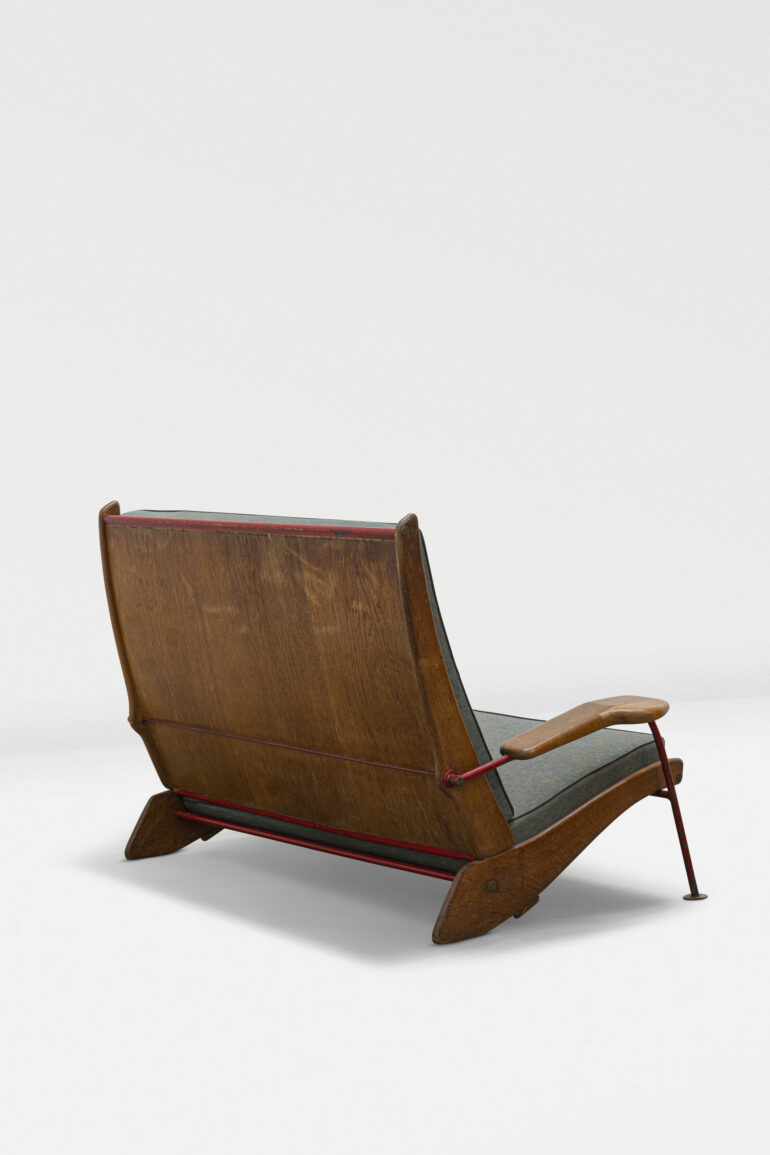
Add Texture to GoogleNothing remains of Marguerite Dollander’s stitches. In the 1950s, as the salty air of Le Lavandou swept through the new family home, this attentive grandmother took it upon herself to cut and assemble the covers for the living room armchairs. A fabric in bold hues—red or green depending on the seat—always accentuated by the precision of immaculate piping. Seventy years later, the original fabric has vanished, swept away by time and successive generations. Yet it is precisely the shadow of that domestic life—the echo of laughter and guitar chords from days gone by—that will justify the spectacular auction scheduled at Christie’s on November 24, 2026. The item up for auction—a two-seater armchair with a red metal frame—is no longer just a chair. It has become a relic of an architectural utopia and a symbol of the paradoxes of the art market.
The Spirit of Maxéville Under the Var Sun
To understand the historical significance of this piece of furniture, we must go back to the immediate postwar period, between 1949 and 1951. Roger and Marguerite Dollander commissioned a vacation home from two brothers whose vision was about to revolutionize the history of design: Henri and Jean Prouvé. The project, built just a few steps from Saint-Clair Beach, was more than just a bourgeois vacation home. It was a manifesto. Henri sketched the house’s key design elements, while Jean oversaw the construction and crafted all the furniture from the industrial heart of Lorraine, in his famous workshops in Maxéville.
The villa is organized around a radical innovation for its time: a central beam made of folded sheet metal, the backbone of an exposed metal structure. Here, the architecture does not hide its strength. The interior design follows the same logic. The building and its furniture emerge from a single conceptual vision. Tables, beds, and chairs are not chosen to decorate a room, but to extend its function. The leading website dedicated to Jean Prouvé’s work documents this holistic approach in great detail—an approach typical of an era that still believed in the absolute fusion of form and function.
A Way of Life Turned into a Museum Piece
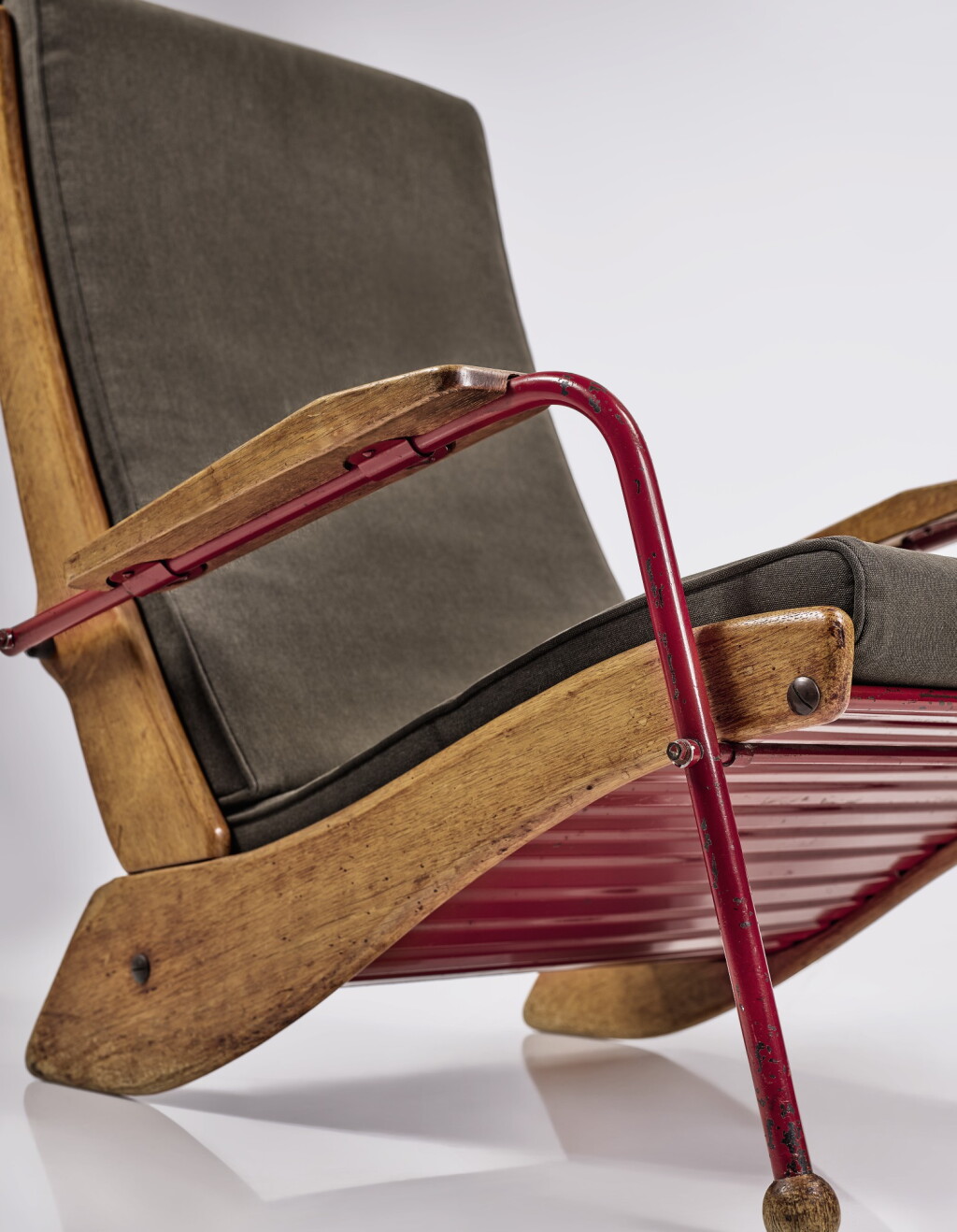
Among the designs conceived specifically for the light of Le Lavandou is the Visiteur FV22 model, affectionately nicknamed “Kangourou.” The villa originally housed three of these pieces. Their raw metal structure gives them an uncompromising aesthetic, softened only by the fabric upholstery designed by the family. In the archives published by Vitra, a descendant of the family, Olivier Lalande, brings these chairs back to life. He describes a joyful atmosphere where people would sink into these armchairs to read a summer novel, share a drink at dusk, or improvise a tune. The two-seater version, with its red-lacquered frame, was at the heart of this social life.
Today, this two-seater armchair is set to go under the auctioneers’ hammers, with an estimate ranging between 400,000 and 600,000 euros. This figure, a pure commercial projection, illustrates the dizzying trajectory of French industrial design on the secondary market. Above all, it highlights a stark dichotomy between financial value—calculated based on rarity and designer status—and use value—shaped by wear and memory—which is now impossible to quantify.

The Dispersion of a Complete Body of Work
The fate of the Kangourou armchair is inextricably linked to the often chaotic fate of modern interiors. The Ministry of Culture did, of course, protect the architectural shell of the Villa Dollander by designating it a historic monument in 1989, before awarding it the “20th-Century Heritage” label in 2001. But the classification of the walls does not freeze the lives of the objects that inhabit them. Nothing compelled the heirs to take on the burdensome role of museum curators, and the artificial preservation of each piece of furniture in situ would not necessarily have frozen time.
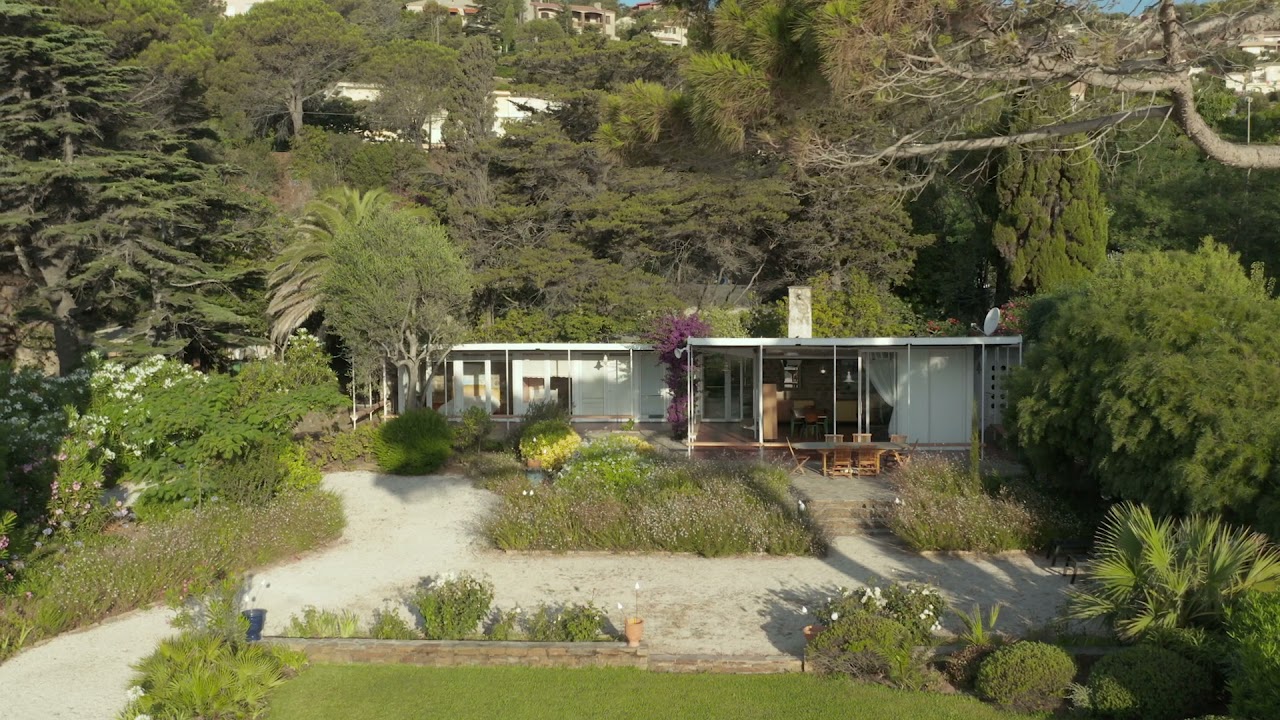
The paths of the house and its contents thus naturally diverged. The chronicle of these successive sales, documented by independent researcher Greg.org, traces an initial dispersal at Christie’s in 2021, where several major pieces and family archival documents changed hands. The architectural setting, for its part, fell subject to the laws of the luxury real estate market. Stripped of its original soul, the villa was put on the market in 2020, with an asking price of 6.4 million euros, according to the publication The Spaces. It finally found a buyer two years later. Its new owner, an Australian who appreciates the legacy of the Prouvé brothers, has since begun an extensive restoration project.
The Paradox of Provenance
This fragmentation raises a curatorial conundrum. What exactly is a collector buying when they’re willing to shell out half a million euros for the FV22 in 2026? The auction house’s lot description meticulously highlights the “Villa Dollander” provenance to justify the object’s valuation. The family history serves as a lever for desirability. Yet the intimate connection that tied this chair to its first occupants—that patiently sewn cover, that piping worn down by Var summers—has been erased in favor of an anonymous museum-style restoration.
The piece thus encapsulates two conflicting realities. On one hand, the triumph of a masterful industrial design, whose radicalism today captivates aesthetes around the world. On the other, the ghost of a family from the last century who were simply seeking modern comfort for their vacations. By removing the piece from its natural environment, the market celebrates Jean Prouvé’s genius while exposing the extreme fragility of these global works. The auction on November 24 will not only validate the market value of a visionary designer; it will also serve as a subtle reminder that, before becoming financial trophies, these objects were simply the silent witnesses to an ordinary life.