Make Texture a preferred source on Google to support us
Add Texture to GoogleFor several years, the Parisian fashion scene mourned the loss of 213 Rue Saint-Honoré. The abrupt closure of Colette in 2017 left a physical void, momentarily bringing the very concept of a multi-brand space in the capital to a standstill. But the world of luxury abhors a vacuum. Far from disappearing under the relentless onslaught of online retail, the model has fragmented, become more specialized, and taken on a distinctly radical character. Today, stepping through the doors of one of these retail spaces in Paris is no longer just a shopping trip. It is about embracing an aesthetic manifesto, about entering a social and cultural circle. The interior design, the scent selection, and the background music act as powerful filters: the space repels as much as it attracts. From the Golden Triangle to the outskirts of the Haut-Marais, these new spots operate on the principle of curation with surgical precision, where a pair of limited-edition sneakers stands alongside a long-out-of-print architecture monograph or a set of brutalist ceramics.
Darkness as a backdrop
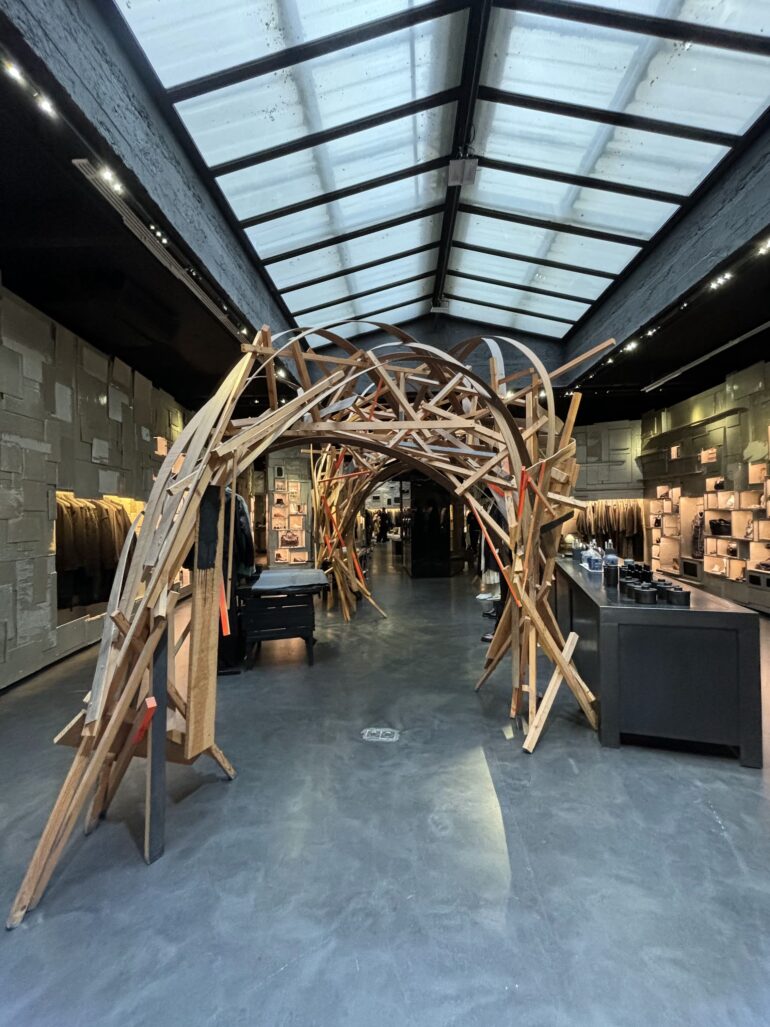
The modern history of avant-garde curation in Paris continues to unfold behind the massive doors of L’Éclaireur on Rue de Sévigné. The space conceived by Armand and Martine Hadida rejects the conventional nature of a traditional storefront from the outset. As soon as you cross the threshold, your eyes must adjust to a dimly lit space pierced by targeted beams of light. The raw wood and interlacing elements of the monumental installation conceived by Belgian designer Arne Quinze engulf the space, forcing visitors to navigate around, explore, and search for objects. Nothing reveals itself at first glance. Pieces by Carol Christian Poell, Dries Van Noten, and Paul Harnden are integrated into a setting that borders on industrial mysticism. The commercial transaction becomes almost secondary in the face of the physical experience of exploration. Visitors come here in search of asymmetrical silhouettes and experimental materials, but also for the enigmatic faces of Piero Fornasetti’s ceramics, which take pride of place on cast-iron tables. The store embraces a certain elitism through the complexity of its aesthetic: one must be well-versed in the vocabulary of avant-garde fashion to decipher its racks.
The Refusal of Aesthetic Compromise
In contrast to this theatrical drama, The Broken Arm, situated across from the greenery of the Square du Temple in the third arrondissement, embraces clinical lighting and clean lines. Founded by Anaïs Lafarge, Romain Joste, and Guillaume Steinmetz, the space is conceived as a direct extension of the editorial vision of an independent publication. The clothing selection here is extremely concise. The founders do not seek to present a comprehensive overview of a season, but rather extract a handful of looks, narrowing their focus to designers such as Lemaire, Kiko Kostadinov, Prada, and Maison Margiela. The apparent austerity of the metal racks contrasts with the lively atmosphere of the adjoining café. The constant flow of regulars coming in to order a specialty pour-over coffee or a seasonal pastry anchors the boutique in the neighborhood’s daily life. It is this interplay between the most demanding conceptual fashion and the relaxed atmosphere of a Parisian café that gives the location its cultural significance. The space does not intimidate with shadow, but with its radical luminosity.
A Clash of Eras in the Heart of the Marais
Organized chaos finds its most accomplished expression on Rue des Francs-Bourgeois, within Dover Street Market Paris. After years of a discreet presence as a perfume shop, the vision of Rei Kawakubo and Adrian Joffe has finally taken over the Hôtel de Coulanges. The contrast is striking from the outset: the classical architecture of a 17th-century mansion clashes with installations made of raw plywood, tubular scaffolding, and exposed concrete walls. The space is laid out like a labyrinth with no predetermined path, forcing customers to get lost. The purchasing strategy defies the traditional rules of luxury merchandising. Here, fine jewelry is displayed just a few centimeters away from graphic T-shirts inspired by skate culture, while complete collections from the Comme des Garçons universe coexist with young, emerging labels. The space demands time. You have to climb the floors, scrutinize every nook and cranny, and accept the jarring juxtaposition of aesthetics to understand the overall logic: to shatter the traditional hierarchy of clothing.

The American Spectre Under a Glass Roof
On the other side of the capital, just a few meters from the Champs-Élysées, the format shifts once again to embrace the codes of meticulously orchestrated hyper-consumption. The arrival of Kith at Pershing Hall on Rue Pierre Charron illustrates streetwear’s definitive shift into the realm of institutional luxury. New York-based founder Ronnie Fieg has transformed this former American Legion building into a temple of sneaker culture. The inner courtyard, topped by a massive glass roof, features a spectacular ceiling composed of plaster moldings shaped like hundreds of sneakers. The experience extends far beyond ready-to-wear fashion. The inclusion of Sadelle’s restaurant—which serves caviar-topped bagels and smoked salmon in a cozy setting—highlights the shifting demand: fashion is now enjoyed alongside a gourmet dining experience. The spaces dedicated to exclusive collaborations and the cereal bar attract a clientele different from that of the neighboring fashion houses on Avenue Montaigne. The energy here is urban, with the pace dictated by weekly launches of limited-edition products, creating a constant sense of anticipation around scarcity.
Historic Houses Embrace the Model
Faced with the impact of these multidisciplinary lifestyle spaces, major luxury brands have had to adapt their own physical strategies. The most symbolic transformation can be seen at the very address where the phenomenon began. By reclaiming the historic location at 213 Rue Saint-Honoré, Saint Laurent Rive Droite has blurred the line between a single-brand boutique and an independent curatorial space. Under the leadership of Anthony Vaccarello, the black-marble-clad space is no longer limited to showcasing the house’s ready-to-wear collections. The space was designed to absorb the surrounding culture. It features rare vinyl records, specialized art books, vintage photography equipment, skateboards, and even condoms stamped with the brand’s logo. Clothing regularly takes a back seat to temporary exhibitions or furniture by 20th-century designers. The founding idea of the 1990s—bringing together a global lifestyle under one roof—no longer belongs exclusively to independent brands. Merchandise—ranging from matches to coffee cups to artistic ceramics—has become the new vehicle for the identity of Parisian fashion houses, marking the final stage in the evolution of the luxury retail sector in the city.