Make Texture a preferred source on Google to support us
Add Texture to GoogleCan a watch span three centuries without turning them into mere decoration? The Tsuba 1720 by PS Horology answers this question through design rather than nostalgia. Its dial does not simply replicate an early 18th-century pocket watch: it draws on its graphic elements, reimagines them within a cushion-shaped steel case, and embraces the compromises necessary for wear on the wrist. This choice is what makes the piece so compelling. Here, the history of British watchmaking serves as the raw material for a contemporary object, in which every deviation from the original model appears to be carefully considered.
A tribute that favors interpretation
The watch takes as its starting point a creation made between 1719 and 1720 by George Graham, a pivotal figure in English watchmaking. Born in 1673 and died in 1751, Graham was a protégé of Thomas Tompion, at a time when watchmaking was undergoing a period of intense technical innovation. The spiral spring had just been invented in 1675, shortly after Graham’s birth, and he would later make his own contribution with a cylindrical escapement in 1726.
PS Horology, however, focuses on an earlier period in his career: the years 1719–1720, during which Graham completed a pocket watch with champlevé decoration. It is less the mechanism than the dial that inspires the Tsuba 1720. The antique dial, carved from gold and brought to life by champlevé enamel, serves as the foundation for a reinterpretation that rejects the facsimile. Literal fidelity would undoubtedly have resulted in a miniaturized museum piece; Peter Speake, on the contrary, chose to let Graham’s artistic language transcend the constraints, conventions, and proportions of a modern wristwatch.
This dialogue is no accident. Peter Speake is one of the leading figures in contemporary British independent watchmaking, while working in Switzerland. After founding several brands, including Speake-Marin, where he served from 2002 to 2017, he launched PS Horology in 2022. The project carves out a space where art, culture, and history carry as much weight as mechanics. The Tsuba 1720 embodies this ambition with a timepiece built around a very specific reference point, rather than a vague, imaginary sense of heritage.
The Dial as a Graphic Battlefield
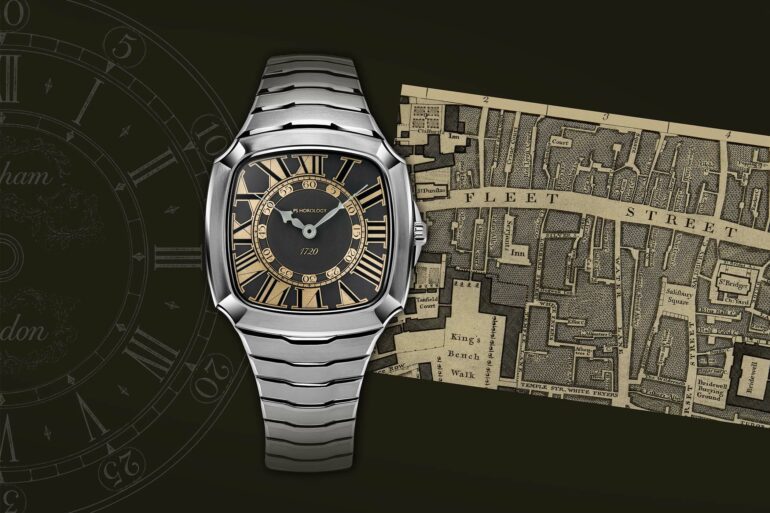
The Tsuba 1720’s first move is to abandon the decorative methods of the pocket watch without compromising its visual depth. Its 18-karat gold dial is laser-engraved, coated with ceramic lacquer, and then polished. The angular Roman numerals, meanwhile, are hand-lacquered in a black deeper than the background. This contrast between the worked gold and the black inscriptions creates a sharper, almost architectural aesthetic.
The key difference, however, lies in the layout of the time indicators. In George Graham’s design, the hours occupied the central area and the minutes were read along the outer rim. PS Horology reverses this layout: the minutes are grouped toward the center, while the hours move to the outer edge. This change may seem subtle on paper; yet it transforms the balance of the dial.
The reason lies in the geometry of the case. Within the slightly square and rounded space of the cushion-shaped design, the Roman numerals, with their straight lines and angles, more naturally occupy the outer rim. The Arabic numerals for the minutes, which are more rounded, are better suited to an inner position. The watch therefore does not seek to present the archive in its original order: it uses the vocabulary of 1720 to solve a formal problem specific to 2026.
This shift in scales also forces the hands to change roles. The long minute hand must point to the central track; the shorter hour hand must now reach the outer markers. However, the hands of the pocket watch already had a distinct identity, with their so-called “beetle” and “poker” shapes. Radically altering them would have erased part of the connection to the historic model. The chosen solution therefore relies on extensions: the hour hand is given an elongated tip to reach its mark, while the minute hand features a sort of step that aids in reading the inner scale. The detail is functional, but it also reveals the principle behind the entire watch: preserving a silhouette, then adjusting it when the context demands it.
A contemporary case, a London-inspired back
The Tsuba 1720 features a cushion-shaped stainless steel case measuring 38.3 mm in diameter and 8.91 mm thick. These proportions give it a understated appearance, far from ostentatious designs. Water resistance is rated at 30 meters, or 3 bars. The watch comes with an integrated stainless steel bracelet, composed of articulated links and secured by a butterfly folding clasp. Here again, the contrast is intentional: the dial evokes the early decades of the 18th century, while the overall design unmistakably belongs to the contemporary wristwatch.

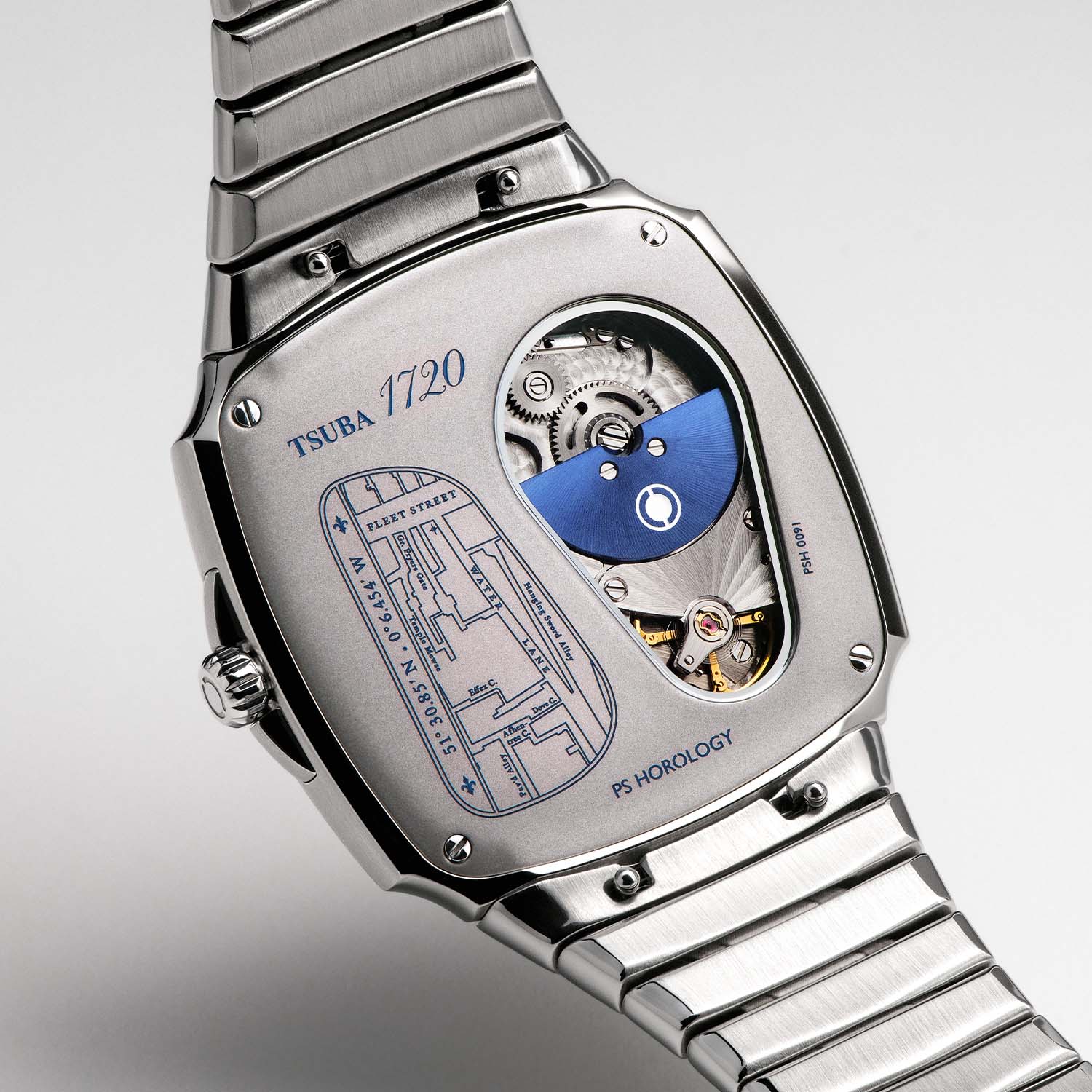
Its case back continues the dialogue with George Graham without resorting to excessive illustration. Partially open, it reveals the micro-rotor of the automatic movement. The solid portion, meanwhile, features a map of Graham’s historic workshop in London. This case back divides the focus between the technical object and its geographical origin: on one side, the movement that brings the timepiece to life; on the other, a reference to a place linked to the master watchmaker to whom it pays homage. The underside of the integrated bracelet is also revealed through this design.
The movement is a Vaucher Manufacture Caliber 5401, an automatic micro-rotor movement. It beats at 21,600 vibrations per hour, or 3 Hz, and offers a 48-hour power reserve. Its functions are limited to hours and minutes, allowing the dial to remain true to its minimalist aesthetic without any additional complications. This minimalism is consistent with the watch’s design: all the energy of the Tsuba 1720 is focused on how time is displayed, not on a multitude of functions.
Nostalgia Without the Pastiche
The success of the Tsuba 1720 lies in the fact that it makes its differences from its predecessor visible. Many watch tributes merely allude to a golden age through typography, color, or the shape of the hands. Here, the reference to Graham extends to the very hierarchy of the dial, the design of the hands, and the finish of the case back. It also forces us to acknowledge that the transition from a pocket watch to a wristwatch is not a neutral process.
By moving the hour ring outward, lengthening the hand that must reach it, and replacing champlevé enamel with laser engraving and ceramic lacquer, PS Horology makes this historical shift clearly visible. The timepiece does not claim to have been designed in 1720. On the contrary, it demonstrates what changes are necessary for a design from that era to remain compelling within a 38.3-mm case, on an integrated steel bracelet, and with a micro-rotor movement.
Limited to 28 pieces, the Tsuba 1720 is priced at 26,000 Swiss francs before tax, or approximately 23,675 British pounds. Deliveries are expected in February 2027. Information and availability are provided directly by PS Horology. For such a limited series, true luxury may not lie in the rarity of the number, but rather in the way it manages to capture on a single dial the legacy of a London workshop, the design choices of 1720, and the standards of a modern watch.