Make Texture a preferred source on Google to support us
Add Texture to GoogleA skeletonized design is never a trivial exercise. By removing material, a watch exposes not only its mechanics but also its design flaws: a case that’s too bulky overwhelms it, a dial that’s too busy obscures readability, and a movement that lacks structure leaves the eye with nothing to focus on. With its new Freelancer Caliber RW1212 Skeleton in anthracite, Raymond Weil takes a more restrained approach. The goal is not to be spectacular at any cost, but to find a design that gives the movement breathing room without turning the watch into a showpiece.
Forty millimeters: the sweet spot
This 2026 edition features a 40-millimeter diameter, falling between the first 42-millimeter Freelancer Skeleton models released in 2021 and the 38-millimeter version introduced in 2024. This simple difference of a few millimeters conveys a fairly clear intention: to offer a contemporary presence on the wrist, while avoiding the bulk of a tool watch on a model whose appeal lies elsewhere—in the interplay of openings and visible components.
The Freelancer is Raymond Weil’s sportiest line. Yet the openwork design does not immediately belong to the vocabulary of sports. It calls for contemplation rather than immediate efficiency, for observing a gear train rather than quickly reading an instrument. The 40-mm diameter serves precisely as a bridge between these two styles. The steel sides and the relatively wide bezel maintain a solid foundation; yet the watch as a whole does not seek to impose the rugged character of a field watch.
The 10.6 mm thickness contributes to this same balance. It maintains a restrained silhouette, consistent with a timepiece designed to transition from a steel bracelet to a leather strap without losing its identity. In a category where visible movements can quickly require additional height and weigh down the profile, this proportion becomes one of the piece’s strongest selling points.
Anthracite to temper the transparency
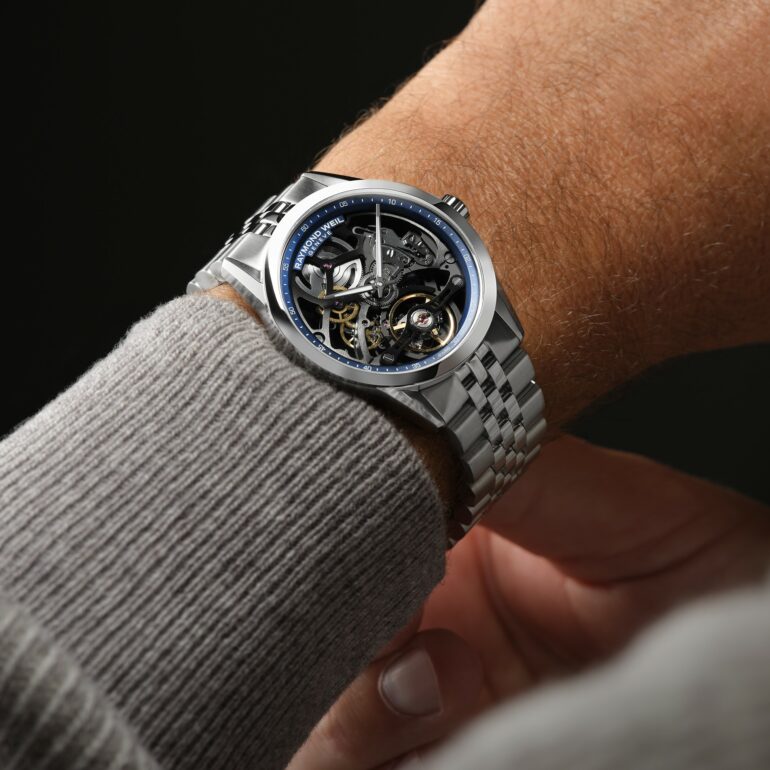
Raymond Weil does not rely on a multitude of colors here. The watch adopts an almost monochromatic aesthetic, dominated by anthracite. This dark gray shade adorns the outer minute track, the brand’s logo, and the movement’s openworked bridges. It lends visual coherence to a dial that, by definition, eschews a solid surface and reveals a multitude of technical elements.
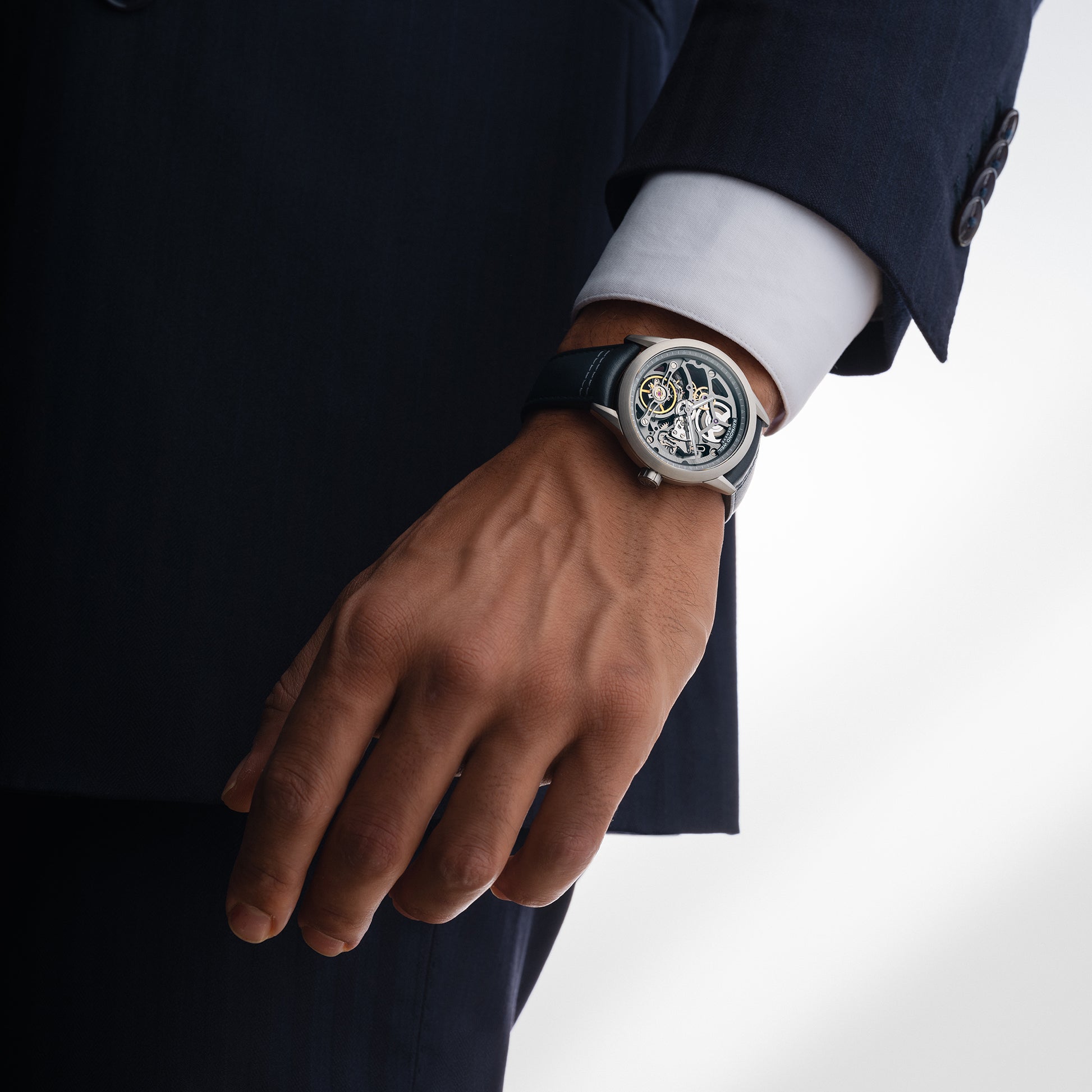
This choice is well-judged: a very open skeletonization can easily lead to an overload of details, each vying for attention. The anthracite color acts as a graphic framework. It connects the bridges to the edge of the dial and allows the mechanical elements to play their role without overwhelming the design. The eye is then drawn to a few natural contrasts: the golden hue of the balance wheel and the gear train, the pink of the visible rubies, and the depth created by the spaces where material has been removed.
This restrained color palette prevents the exposed mechanism from being mistaken for mere decoration. The components are not concealed, but neither are they treated as independent ornaments. The dial becomes a canvas where the metal structures, rubies, and moving parts form a technical composition. A more subdued approach than a theatrical one, enhanced by anthracite gray rather than a more garish contrast.
A Caliber Designed to Remain Visible
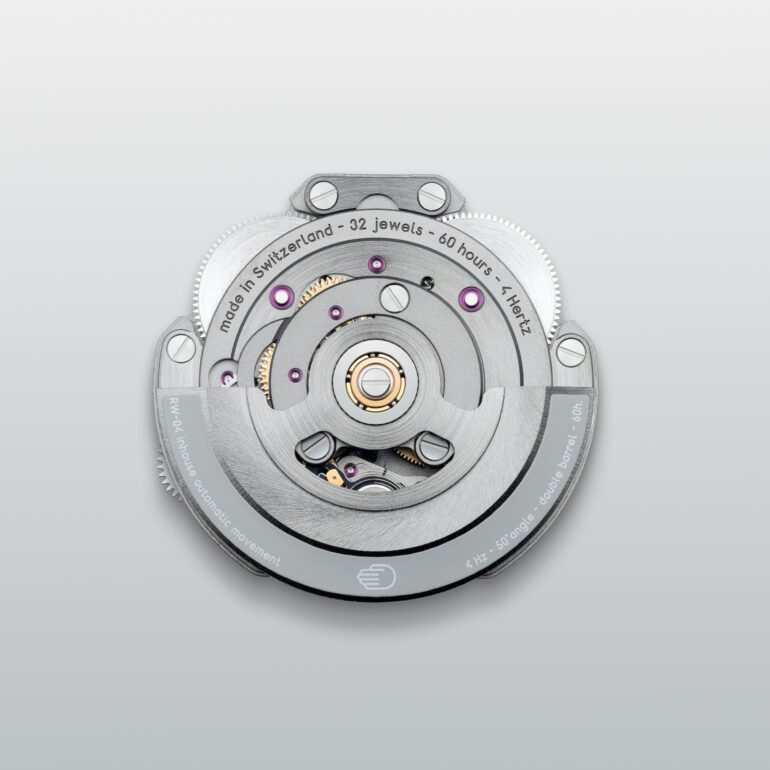
At the heart of this Freelancer lies the RW1212 caliber, an automatic movement developed exclusively for Raymond Weil in collaboration with Sellita. The collection, which already included several sizes and non-skeletonized versions, is now known as the Freelancer RW1212. The name change underscores the movement’s prominence within the brand’s lineup: it is no longer merely hidden behind a dial; it has become the central element around which the watch is organized.
In this Skeleton version, the caliber is extensively hollowed out to open up the visual field. The removal of material reveals the bridges, gear trains, and jewels, while giving the watch a depth that is difficult to achieve with a conventional dial. The process remains challenging: removing metal only makes sense if the structure retains a clear, legible form. Here, the anthracite bridges trace the contours needed to guide the eye through the mechanism.
At 11 o’clock, the open barrel offers one of the most revealing details of the entire design. The mainspring is visible as it operates, from winding to unwinding. This view of the power reserve brings to life a figure often reduced to a line on a technical spec sheet: 41 hours. The watch displays the hours and minutes, but its visual appeal also lies in this mechanical time as it builds up and runs down.


This opening at the 11 o’clock position serves as a sort of counterpoint to the usual conventions of sports watchmaking. Where one might expect an additional function or a utilitarian display, the Freelancer reveals its energy. It is not a complication in the traditional sense, but a direct way of inviting the wearer to look at the mechanism rather than just its result.
Steel or blue leather: two distinct styles
The 2786-ST-60000 comes with a five-link steel bracelet, while the 2786-STC-60000 features a dark blue calfskin leather strap. The two options create very different effects. The metal bracelet accentuates the continuity between the case, the bezel, and the Freelancer’s taut lines. It also reinforces the watch’s everyday appeal; its screw-down crown and water resistance to 100 meters (10 bar) serve as a reminder that this is not merely a dress watch.
The dark blue leather adds a more dressy touch. However, it introduces the only exterior color not already present on the dial. The watch features no blue accents on its anthracite dial, unlike the 38-mm version, which did. This difference is not a design flaw, but it gives the leather version a more contrasting personality, whereas the steel bracelet emphasizes continuity in materials and tones.
This choice also allows for a different interpretation of the two prices. The leather strap version is priced at 3,395 pounds; the steel bracelet version is priced at 3,495 pounds. The difference is small, but it confirms that the bracelet is more than just an accessory here. For a watch whose case seeks to reconcile the sporty look of the Freelancer family with the visual complexity of an open dial, the steel naturally extends the original design.
A model positioned above the entry level
With these prices, the Freelancer Calibre RW1212 Skeleton is positioned in the mid-range luxury watch segment. It does not present itself as an entry-level model based solely on price, yet it does not reach the price points that make mechanical watches with exposed movements inaccessible to most buyers. Its positioning is based on a more precise formula: a brand-exclusive automatic movement, a skeletonized construction, a steel case water-resistant to 100 meters, and a size that eschews excess.
The decision to opt for 40 mm therefore seems less like a compromise and more like a deliberate choice. After 42 mm and then 38 mm, Raymond Weil has settled on a size that gives the RW1212 caliber room to breathe while ensuring the watch remains wearable in a variety of settings. Raymond Weil provides detailed specifications for both models: the 2786-STC-60000 with a leather strap and the 2786-ST-60000 with a steel bracelet. Between the understated brilliance of the gold balance wheel, the pink rubies, and the visible spring at 11 o’clock, it is ultimately this visual discipline that best defines the anthracite edition.